
Apple and Alibaba Team Up for AI in China: Can AI Save Apple's Sales?

Shearing sheep
February 12, 2025
GoGPT Summarizes Articles
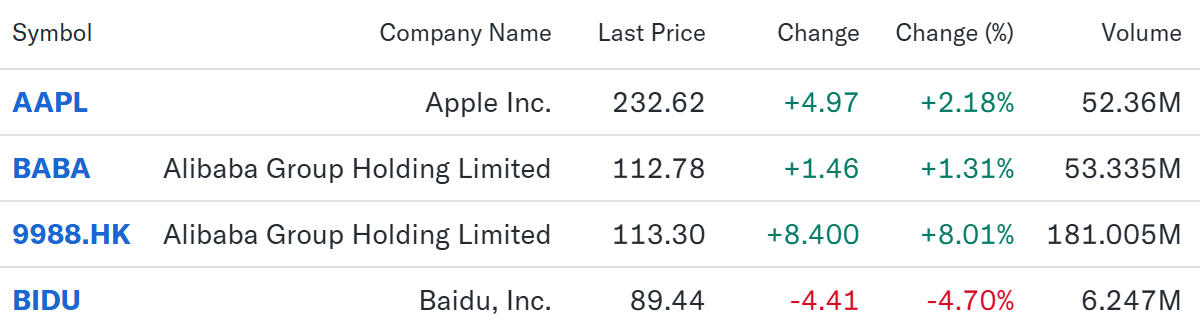
Big news this week: Apple ($AAPL) and Alibaba ($BABA) are joining forces to develop AI features for iPhone users in China. The announcement sent ripples through the market, with shares of Apple rising 2.18% and Alibaba climbing 1.31% on Tuesday, while Baidu ($BIDU)—Apple’s former AI partner—saw its stock drop by 4.7%. As of the time of writing, Alibaba’s Hong Kong-listed shares are up 8%. So, what’s the story here? Let’s dive in.
The Deal: Apple + Alibaba = AI Powerhouse?
Apple's strategy is clear: they're aiming to capture the Chinese market with AI features tailored to local users. And who better to partner with than Alibaba, the e-commerce giant that sits on a mountain of data about Chinese consumers—everything from shopping habits to payment preferences. This data is invaluable for training AI models that can understand and respond to user requests in a way that feels personal and relevant.
But why Alibaba and not Baidu? According to reports, Baidu—Apple's initial choice—failed to meet Apple's standards for developing models for Apple Intelligence. This led Apple to explore other options, including Tencent, ByteDance, and Deepseek. In the end, Alibaba emerged as the winner, likely due to its strong AI capabilities and its massive cloud computing infrastructure, which is a huge advantage when it comes to deploying AI at scale.
Apple's Struggles in China
Let's face it—Apple has been having a tough time in China. The company's revenue in the region has declined for two consecutive years, with a notable 11% drop in the quarter ending last December. Local brands like Huawei and Xiaomi are gaining ground, and Apple's market share in China's smartphone market is shrinking.
Tim Cook himself acknowledged that the lack of Apple Intelligence features in iPhones has hurt sales in China. But here's the kicker: even in markets where Apple Intelligence is available, like the U.S., it hasn't significantly boosted iPhone sales. So, is AI really the silver bullet Apple is hoping for?
Can AI Turn the Tide?
AI is undoubtedly a game-changer, but it's not a magic wand. Apple's partnership with Alibaba could help them deliver more personalized and localized AI features, which might make iPhones more appealing to Chinese consumers. Alibaba's Tongyi Qianwen model, which recently launched its Qwen2.5-Max version, has shown performance on par with some of the world's top AI models. If Apple can leverage this tech effectively, it could give them a competitive edge.
However, let's not forget that AI is just one piece of the puzzle. Apple's challenges in China go beyond software features. They're up against stiff competition from local brands that offer high-quality devices at lower prices. Plus, there's the ongoing tension between the U.S. and China, which could impact Apple's operations in the region.
My Take
I think this partnership is a smart move by Apple, but it's not a guaranteed win. AI can enhance the user experience, but it's not going to single-handedly reverse Apple's declining sales in China. The company needs to address broader issues, like pricing and competition, if it wants to regain its footing in this critical market.
That said, Alibaba's involvement is a big deal. Their expertise in AI and cloud computing could give Apple the boost it needs to deliver cutting-edge features that resonate with Chinese users. If executed well, this collaboration could help Apple claw back some market share—but it's going to take more than just AI to turn things around.
#Best Stocks for China’s Bull Run#$Apple Inc.(AAPL)#$Alibaba Group Holding Limited American Depositary Shares each represents eight Ordinary Shares(BABA)#$Baidu Inc.(BIDU)#apple#Alibaba