
Gold Shines Amid Trade Tensions: What's Next for the Metal?

Shearing sheep
February 18, 2025
GoGPT Summarizes Articles
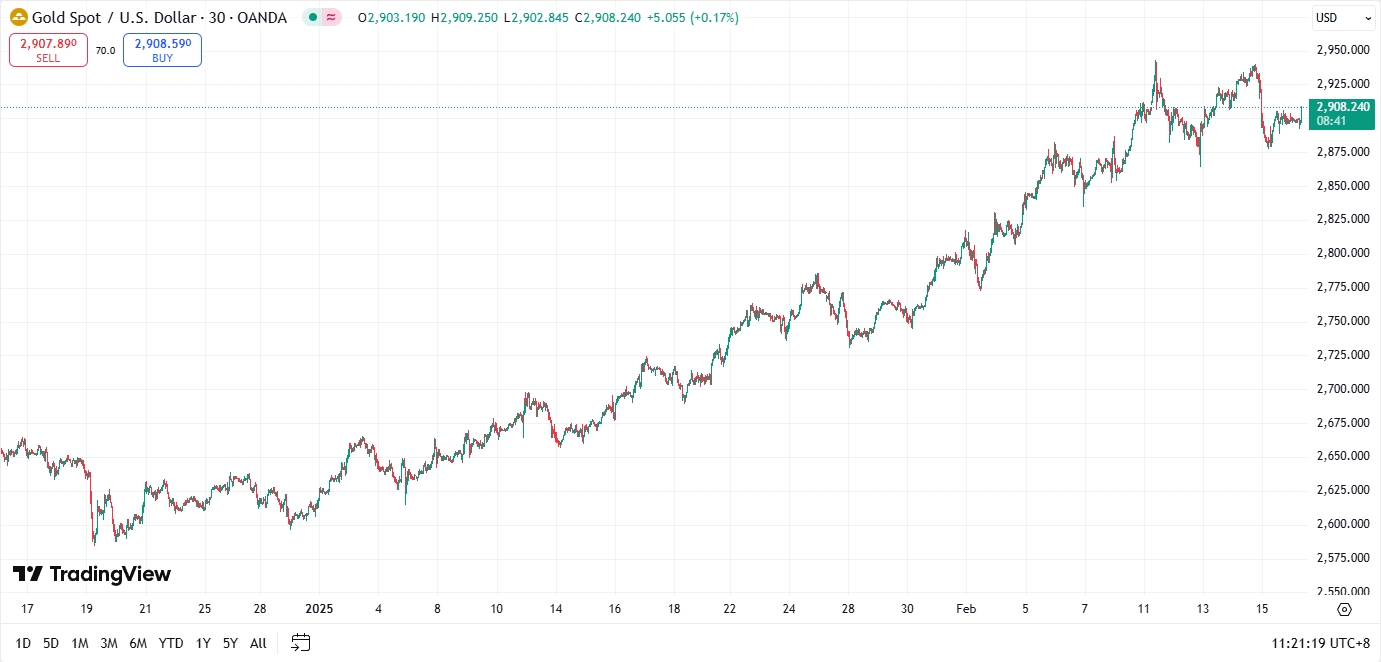
Recently, gold has been on quite the rollercoaster. After nearly hitting the $3,000 mark twice last week, it experienced a sharp decline on Friday, marking its biggest drop since December 18. However, it managed to recover slightly on Monday, gaining 0.56% and closing at $2,898. Despite the volatility, gold's long-term outlook remains strong, supported by ongoing trade tensions, geopolitical risks, and robust central bank buying.
Economic Data and Fed Policy
Last week's US economic data was mixed. The Consumer Price Index (CPI) and Producer Price Index (PPI) came in slightly higher than expected, while Retail Sales disappointed investors, fueling speculation about potential easing by the Federal Reserve (Fed). Fed officials have maintained a cautious stance, with Philadelphia Fed President Patrick Harker emphasizing the need for steady policy and a focus on lowering inflation. Fed Governor Michelle Bowman also noted that while she expects inflation to decline, upside risks remain.
This week, market participants will be closely watching further Fed speeches, housing data, the latest FOMC Meeting Minutes, Initial Jobless Claims, and the S&P Global Flash PMIs final reading for February. These releases could provide more clarity on the Fed's next moves, but for now, gold seems to be benefiting from the uncertainty surrounding monetary policy and economic conditions.
Gold's Momentum and Central Bank Demand
The US 10-year Treasury bond yield dropped four basis points (bps) on Friday, settling at 4.478%. US real yields, which have an inverse relationship with gold prices, also fell by four basis points to 2.039%, providing a tailwind for XAU/USD. Additionally, the World Gold Council revealed that central banks purchased over 1,000 tonnes of gold for the third consecutive year in 2024, with purchases surging by more than 54% year-over-year to 333 tonnes following Trump's electoral victory. This sustained demand from central banks is likely to continue supporting gold prices.
Gold has outperformed major stock indices, rising over 7% since Trump's inauguration, while the S&P 500 has gained less than 2% during the same period. This highlights gold's role as a hedge against trade wars, inflation, and global economic slowdowns.
HSBC analysts have pointed out that gold tends to perform well during periods of "trade shrinkage," as seen during the global financial crisis and the COVID-19 pandemic. With tariffs on the rise and global trade becoming increasingly unpredictable, gold's appeal as a safe-haven asset is growing.
UBS's Bullish Outlook
UBS has raised its gold price target, predicting that gold could reach $3,200 by the end of the year before stabilizing at $3,000 by the end of 2025. UBS analyst Joni Teves highlighted “unprecedented market dislocation” and “entrenched bullish sentiment” in the gold market, driven by geopolitical uncertainties, tariff concerns, and fears of stagflation.
Technical Perspective
From a technical standpoint, gold has been testing the $2,900 level. If it can break past this resistance, the next target could be $2,942—the year-to-date high. Beyond that, $2,950 and the psychological $3,000 mark are within reach. However, if the price dips below $2,900, we might see a retracement to the $2,877 level, with further support at $2,864. A break below these levels could lead to a test of the October 31 swing high at $2,790.
Investor Sentiment
Despite the surge in gold prices, Western investors have been relatively slow to jump on the bandwagon. Orbis Investments' Alec Cutler pointed out that the number of iShares and SPDR ETF investors has been declining over the past two years, suggesting that the recent price increases have been driven primarily by central banks and Asian investors. However, Cutler predicts that once Western investors start allocating more to gold, the rally could accelerate further.
Conclusion
In my view, gold remains a critical component of any diversified investment portfolio, especially in these uncertain times. The combination of geopolitical risks, trade uncertainties, and potential inflationary pressures creates a favorable environment for gold. While the $3,000 mark seems ambitious, the underlying fundamentals suggest that gold could well surpass this level in the coming months.
#gold#xauusd