
Microsoft's Quantum Leap: Majorana 1 Chip and the Future of Quantum Computing

Shearing sheep
February 20, 2025
GoGPT Summarizes Articles
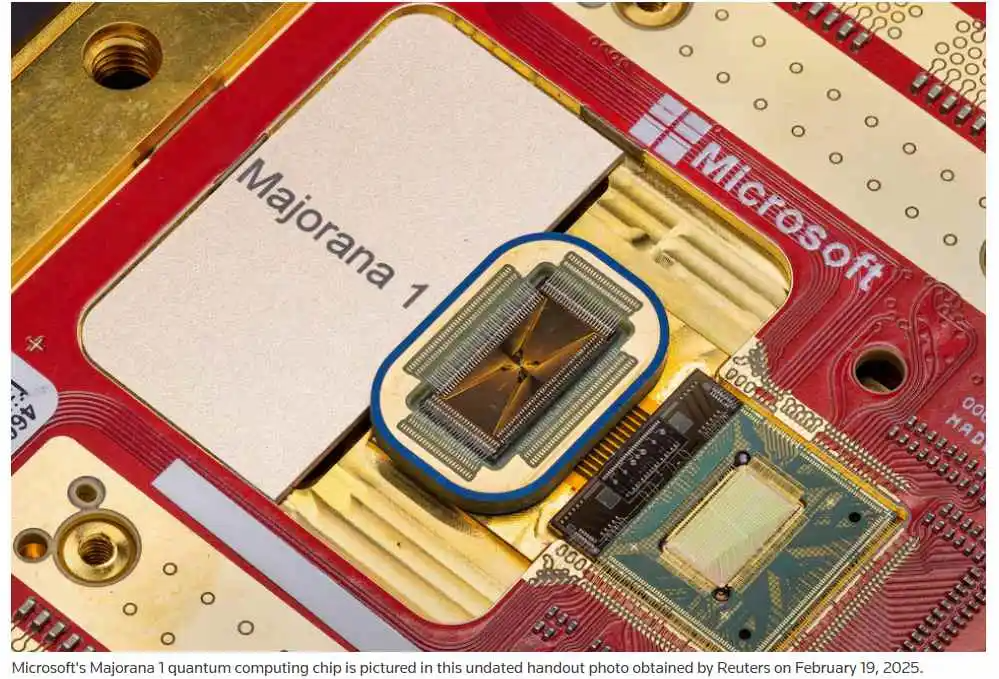
Big news from the tech world this week! Microsoft ($MSFT) has just unveiled its first quantum computing chip, Majorana 1, and it’s a game-changer. After nearly two decades of research, Microsoft has introduced a chip that built with a breakthrough class of materials, a novel approach that could significantly reduce errors in quantum computing. This is a big deal because, as many of you know, one of the biggest hurdles in quantum computing has been the fragility of qubits—they’re highly sensitive to environmental noise, which can lead to computational errors.
So, what’s so special about Majorana 1?
Well, it uses a new state of matter called topoconductor, which allows for the observation and control of Majorana fermions. These particles are more stable than other types of qubits, making them faster, smaller, and digitally controllable. Microsoft has managed to create a chip with 8 interconnected units, each containing four Majorana particles, forming a single qubit. This is a significant step toward building a scalable quantum computer.
But here’s the kicker: Microsoft isn’t just stopping at creating these particles. They’ve also developed a new measurement technique that can detect the difference between a billion and a billion-plus-one particles in a superconductor. This precision is crucial for determining the state of a qubit and lays the groundwork for practical quantum computing.
Now, let’s talk about the implications.
Microsoft’s ultimate goal is to pack 1 million qubits onto a single chip. If they can pull this off, it could revolutionize industries like AI, drug discovery, and materials science. Imagine being able to simulate complex molecular structures or optimize AI models at speeds that are currently unimaginable. This isn’t just about faster computing—it’s about solving problems that are currently beyond our reach.
But let’s not get ahead of ourselves. While Microsoft is optimistic, claiming that practical quantum computing is just “years, not decades” away, there are still significant challenges to overcome. For one, maintaining quantum coherence (keeping qubits stable) at scale is no small feat. And while Microsoft has made strides in error reduction, we’re still far from a commercially viable quantum computer.
It’s worth noting that no company, including Google and Microsoft, has yet achieved precise control over quantum states to enable large-scale commercialization of quantum computing. Google’s CEO has emphasized that their Willow quantum chip is a “significant step toward building a practical quantum computer,” indicating that even Google still has a long way to go before achieving controllable, commercially viable quantum computing.
That said, the competition is heating up. Companies like Google ($GOOGL), IBM ($IBM), IonQ ($IONQ), and Rigetti ($RGTI) are also making significant progress in quantum computing. Google’s Willow chip and IBM’s Eagle and Condor chips are pushing the boundaries of what’s possible. And let’s not forget NVIDIA ($NVDA), which is betting big on quantum computing with its CUDA Quantum platform, aiming to integrate quantum processors with traditional GPUs and CPUs.
So, what does this mean for investors?
Well, the quantum computing market is still in its infancy, but the potential is enormous. Companies that can crack the code on scalable, error-resistant quantum computing could dominate the next era of tech. IonQ and Rigetti have already seen their stock prices soar—IonQ is up 237% in 2024, while Rigetti has surged nearly 1500%. The two companies reported a combined revenue of $14.8 million in Q3 of last year. In January, Microsoft further fueled market excitement by declaring 2025 as the “Year of Quantum Readiness.”
In my opinion, while we’re still a few years away from seeing quantum computing become mainstream, the progress being made by Microsoft and others is incredibly exciting. The “AI + Quantum” convergence could be the next big thing, potentially leading to breakthroughs in everything from drug discovery to climate modeling. But as with any emerging technology, there are risks. Quantum computing could also disrupt current encryption methods, posing new challenges for cybersecurity.
Jason Zander, Microsoft’s Executive Vice President of Strategic Missions and Technologies, described Majorana 1 as a “high-risk, high-reward” research strategy. And he’s right—this is a bold move, but one that could pay off massively if Microsoft can overcome the remaining technical hurdles. #aichip #microsoft
#aichip#microsoft#$Microsoft Corp(MSFT)#$Alphabet Inc. Class A Common Stock(GOOGL)#$International Business Machines Corporation(IBM)#$IonQ Inc.(IONQ)#$Rigetti Computing Inc. Common Stock(RGTI)#$Nvidia Corp(NVDA)