
The "Leader of American Retail Investors" Increases His Stake in Alibaba to $1 Billion.

Magical Investor
February 21, 2025
GoGPT Summarizes Articles

Will Retail Investors Follow Suit with Cohen's Stake Increase?
Cohen, affectionately dubbed the "King of Meme Stocks," shot to fame during the pandemic.
His shrewd strategies catapulted GameStop and other companies' stock prices into the stratosphere. This didn't just change the game for those companies.it also galvanized a new generation of retail investors. His influence is so far-reaching that his every move is closely watched by individual investors across the country.
Insiders have spilled the beans: over the past few months, Cohen has been quietly but steadily scooping up Alibaba shares. His current holding of around $1 billion, equivalent to about 7 million shares, shows his unwavering confidence in China's long-term economic growth.
Back in 2023, Cohen privately pressured Alibaba to speed up its stock buyback plan. He was convinced that the company's shares were a steal, way undervalued.
He also quietly explored the idea of a long-term partnership with the e-commerce giant.
Sure, a $1 billion stake might seem like a drop in the bucket compared to Alibaba's gargantuan $325 billion market cap. But Cohen has a knack for sparking a frenzy among retail investors. His past moves on Wall Street have often led to a flood of ordinary investors jumping on the bandwagon. So, the news of his Alibaba stake increase could very well trigger a wave of retail investment, potentially sending Alibaba's stock price on an even wilder ride.

Of course, many netizens have also said that they won't believe it until the person himself makes a statement. As of the time of writing this article, neither Ryan Cohen nor Alibaba has made any comments yet.
It's Not Just Alibaba: Chinese Stocks in the US Making a Strong Rebound
This week, Alibaba announced its most impressive revenue growth since the end of 2023, thanks to its red-hot AI business.
This news sent its stock price surging by over 8% on Thursday. Year-to-date, the stock has rocketed nearly 60%, turning heads across the investment world.
But Alibaba isn't the only one shining. Other Chinese stocks listed in the US have also staged a remarkable comeback.
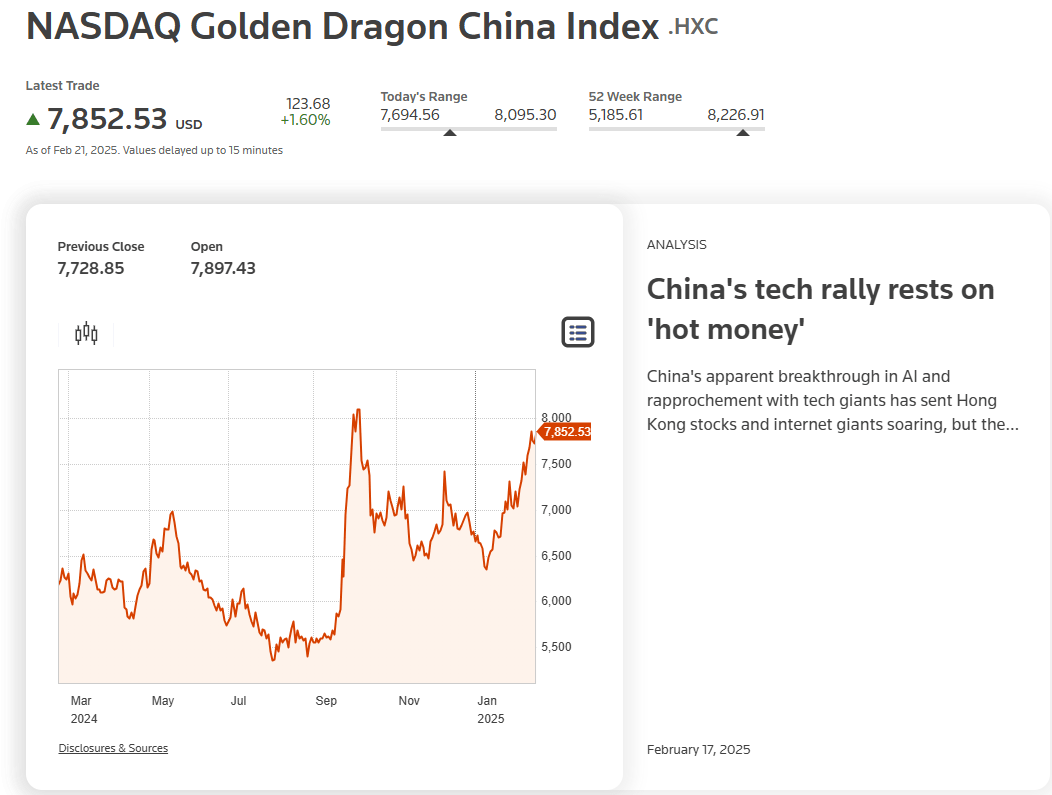
Since November last year, the NASDAQ Golden Dragon China Index, which tracks these companies, has skyrocketed by over 60%.
In contrast, the S&P 500, NASDAQ Composite, and Dow Jones Industrial Average have only managed gains of 1.83%, 0.34%, and 1.56% respectively.
Last November was a particularly big month for the NASDAQ Golden Dragon China Index. It surged 42.13%, marking its largest monthly gain since records began in 2003, dwarfing the second-place 20.1% increase in September 2007.
Looking at individual stocks, Bilibili, Huya, iQiyi, and Tencent Music have all more than doubled in value since November last year. Xunlei, KE Holdings, Baozun, TAL, New Oriental, and Pinduoduo have jumped by over 70%. And that's not all—Zhihu, NetEase, and JD.com have seen gains of over 50%.
In fact, many of these stocks have more than doubled from their lows last year. New Oriental's stock has soared over 4-fold, while Pinduoduo and iQiyi have seen triple-digit increases. Huya, Tencent Music, and GDS Holdings have more than tripled, and KE Holdings, Xunlei, and BOSS Zhipin have doubled or more. Notably, most of these high-flying Chinese stocks are in the tech-heavy internet sector.
Institutions that are optimistic about Chinese stocks
The investment community's attitude towards Chinese stocks is undergoing a major shift.
Big-name firms like BlackRock's Chief Investment Officer believe that the platform economy, including internet companies, is on the cusp of a major turnaround.
With the implementation of favorable policies, the release of game licenses, and progress in Sino-US audit supervision, the sector is primed for growth, yet the current stock prices haven't fully reflected this potential.
GuoHai Franklin Fund also points out that the internet industry has been a major driver of employment and economic development in China over the past decade and will continue to play a crucial role in the economic recovery.
While these companies are somewhat cyclical due to their reliance on advertising revenue during tough economic times, their long-term prospects look bright.
Following in the footsteps of Goldman Sachs and Bank of America, Morgan Stanley has recently joined the ranks of those bullish on the Chinese stock market.
In a recent report, Morgan Stanley's strategy team predicted that, propelled by China's rapid AI development, the Chinese stock market is set for a more sustainable upswing.
Morgan Stanley's change of heart isn't an isolated case. As China's AI breakthroughs reverberate globally, many Wall Street investment banks are turning bullish on Chinese stocks.
In this wave of optimism, many institutions note that long-term investors are re-evaluating their positions and are increasingly looking to pour money back into Chinese assets.
As I've said before, Chinese stocks have been a rather good choice recently.
#$Alibaba Group Holding Limited American Depositary Shares each represents eight Ordinary Shares(BABA)#$JD.com Inc.(JD)#$PDD Holdings Inc. American Depositary Shares(PDD)