
Bybit was hacked, and virtual assets worth 1.4 billion US dollars were stolen

Magical Investor
February 24, 2025
GoGPT Summarizes Articles

A risk event has once again emerged in the cryptocurrency market, causing a stir in coin prices.
On the evening of February 21st, cryptocurrencies including Bitcoin plunged sharply. Bitcoin rapidly dropped from around $99,500 to break below $95,000, and Ethereum also declined from around $2,800, barely holding above $2,600.
In the 24 hours up to 4 am on February 22nd, more than 170,000 people across the network were liquidated, with the total liquidation amount exceeding $570 million.
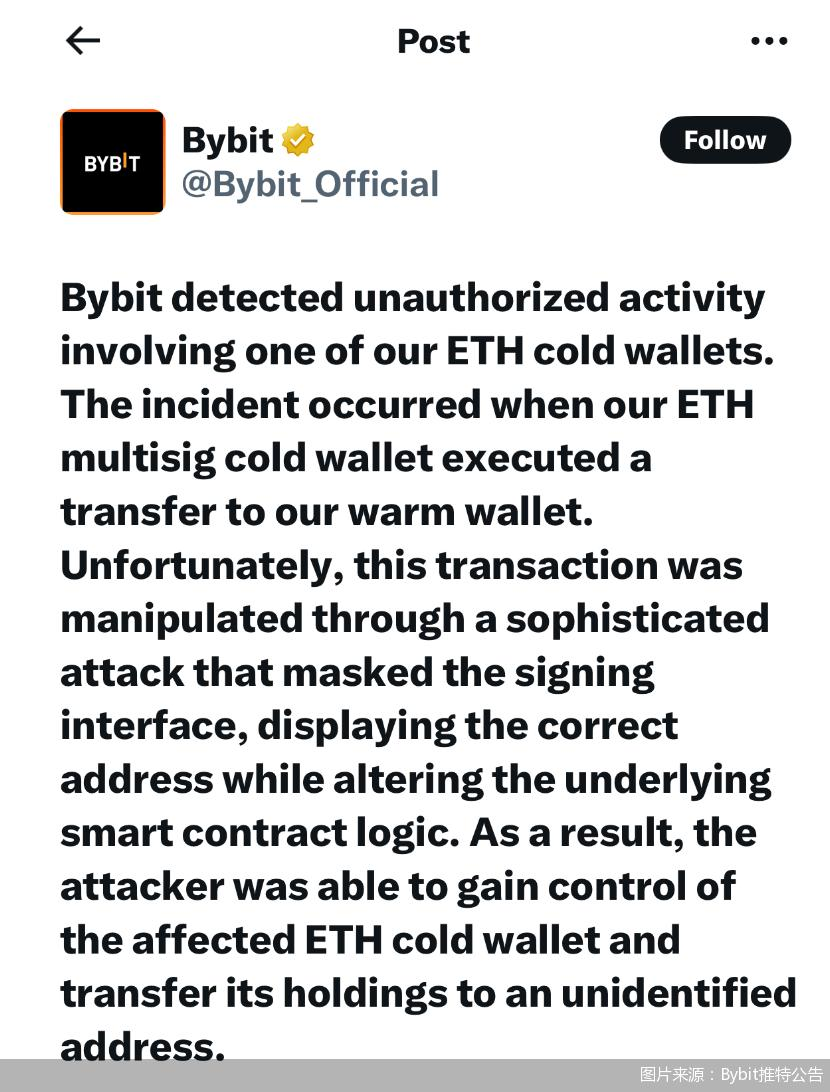
The main reason is that the bybit exchange was hacked, resulting in a loss of assets worth $1.4 billion.
These assets are mainly ETH, which has a market capitalization second only to BTC and is one of the only two blockchain assets with ETFs listed on US stocks.
Bybit is approximately among the top 5 to 7 virtual currency exchanges globally. According to public asset proofs, the assets on their platform are roughly $16 billion, and the assets stolen this time account for 8.7% of the total. After the incident was exposed, a large number of panicked users withdrew their assets, with over $3 billion withdrawn within a day. Bybit urgently borrowed a bridge loan from its peers to barely withstand the bank run.
I've read some analyses. Before this incident, bybit's annual profit was roughly between $1 billion and $1.5 billion. From a static perspective, it's almost like a year's work going down the drain.
But it should be noted that this was before the incident. After being hacked, the platform's security image has taken a huge hit, with a large amount of assets withdrawing, and its profitability will inevitably drop significantly. It may take several years to fill this $1.4 billion hole.
I've closely followed this incident. Through on-chain data tracking, it has been determined that this operation was carried out by the North Korean hacker group Lazarus Group. Many people are surprised when they hear that it's North Korean hackers, because the ordinary people in that country hardly have access to the Internet, yet there are actually hackers?
Yes, and they are extremely powerful. They are all specially trained and organized by the North Korean government. Hackers from other countries mostly operate alone to hide their tracks, while North Korean hackers operate as a team, backed by an organization.
There's strength in numbers. They have been attacking major exchanges and blockchain protocols on the Internet for years and have been successful many times, stealing billions of dollars in total.
Nowadays, exchanges usually use cold wallets and multi-signature wallets to store large amounts of assets. Cold wallets are offline and isolated from the network, and multi-signature wallets require multiple different people to sign simultaneously for a transfer. Neither of these two types of wallets can be breached by hackers in the pure sense. So, after the incident, I was very curious about how the North Koreans managed to do it.
According to the information revealed so far, the computer of one of the authorized persons of the multi-signature wallet was hacked, and a fake front-end UI was created. On the surface, it looked like a normal transfer, but underneath, it was authorizing a malicious contract. The first person was deceived and didn't realize it. The command sent was also not carefully checked by the next two people. In the end, all three people confirmed and agreed, and that was it.
Let's talk about the follow-up. After the $1.4 billion worth of ETH was stolen, it has been transferred to 51 different anonymous addresses. If it were an ordinary hacker, one could try to negotiate and offer a 10-20% bounty for a settlement between the two parties. However, North Korean hackers never settle. They are all working for their country and their leader and have no right or room for negotiation.
But the scale of this $1.4 billion worth of assets is really too large, so large that it's extremely difficult to launder it without leaving a trace on the public blockchain.
Currently, the two sides are at a standstill. Bybit hopes that more people in the industry will assist in tracking and encircling this huge sum of money to prevent the other side from cashing it out. The North Korean side isn't in a hurry either. They can't launder it in the short term, but they can take a long-term approach and launder it slowly.
This $1.4 billion worth of ETH can't be directly sold for US dollar stablecoins, as that would lead to being tracked and frozen. The specific operation path they can take is probably to exchange the ETH for BTC in batches, and then break it up into thousands of small accounts and sell it on some Asian trading platforms. This requires a large number of forged KYC accounts, and even with the support of the North Korean government, it's very difficult to manage. So, the progress of money laundering will be extremely slow, possibly taking 5 to 10 years.
This is truly astonishing. Many companies can't even earn this much money in a whole year. Therefore, investors should still be cautious when trading.$BTOP
#$Bitwise Trendwise BTC/ETH and Treasuries Rotation Strategy ETF(BTOP)