
On the second day after FSD entered China: The stock price plummeted by 8%, and Tesla's market capitalization dropped below one trillion dollars

Magical Investor
February 26, 2025
GoGPT Summarizes Articles
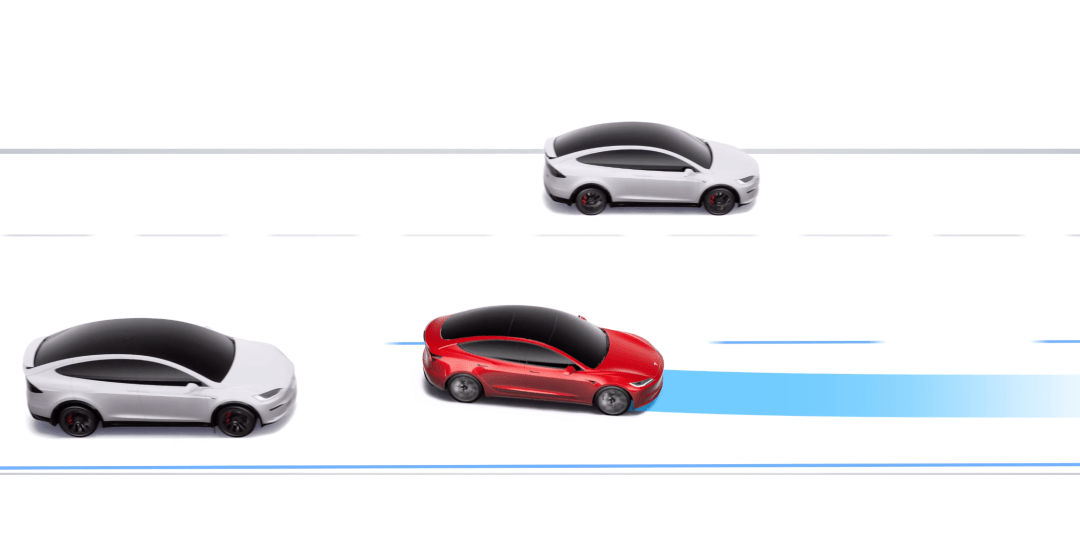
On February 25, 2025, Tesla, through an unexpected OTA update, officially launched the Full Self-Driving (FSD) function, which had been in the making for years, into the Chinese market.
This update, which Musk specifically mentioned during an earnings report meeting, not only has the potential to rewrite the competitive landscape of China's intelligent driving market but also set off a comprehensive shock involving users, automakers, and the media within 24 hours.
However, the capital market did not respond positively. On February 25, Tesla's stock price dropped by more than 8%, closing at $302.8. Its market capitalization evaporated by $89.2 billion overnight, and the total market capitalization also fell below the threshold of one trillion dollars.
Musk, who is successful in the political arena, is busy laying off employees in Washington, while users are starting to vote with their wallets: "You're acting more like a politician as a CEO, so we won't buy your cars anymore."
Today, let's talk about Tesla, which is showing all signs of decline.
Can't Tesla's FSD adapt to China?
On February 26, Tesla's Full Self-Driving (FSD) function was officially launched in the Chinese market. Previously, FSD was only available in North America. According to feedback from the first batch of users who experienced it, FSD performs well in China's driving environment and has already demonstrated its adaptability to China's traffic rules and road conditions.
However, some car owners pointed out that although Tesla's FSD has no problems with its driving ability, its localization level is still somewhat lacking. Although FSD's lane changes and turns are very smooth, it can be relatively slow in specific situations such as bicycle lanes and bus lanes. In addition, there are still unsolved problems such as running red lights, changing lanes over solid lines, and performing three-point turns.

In response, Musk said that the above evaluation results were because Tesla could only train FSD in a simulated environment through videos of Chinese roads on the Internet.
In other words, in Musk's view, this is not the true level of FSD, and at most, it can be regarded as a "simplified version" of FSD.
The customer service also publicly responded that this update is being pushed out in batches and is an official gray-scale test. The intelligent driving assistance launched in China is currently only at the L2 level and cannot achieve the fully autonomous driving function of FSD in the United States.
In addition, an insider in the intelligent driving industry told the media that the subscription fee of over 60,000 yuan for FSD is difficult for most Chinese consumers who are accustomed to free software to accept. In the short term, it may not have a particularly obvious effect on boosting sales.
At the same time, Tesla also faces competition from intelligent driving technologies in the Chinese domestic market. Many domestic enterprises have launched L2-level intelligent driving systems that are no less competitive than FSD, and some are starting to develop L3-level autonomous driving technologies.
A significant drop in European sales
Data released by the European Automobile Manufacturers Association on February 25 showed that in January, Tesla's new vehicle registrations in the European Union, the European Free Trade Association, and the UK market were 9,945 units, a significant drop of 45.2% compared to 18,161 units in the same period last year.
Data from the German Federal Motor Transport Authority (KBA) showed that Tesla's new vehicle sales in Germany in January this year fell by 59.5% year-on-year to 1,277 units, reaching the lowest monthly level since July 2021.
Tesla's new vehicle sales in France plummeted by 63% in January, marking the worst performance since August 2022. Overall, the sales of pure electric vehicles in the European Union, the European Free Trade Association, and the UK market increased by 37.4% year-on-year to 166,065 units in January.
Some people attribute Tesla's sales decline in the region to the dissatisfaction caused by Musk's public interference in European politics over the past few months.
It now seems that Musk's intervention in European politics has aroused public resentment and even triggered protests and sporadic acts of vandalism.
Last month, someone projected an image at Tesla's factory in Germany. The content was a controversial gesture made by Musk at President Trump's inauguration ceremony, and this gesture was interpreted by some people as a Nazi salute. In addition, a Tesla showroom in the Netherlands was also vandalized with Nazi symbols spray-painted on it.
Why did Tesla's stock price plummet, and how should we respond?
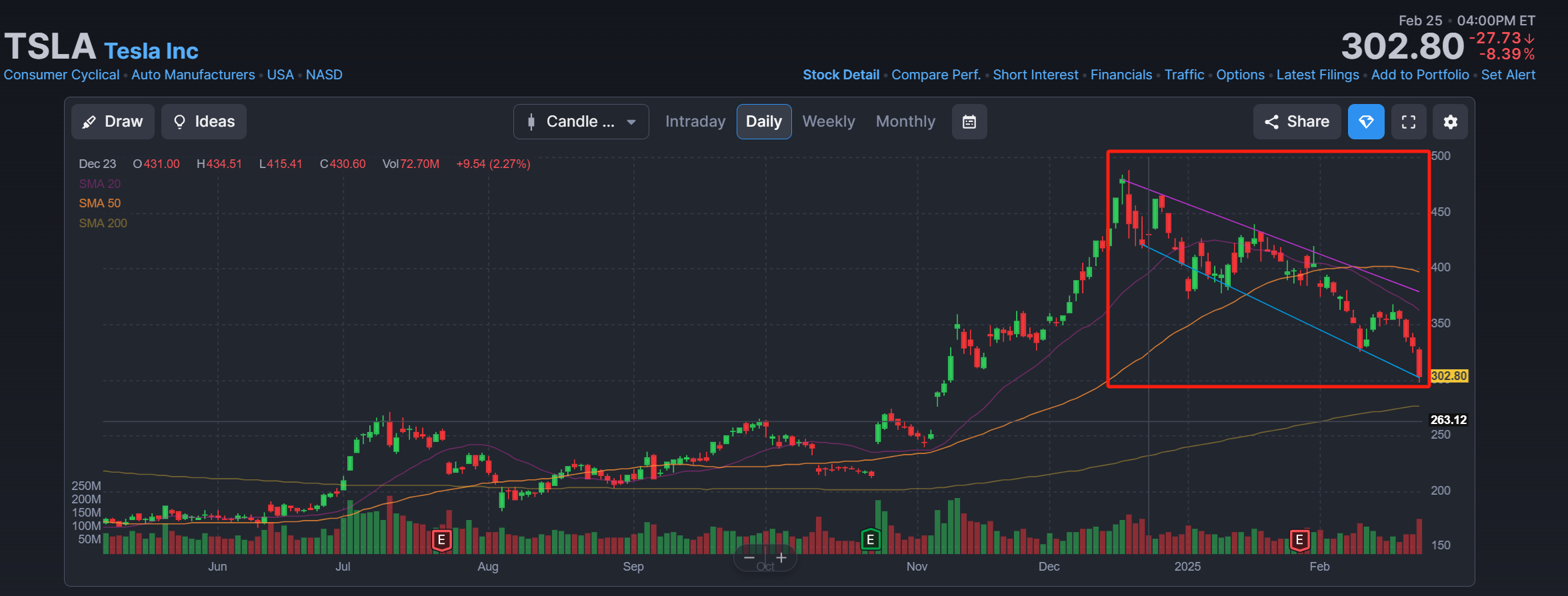
Currently, Tesla's stock price is only about 20% higher than before Trump's election victory, and this part of the increase mainly came from a 15% single-day jump in Tesla's stock price on the first day after the election.
Since the beginning of this year, Tesla's stock price has cumulatively dropped by 25%, shrinking by more than 35% compared to its all-time high on December 16 last year. Although Musk still ranks as the world's richest person with a net worth of approximately $380 billion, his net assets have evaporated by more than $100 billion.
Recently, Ross Gerber, a senior investor in Tesla and CEO of Gerber Kawasaki Wealth Management, issued a warning that Tesla's stock price could drop by 50% this year, mainly due to four reasons: First, the full self-driving plan "won't work"; second, Musk is distracted and doesn't have enough time; third, Tesla's sales are slowing down, posing a real threat; fourth, Tesla is overvalued.
The recent much-publicized storm over the acquisition of OpenAI is also an important reason for the decline in the stock price.
On February 10, an investor consortium led by Musk proposed to acquire OpenAI's non-profit organization for $97.4 billion.
What does $97.4 billion mean? When Musk acquired Twitter in 2022, he only spent $44 billion. This price is not only more than twice the acquisition price of Twitter but also equivalent to 10% of Tesla's current market capitalization.
Although OpenAI's CEO Altman has clearly rejected this proposal, investors are still a bit uneasy. After all, when Musk completed the acquisition of Twitter, Tesla's stock price plummeted by 33% compared to before the acquisition.
But in fact, in my opinion, Tesla's brand advantage still exists. When we think of new energy, we think of Tesla. Currently, Tesla's price-to-earnings ratio is as high as 112 times, far higher than those of traditional automakers such as Ford and General Motors, and of course, also higher than the average of 93 times over the past five years.
But actually, I think it still deserves these valuations because Tesla is no longer just a traditional car company. Technologies like robots and AI provide it with infinite room for future growth. These two sectors are also industries that can transform the social structure, and I believe that Tesla already has a certain leading edge in these aspects.
#U.S. Tech Giants: Tracking U.S. Market Leaders#$Tesla Inc. Common Stock(TSLA)