
Has NVIDIA entered a downward channel? Can the stock price rise back up?

Magical Investor
March 5, 2025
GoGPT Summarizes Articles

Previously, under the global spotlight, NVIDIA presented a financial report that exceeded expectations, yet its stock price showed no signs of improvement.
Since reaching its peak on January 6th, NVIDIA's stock price has cumulatively dropped by more than 23%, which already meets the definition of a "bear market" in technical analysis.
The Better-than-Expected Earnings Report Failed to Save the Stock Price
On February 27th, NVIDIA released its fourth-quarter earnings report for the fiscal year 2025 ending at the end of January this year. The revenue during the period reached $39.331 billion, an increase of 78% year-on-year, higher than the Bloomberg consensus estimate of $38.2 billion, and also exceeding the company's performance guidance of $37.5 billion given in the previous quarter.
The net profit was $22.091 billion, also higher than the Bloomberg consensus estimate of $20.9 billion.
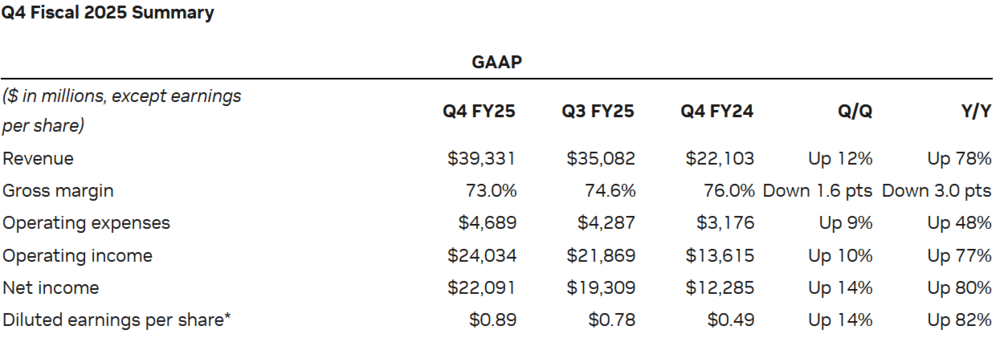
Meanwhile, Jensen Huang stated that the release of DeepSeek-R1 is favorable for the AI market.
On February 25th, NVIDIA announced the open sourcing of DeepSeek-R1-FP4, the first optimization solution based on the Blackwell architecture. With the support of the new model, the B200 using Blackwell achieves an inference throughput of 21,088 tokens per second, which is 25 times higher than that of the H100. At the same time, the cost per token under this solution has decreased by 20 times.
It can be seen that the chip with the Blackwell architecture remains the optimal choice. The earnings report for this quarter shows that NVIDIA delivered a total of $11 billion worth of Blackwell chips in the fourth quarter of fiscal year 2025, which is the fastest revenue increase for new products in NVIDIA's history.
However, the good earnings report failed to save NVIDIA's stock price. After the earnings report was released, NVIDIA's stock price rose nearly 4% on the same day, but on the next trading day, it plummeted by 8%.
When Will NVIDIA Get out of the Downward Channel?
Currently, I believe there are three negative factors for NVIDIA in the short term, and the most important one is the chip control measures against China.
According to a report by Mizuho Securities of Japan on March 1st, based on industry news and the investigation by its Washington team, the Trump administration of the United States may introduce new export control measures for AI chips to China.
This may lead to a reduction of $4 billion to $5 billion in NVIDIA's revenue for the fiscal year 2026 and affect its earnings per share by $0.18.
Since the United States first banned NVIDIA's A100/H100 from being exported to China in October 2022, this game has entered a "cat-and-mouse" mode: the United States raises the technical threshold → NVIDIA launches a downgraded version of the chip → the United States blocks it again. The H20 chip that has been targeted this time is the latest product of this cycle.
In addition, Singapore is investigating whether the servers exported to Malaysia by Dell and Supermicro contain NVIDIA chips that are prohibited from being exported to China, with a focus on whether these servers flow into China through third parties. This incident highlights the crucial role of intermediaries in high-end semiconductor trade.
Furthermore, NVIDIA has already entered a product iteration cycle. NVIDIA's advanced CoWoS packaging orders may decrease because the Hopper GPU is approaching the end of its product life cycle, and the market is waiting for the release of the next-generation GB300 GPU to drive a new round of demand.
Is It Worth Buying?
Recently, I also came across an interesting theory from a leading figure in China's private equity industry.
He said, "The cycle of NVIDIA does not stem from its 'B2B' or 'non-platform' nature, but rather from the fact that it is always a 'capital good'/'durable consumer good'. If a company's product is a'repeatedly consumed fast-moving consumer good', the demand will be relatively stable, such as food and beverages, online games, and coal. However, if a company's product is a 'capital good'/'durable consumer good', due to its reusability, the downstream demand usually shows great volatility.
So, when applying Jevons' paradox to computing power, there is an error that we didn't notice before: as the model cost decreases and the computing power efficiency improves, the AI scenarios will indeed expand, and the total demand for computing power will also increase significantly. But the difference is that coal is a one-time consumption resource, while computing power is a reusable resource. Even if the total annual demand for computing power increases significantly, the demand for AI chips that generate computing power may still decline!"
In simple terms, due to the nature of being a "reusable capital good", NVIDIA's product revenue is the "second derivative" of AI demand, and the revenue growth rate is the "third derivative".
Therefore, the cycle of NVIDIA will definitely be highly volatile, even in the case where the demand for AI computing power keeps increasing.
I think this theory is reasonable.
In addition, NVIDIA's annual GTC conference will not be held until March 17th. Before that, there is a lack of major positive news in the market to boost the stock price.
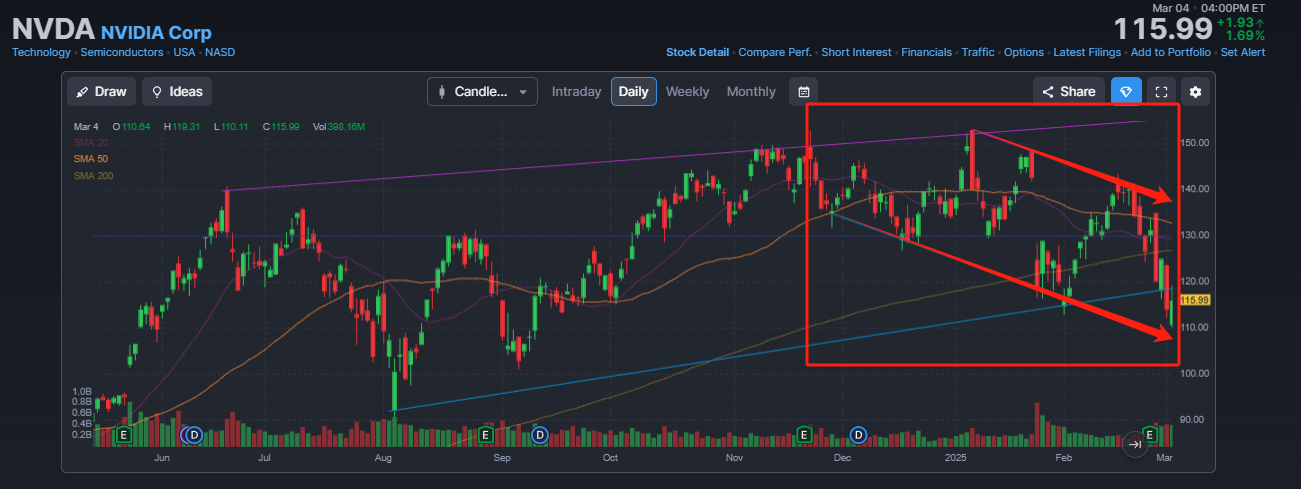
And judging from the stock price chart, NVIDIA has now clearly entered a downward channel. By observing the 5-day moving average and the 60-day moving average, it can be seen that NVIDIA's stock price may have a certain upward rebound trend in the short term, but in the long run, there is no doubt that it has entered a downward channel.$NVDA
#U.S. Tech Giants: Tracking U.S. Market Leaders#$Nvidia Corp(NVDA)