
Alibaba Open-Sources QwQ-32B: Small But Mighty AI Model Outperforms DeepSeek-R1

Shearing sheep
March 6, 2025
GoGPT Summarizes Articles
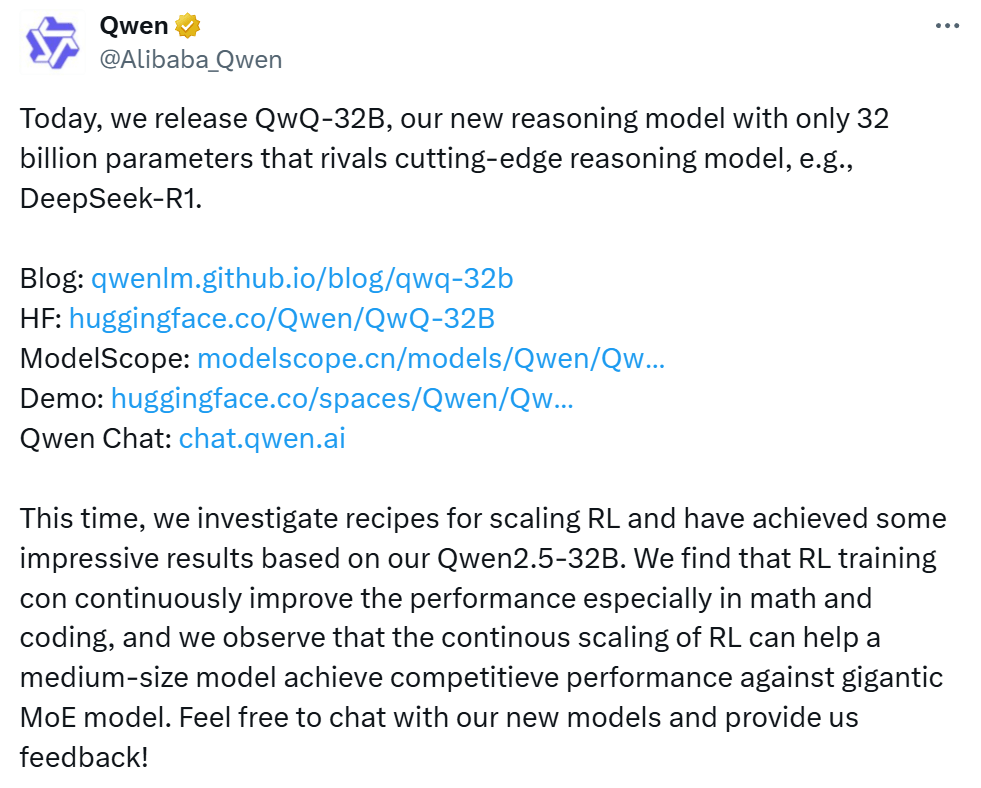
Today, Alibaba has once again made headlines with its latest AI model, QwQ-32B, demonstrating remarkable performance despite its relatively compact size.
QwQ-32B is a 32-billion-parameter model that has outperformed the much larger DeepSeek-R1, which boasts 671 billion parameters (with 370 billion actively used). This challenges the long-held assumption that bigger models are always better, proving that with the right training techniques, smaller models can achieve comparable—if not superior—performance at a fraction of the cost.
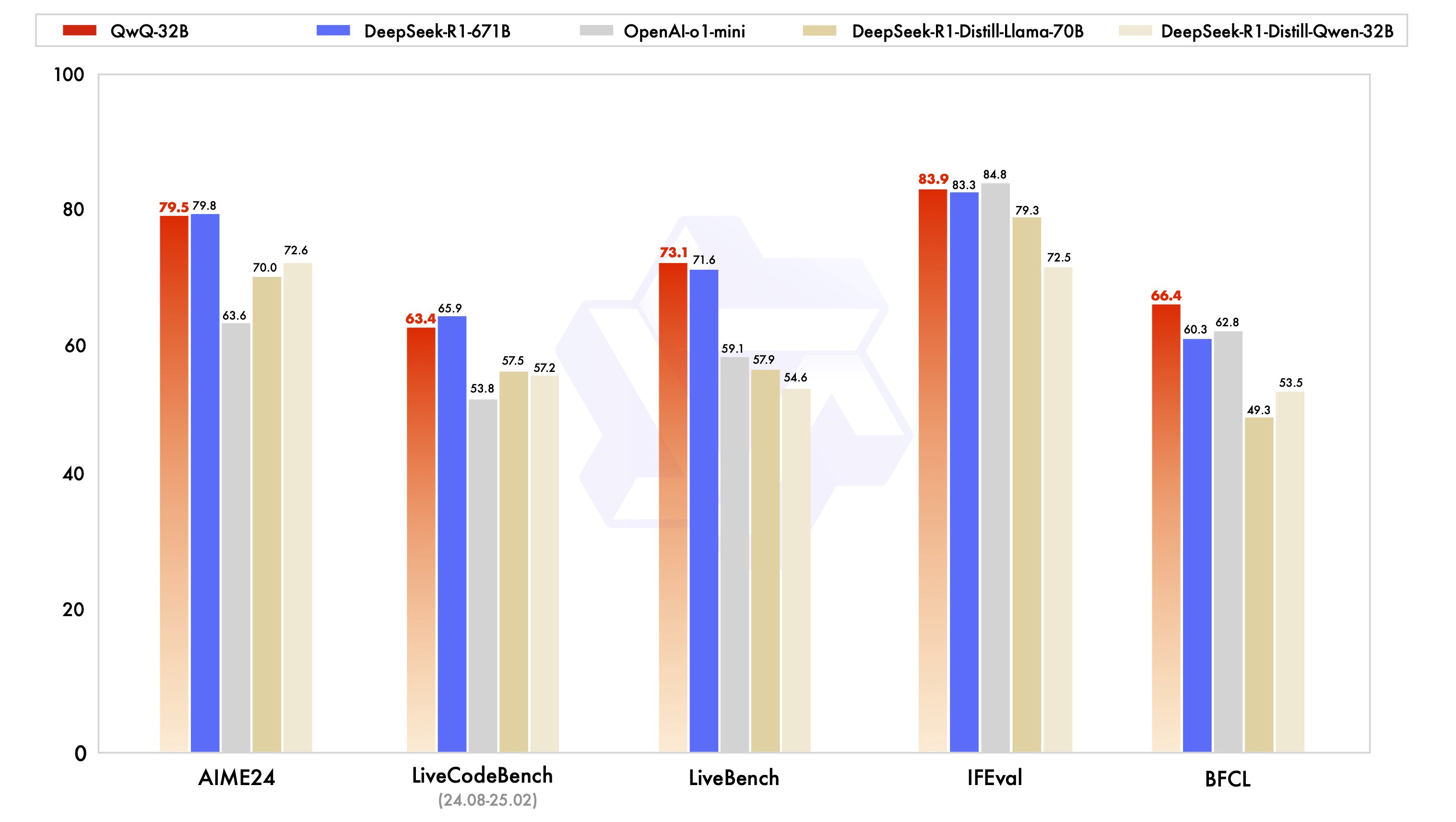
Unparalleled Cost Efficiency
What makes QwQ-32B even more impressive is its cost efficiency. Operating at just 1/10th the cost of DeepSeek-R1, QwQ-32B provides a high-performance alternative for businesses seeking cost-effective AI solutions.
For instance, in the LiveBench benchmark:
-
QwQ-32B scored 72.5 points, with a cost of $0.25 per output token.
-
DeepSeek-R1 scored 70 points, at $2.50 per output token.
-
o3-mini scored 75 points, but at a much higher cost of $5.00 per output token.
That’s a significant cost-performance advantage that makes QwQ-32B a compelling choice for AI applications.
The Secret Behind QwQ-32B’s Success: Reinforcement Learning
Alibaba’s innovative reinforcement learning (RL) approach is key to QwQ-32B’s exceptional performance. The model was trained using a phased RL strategy that prioritized real-world validation over traditional reward models:
-
Initial Phase – Focused on math and programming tasks. Instead of relying solely on reward models, the training process involved direct validation:
- Math solutions were checked for correctness.
-
Code outputs were executed to verify functionality.
-
Expansion Phase – Introduced general-purpose RL training, combining reward models with rule-based verifiers. This ensured the model retained its strong math and coding abilities while improving its broader AI capabilities.
As training progressed, QwQ-32B demonstrated consistent improvements across various benchmarks, proving the effectiveness of this approach. Moreover, Alibaba has open-sourced QwQ-32B under the Apache 2.0 license, making it accessible to a broader audience and encouraging community engagement.
Alibaba’s Expanding AI Ecosystem
QwQ-32B is just one piece of Alibaba’s extensive AI portfolio. The company has been heavily investing in its Tongyi model family, which includes models like Tongyi Qianwen and Tongyi Wanxiang.:
-
Tongyi Qianwen (Qwen) – This is Alibaba’s flagship large language model family, ranging from 700 million to 72 billion parameters. The latest iteration, Qwen 2.5, supports over 29 languages and excels in language understanding, math, and programming. It also offers specialized instruction-following and quantized models, making it suitable for both cloud and edge deployments. Qwen 2.5 is already being integrated into various Alibaba services, including their AI-powered search platform, Quark.
-
Tongyi Wanxiang (Wanx) – This is Alibaba’s multimodal video generation model. The latest version, Wanx 2.1, can generate high-quality videos from text and image inputs. It has achieved impressive scores in the VBench evaluation, particularly in motion stability, semantic alignment, and visual consistency. Wanx 2.1 offers multiple versions, including T2V-1.3B, T2V-14B, I2V-14B-720P, and I2V-14B-480P, catering to different input types and output resolutions.
Additionally, Alibaba has developed other specialized models, such as:
-
Qwen-VL: A visual understanding model focused on image and video content comprehension and generation.
-
Qwen-Audio: An audio language model designed for audio generation and understanding.
-
Tongyi Lingma: An AI programming assistant based on the Qwen 2.5-coder model, offering features like code completion, optimization, and debugging assistance to significantly boost developer productivity.
Alibaba’s AI Ambitions: A $52 Billion Investment
Alibaba has announced plans to invest 380 billion yuan (~$52 billion) over the next three years in cloud computing and AI infrastructure. This figure exceeds their total investment over the past decade, signaling their ambition to become a global AI powerhouse.
Following the QwQ-32B release, Alibaba’s ($BABA) stock jumped 8.61%, underscoring market confidence in its AI strategy.
A Shift in AI Trends? Smaller, Smarter Models
For years, AI research has focused on scaling models larger and larger, often requiring massive computational resources. But with models like DeepSeek-R1 and now QwQ-32B, we’re seeing a shift: smaller, more efficient models that rival—or even outperform—their larger counterparts.
This shift is particularly significant for open-source AI and small-to-medium enterprises, which often lack the resources to deploy massive models.
If Alibaba’s reinforcement learning approach and cost-efficiency strategy set a new industry standard, we might soon witness a wave of more accessible and sustainable AI—a game-changer for the entire ecosystem. #Alibaba
#Chinese Equity Markets: Insights, News & Trading Signals#$Alibaba Group Holding Limited American Depositary Shares each represents eight Ordinary Shares(BABA)#Alibaba