
Bretton Woods System 3.0: Where is the US Dollar Headed?

1.Why does gold keep rising?
We previously discussed the concept of Bretton Woods System 3.0. Under Bretton Woods System 2.0, the US dollar was decoupled from gold during the Nixon era, then anchored to US government credit, allowing for the issuance of treasury bonds. Now, even the Trump team seems to believe this might be difficult to sustain.
Stephen Miran, Chairman of the US National Economic Council, believes the Bretton Woods agreement might return to gold. However, gold alone isn't enough, so other commodities like minerals might be added. This explains why gold has been skyrocketing for so many years.
Don't underestimate the US, its gold reserves are quite substantial. Of course, it's still not enough to fully back their reserve assets, which is why they've recently begun considering introducing Bitcoin as a reserve asset. If currency is issued without credit assets to balance it, we could see hyperinflation like in Zimbabwe.
2. Why is it difficult to maintain the US dollar's international currency status?
If the US wants to maintain its international reserve currency status, the dollar issuance would be quite large, but there's no asset to balance it. That's why the Trump team is considering introducing virtual currencies as assets to balance it out.
Given the ongoing Russia-Ukraine war, if a large-scale international conflict were to break out, you'd find that only tangible economies like Russia's would truly matter - meat, wine, oil and minerals. Compared to the Europe economy, you can image that if Russia throws a bomb, France throwing a Louis Vuitton handbag in return would be useless.
So the west are trying to grab resources, which explains why the Trump administration was particularly keen on resource acquisition. Their approach differs from the Democrats, though. When Biden took office, he wanted to propose an alternative to the Belt and Road Initiative, that's why Americans went to Africa to develop railways for some countries, aiming to secure resources. But building railways is not easy, and what's the state of America's own railways? You know, those train derailments. Americans can't do it. Now, Musk's DOGE department's layoff list includes someone from the US Africa Command, so it seems the Trump team definitely won't be going to Africa to grab resources. Currently, it's mainly French forces doing construction in Africa, but they're gradually being replaced by Russia.
In their view, goods are equivalent to what we call money, because they're linked to it. Money flows everywhere, from one bank to another, currently using the SWIFT channel. Maritime shipping routes are like SWIFT, with ports like Panama, Malacca, Suez, Rotterdam, Hamburg, and Shanghai acting as banks.
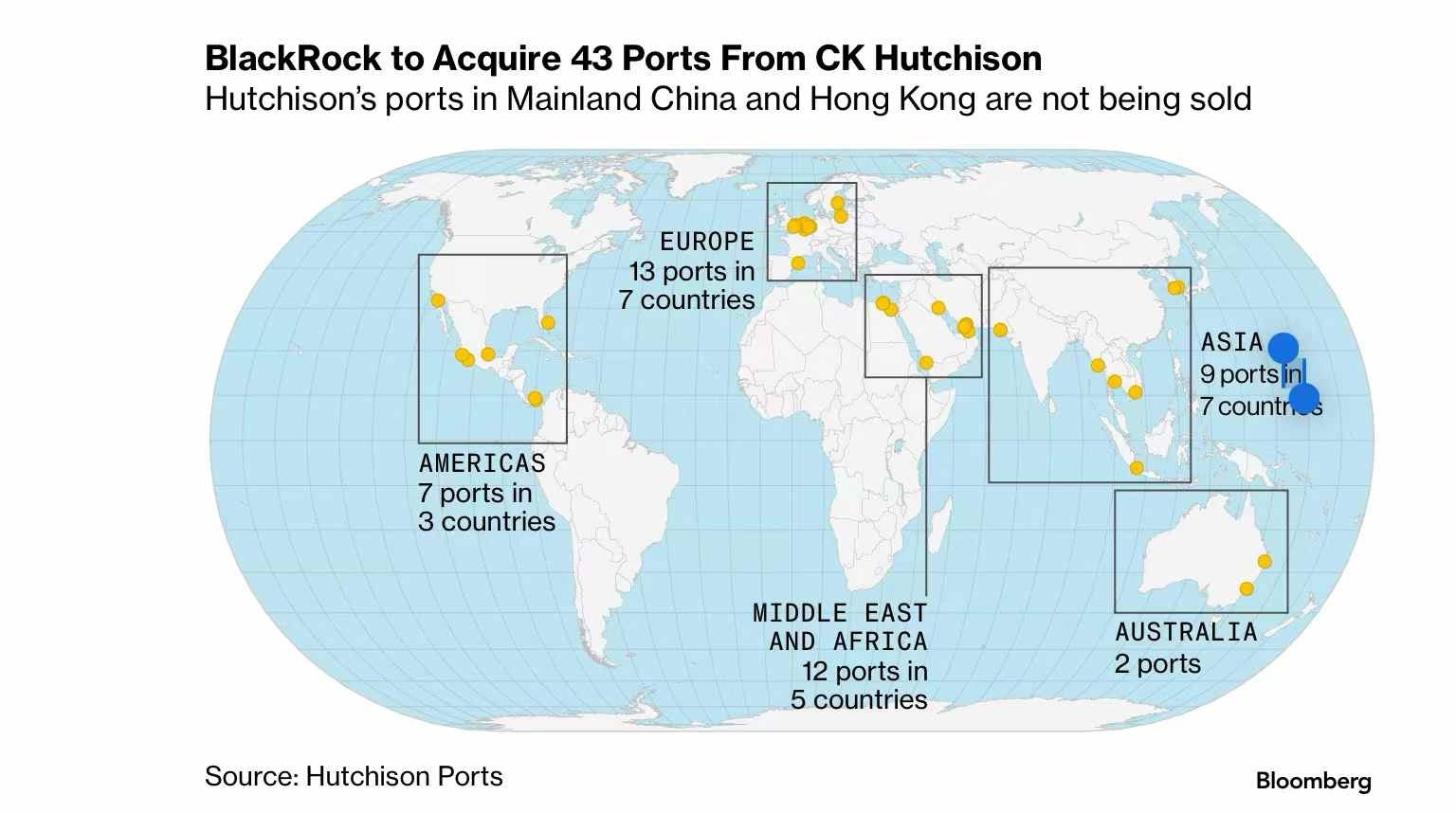
Hong Kong tycoon Li Ka-shing sold 43 ports to America's BlackRock, which is like the US reclaiming some banks and channels. Trump said he wants Greenland in the north, Panama in the south, wants to rename the Gulf of Mexico as the American Gulf, and turn Canada into the 51st state. He wants to turn these into fully controlled domains.
For all financial-related issues the Trump team encounters, they can just call the Federal Reserve to solve them. The only problem the Fed can't solve is when it comes to commodities. That's the reason behind their actions.
3. Inherent Institutional Flaws in the US
There's also an institutional flaw in the US system that leads to conflicting objectives. For instance, Trump wants America to produce more oil, but existing US oil wells have already undergone asset depreciation. The current operating cost in Texas is $45, which is the breakeven point. For new oil wells, the breakeven point is $65, but recently oil prices have fallen below $65. In this situation, if the oil price is $66, basically no capital is willing to invest in development. However, if oil prices are good, say back to $77 or $80, they might be willing to develop, but then life becomes difficult for average Americans.
The solution is actually a matter of institutional design - a dual-track pricing system. Whether it's Russia, Iran, or Saudi Arabia, all oil-producing countries use a dual-track pricing system. Domestic consumers get oil cheaper than water, while exported oil is sold at international prices.
Due to institutional constraints, the US can't implement such a dual-track system. This results in conflicting objectives - they can't simultaneously reduce inflation domestically through lower oil prices and increase crude oil production when international prices are high. They can't resolve this issue.