
AI Delays Again, iPhone Sales Slump in China — How Can Apple Escape Its Dilemma?

Shearing sheep
March 15, 2025
GoGPT Summarizes Articles
Apple's virtual assistant, Siri, has been a key part of its ecosystem since its debut in 2011. But let's be honest — Siri has long lagged behind competitors like Google Assistant and Amazon's Alexa when it comes to intelligence and functionality. Now, recent reports from inside Apple show a company struggling to catch up in the AI race.
Robby Walker, Apple's senior director in charge of Siri, reportedly called the delays in launching new AI features as "ugly and embarrassing" during a closed-door meeting. Worse still, Apple had already pre-announced these features — only to now push them back to next year at the earliest.
The main reason for this delay? Quality issues. Apple's internal testing found that its new AI technologies have a success rate of only 66% to 80% — meaning up to one in every three user interactions could end in failure. For a company that markets its products around seamless user experiences, this is a massive problem.
But this isn't just about Siri. It reflects broader issues with Apple's entire AI strategy, which they've branded as "Apple Intelligence." Despite being a tech giant, Apple is clearly struggling to keep up with the rapid AI advances being made by rivals like Google and Microsoft.
What makes things worse is that Apple had positioned these AI features as key selling points for the upcoming iPhone 16 series — a lineup that's rumored to have minimal hardware upgrades. Now, without these AI features ready, Apple risks disappointing both consumers and investors.
Trouble in China
On top of its AI challenges, Apple is facing serious headwinds in China — one of its largest markets.
According to IDC, while the newly launched iPhone 16e has sold better than the older iPhone SE (3rd gen), the boost isn't enough to reverse Apple's declining sales trend in China. IDC reports that iPhone 16e sales during its first three days were 60% higher than iPhone SE's initial launch, but Apple's total market share in China is still projected to fall about 2% this year.
Nabila Popal, senior research director at IDC, points out that competition from Android brands is intensifying, especially as Chinese government subsidies are expected to benefit local Android players much more than Apple.
The numbers speak for themselves — Apple reported that its sales in China fell about 11% during the recent holiday season, with iPhone likely being the main reason for that decline.
A New AirPods Feature?
There may be a small silver lining. Reports suggest that Apple is planning to introduce a real-time translation feature for AirPods, which would allow users to translate face-to-face conversations on the fly. This feature is expected to be part of an AirPods software update later this year, tied to iOS 19.
However, Google's Pixel Buds have offered this feature for years, and Apple's own Translate app has been around since 2020. So while this could be a positive move, it may not be enough to shift the narrative unless it brings something truly innovative.
Can Apple Turn Things Around?
The reality is clear: Apple has fallen behind in AI, and while it's now racing to catch up, the gap with competitors remains significant — at least in the short term.
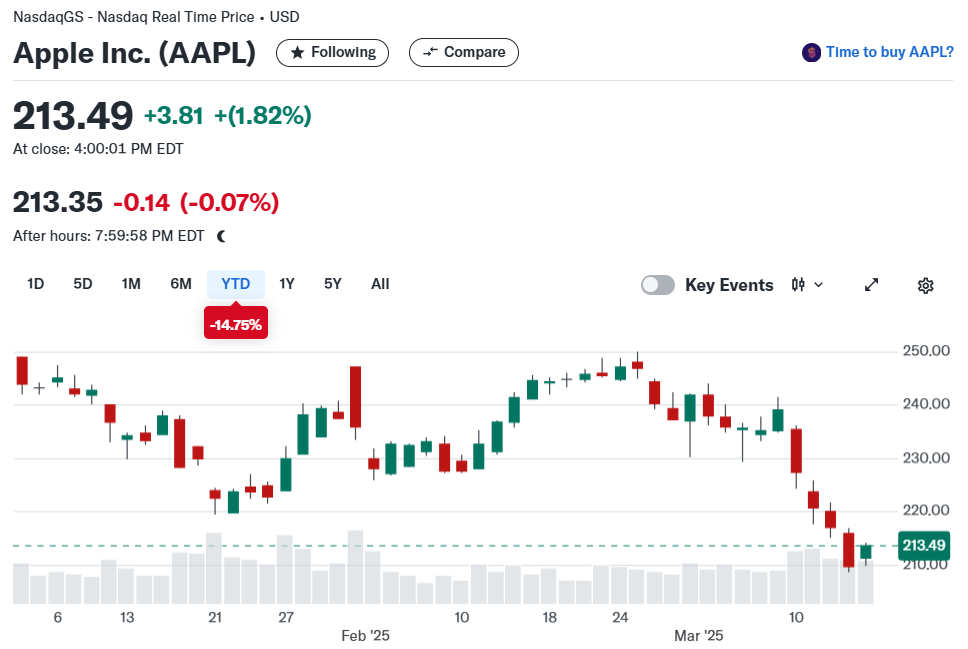
Year to date, Apple's stock has dropped more than 14%, as part of a broader decline in tech stocks. Shares did rebound slightly on Friday, climbing 1.82% to close at $213.49. But with AI feature delays and weakening iPhone sales in China, Apple's stock is likely to stay under pressure for now.
Still, for long-term investors who believe in Apple's ability to eventually overcome these hurdles, the current dip in stock price could present a buying opportunity.
If Apple wants to truly reverse course, it needs to accelerate AI development — and not just catch up, but leap ahead with features that are innovative, unique, and, above all, reliable.
#apple#$Apple Inc.(AAPL)