
Bridgewater’s Q4 Move: A Shift in Market Logic?

Last time, I analyzed Buffett’s portfolio changes. today, let’s take a look at Bridgewater’s latest 13F filings.
I have always considered Bridgewater Associates’ portfolio changes as a valuable market indicator, and its Q4 2024 filings send a clear message: the fund is actively reducing risk exposure while shifting toward more defensive assets. This isn’t just a routine adjustment—I see it as a reflection of Bridgewater’s deep understanding of macroeconomic trends and a potential signal of an evolving market landscape.
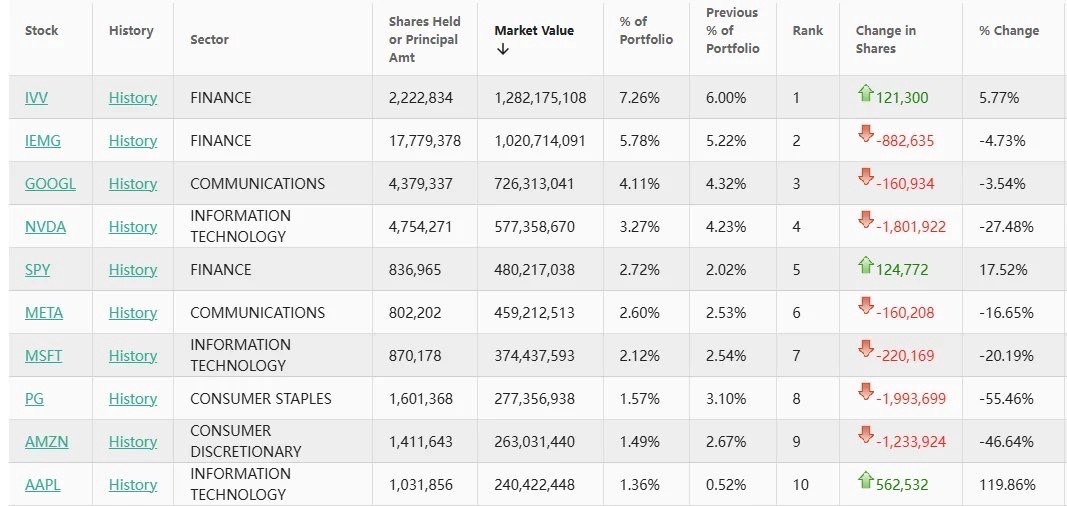
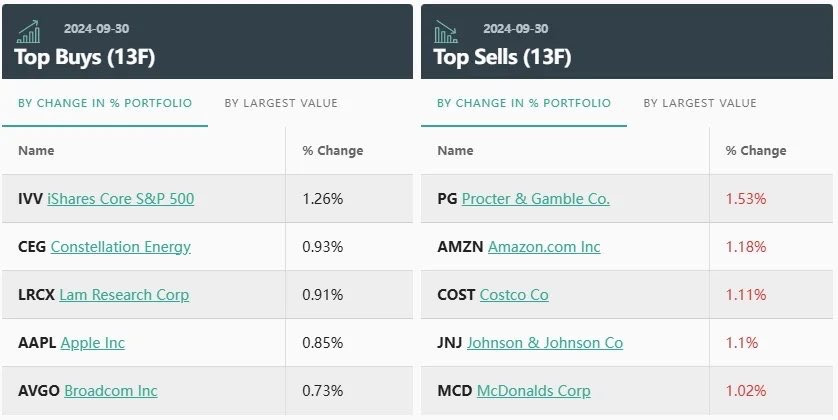
When I analyzed the specific moves, I noticed that Bridgewater significantly cut its holdings in major tech stocks like NVIDIA, Apple, Microsoft, and Amazon while increasing its exposure to the S&P 500 ETF (SPY) and the energy sector. This made me wonder: What’s the underlying logic behind these shifts? And how do they align with Bridgewater’s investment philosophy?
Bridgewater’s Investment Strategy: Dynamic Balance and Risk Management

To fully grasp Bridgewater’s portfolio changes, I always go back to its core investment framework. Founded by Ray Dalio, Bridgewater is best known for its “All Weather” investment strategy, which emphasizes asset allocation to ensure stable returns across different economic conditions.

I have seen how this approach helps Bridgewater avoid over-reliance on any single sector or market, continuously adjusting its portfolio based on macroeconomic trends to achieve diversification and low correlation among assets.
Unlike traditional stock-picking strategies, Bridgewater’s approach is macro-driven, focusing on economic cycles, inflation, monetary policy, and debt dynamics. I find this perspective particularly insightful because it means Bridgewater’s asset allocation isn’t just about individual stocks—it reflects a broader view of global market trends.
From my perspective, its latest adjustments send a clear message: tech stock valuations and risk-reward ratios are becoming increasingly unbalanced, and the market may be entering a new adjustment phase.
Cutting Tech Stocks: A Bubble or a Cyclical Shift?
When I saw Bridgewater’s Q4 filings, one thing stood out: a sharp reduction in tech holdings. The firm slashed its positions in $NVDA, $GOOGL , $META, $MSFT, $AAPL, and $AMZN.

While these companies remain fundamentally strong, I believe Bridgewater’s sell-off was driven by several key factors:
First, tech stock valuations have reached historic highs. Over the past two years, the AI boom has fueled massive rallies, pushing stocks like NVIDIA to price-to-earnings (P/E) ratios exceeding 100x. However, AI commercialization is still in its early stages, and sustaining such high valuations remains uncertain.
Second, monetary policy uncertainty has increased market risks. While the consensus expects the Fed to cut rates in 2024, Bridgewater appears unwilling to hold excessive tech exposure at peak valuations. Given that higher interest rates directly impact discounted cash flow models, prolonged elevated rates could pressure tech stock valuations.
Lastly, a shift in market leadership may be underway. The AI-driven rally of 2023 could give way to profit-taking in 2024, with capital flowing into lower-valuation, more stable sectors. Bridgewater’s adjustments suggest it is positioning for this potential shift.
Raising SPY Exposure: Hedging or a Strategic Move?
One of the most significant moves I noticed in Q4 was Bridgewater increasing its holdings in the SPDR S&P 500 ETF ($SPY ) to 22.12%, making it the fund’s largest position. This caught my attention because it carries significant implications.

Rather than exiting equities entirely, Bridgewater is reducing single-stock risk while maintaining broad market exposure. If I were managing a fund of this scale, I would see SPY as a way to still benefit from overall market growth while avoiding concentrated risks.
This move also suggests that Bridgewater does not foresee an imminent U.S. stock market collapse but anticipates heightened individual stock volatility. If that’s the case, holding SPY allows Bridgewater to stay invested while insulating itself from potential corrections in overheated sectors.
Energy and AI Infrastructure: New Growth Drivers?
While reviewing Bridgewater’s holdings, I noticed that despite reducing direct tech exposure, it has increased its investments in AI-related infrastructure, particularly in energy and data centers. This suggests that Bridgewater isn’t abandoning tech entirely but rather shifting toward industries poised to benefit from AI expansion.

Notably, Bridgewater increased its stakes in Vistra $VST and Constellation Energy $CEG two major U.S. energy companies supplying power to data centers. With AI models becoming more computationally intensive, I see electricity demand surging, making energy infrastructure a crucial bottleneck. Bridgewater’s move appears to be a long-term bet on AI-driven energy consumption growth.

I also found it interesting that Bridgewater initiated a position in $TSLA . While the allocation is small, I think this could indicate confidence in Tesla’s autonomous driving and energy storage potential. But I bet Dalio didn’t anticipate that Elon Musk’s increasing involvement in politics would have such a dramatic impact on Tesla’s stock price.
Bridgewater vs. Buffett: A Clash of Investment Philosophies
Bridgewater’s aggressive rebalancing contrasts sharply with Warren Buffett’s investment strategy. In Q4, Buffett maintained his large Apple position and made no significant changes to his tech holdings.

I see this divergence as a reflection of two fundamentally different investment philosophies:
• Bridgewater follows a macro-driven strategy, continuously adjusting its portfolio based on market conditions and systemic risks rather than making concentrated bets on individual companies.
• Buffett is a value investor, focused on holding high-quality companies long-term, regardless of short-term market fluctuations.
For investors like me, this difference offers valuable insights. If you prefer a flexible approach, it may be wise to reduce exposure to overvalued assets and pivot towards defensive sectors. If you favor long-term conviction, short-term market noise should not dictate investment decisions.
Signs of a Market Rotation?
Bridgewater’s latest moves made me think about a key question: Is the market shifting from a tech-driven rally to a more value-oriented phase?
Tech stocks have led the market for the past two years, but Bridgewater’s portfolio adjustments suggest it is preparing for a potential rotation. As the market becomes more sector-diverse, I believe capital may start flowing into energy, infrastructure, and other stable growth industries.
How Should Investors Respond?
If this shift materializes, I think it’s essential to reassess portfolios overweight in high-valuation tech stocks. Reducing risk exposure and diversifying into sectors with long-term growth potential—such as energy, industrials, and AI infrastructure—could be a more balanced strategy.
Is Bridgewater’s repositioning a leading indicator of a broader market shift, or just a tactical hedge? I’ll be watching closely over the next few quarters, as this could be one of 2025’s defining market narratives.
If you want to learn more about 13F filings, click here to check out my previous post here. And if you're interested in institutional portfolios and market trends, follow me for more insights and analysis!