
Nvidia GTC 2025: Why Didn’t the Market Buy It This Time?

Over the past eight annual GTC events, $NVDA ’s stock has surged 87.5%, with daily fluctuations ranging from -0.59% to 21.8%. However, this year, after the GTC conference, Nvidia’s stock fell by 3.4%. Despite Jensen Huang’s passionate speech, why did the market hit the “pause” button this time?
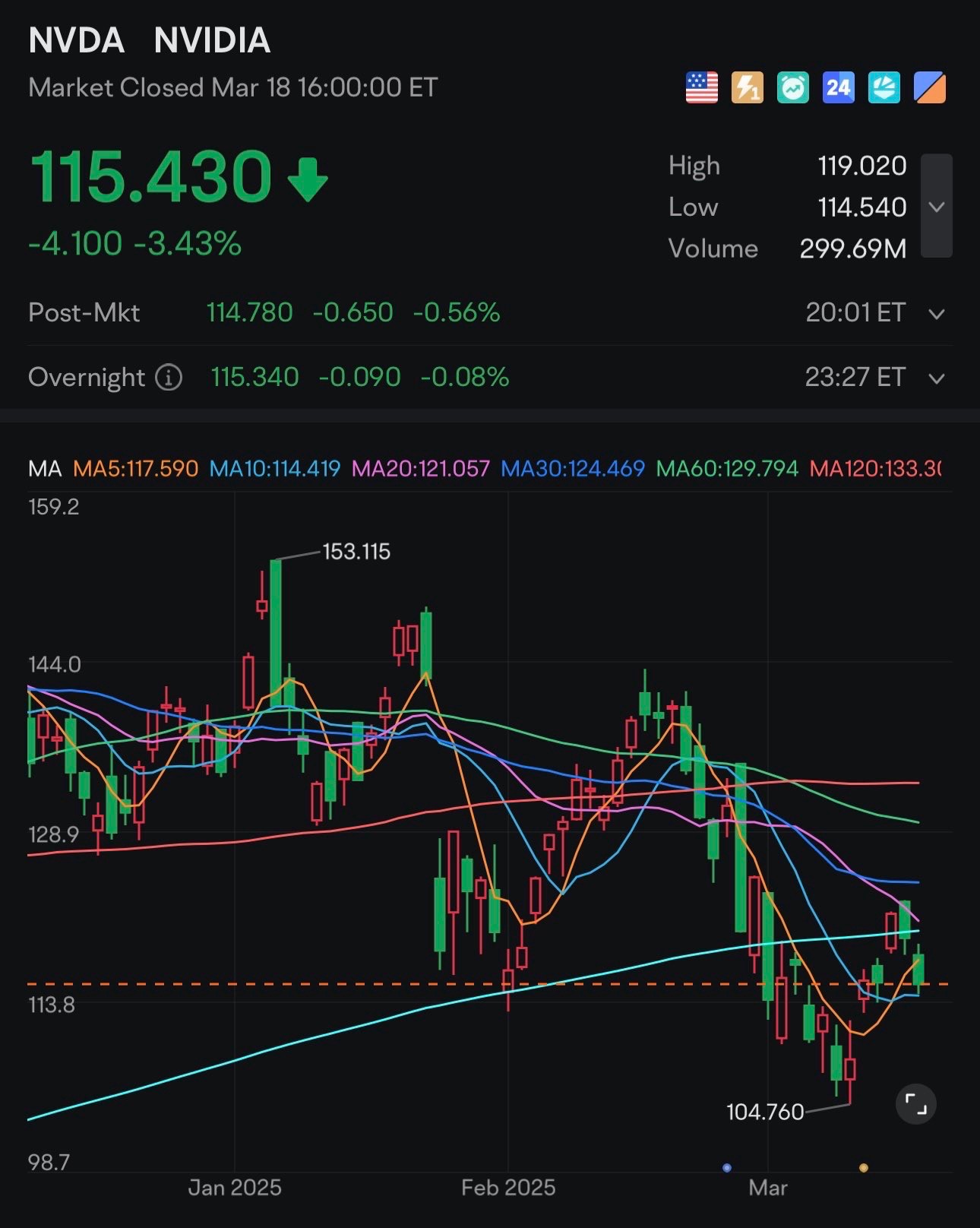
In my opinion, this is not about Nvidia’s technological capabilities; rather, it’s a matter of the gap between market expectations and reality. Investors were hoping to see new, short-term growth catalysts, but what Nvidia offered was a long-term vision. At the same time, the competitive landscape in the industry is changing quietly, with major companies accelerating their own chip development and the rise of large AI models reducing reliance on Nvidia GPUs.
Why Was the Market Disappointed?
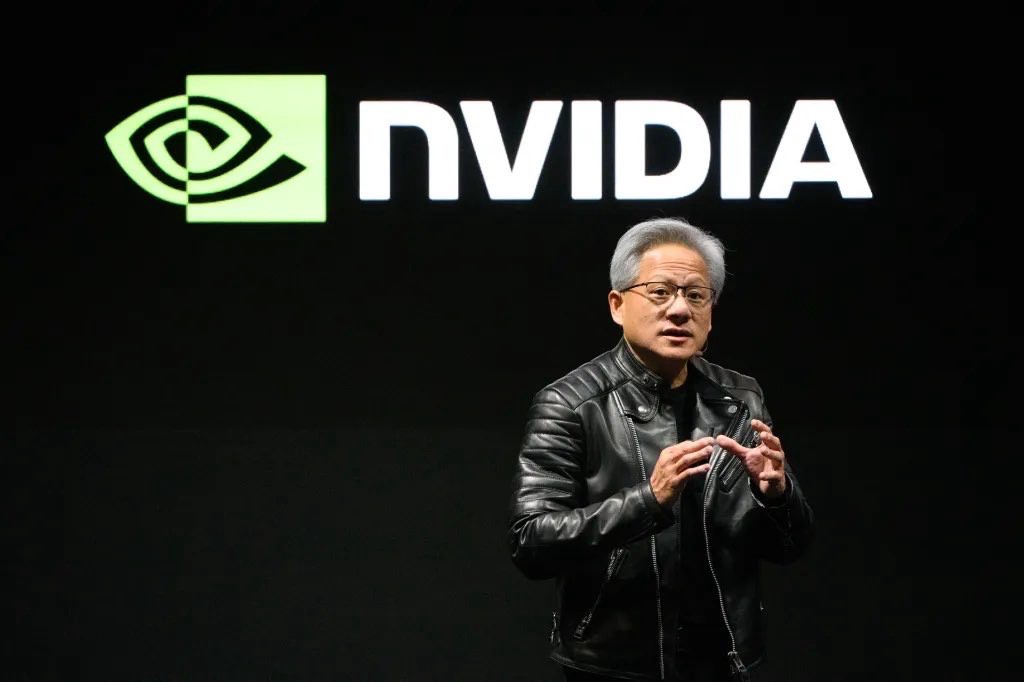
The GTC event has always been Nvidia’s stage to showcase its future blueprint, and this year was no different. Huang shared an in-depth product roadmap and highlighted Nvidia’s involvement in robotics, autonomous driving, quantum computing, and other fields. However, what the market wanted were short-term revenue growth points, not visions that would take years to materialize.
1. Emerging Fields Are Hard to Monetize Quickly
• Quantum computing is still in its early stages, making it unlikely to contribute significant revenue in the short term.
• Robotics, while closer to reality, is not advancing fast enough to scale up commercial revenue the way Nvidia’s core AI chip business does.
2. The Conference Lacked Any Unexpected Surprises
Many analysts, including Maribel Lopez, founder of Lopez Research, felt Huang’s speech largely covered already known information. Lopez noted that the market was hoping for a “magic rabbit pulled out of a hat”—something entirely new that could immediately scale Nvidia’s market share, rather than an extension of its existing business.
Blayne Curtis, an analyst at Jefferies, also hoped to see more proof of how Nvidia could expand its market size and reduce Total Cost of Ownership (TCO), but this year’s GTC failed to provide sufficient surprises.
Industry Competition Heats Up: Nvidia’s Dominance Faces Challenges
Nvidia’s powerful growth has its hidden concerns, and the market is now reassessing its long-term position.
1. Major Players Developing In-House Chips, Reducing Nvidia’s Market Demand
In the past, Nvidia’s GPUs were nearly the only option for AI computation. However, now tech giants are accelerating their efforts to reduce reliance on Nvidia:
• $GOOGL has TPUs, $AMZN has Trainium and Inferentia, $MSFT launched Azure Maia, and $META is also developing its own AI chips.
• $AAPL’s M-series chips have already reduced dependence on Intel and AMD, and could potentially expand into the AI computation field.
While these in-house chips may not fully replace Nvidia’s GPUs, they have certainly weakened Nvidia’s monopoly in cloud computing and large model training markets.
2. Optimization of Large AI Models Reduces Reliance on Nvidia GPUs
• The emergence of AI companies like DeepSeek indicates that training methods for large models are evolving, no longer requiring heavy dependence on Nvidia’s GPUs.
• Advances in quantization technology are reducing the computing power needed during AI inference, which decreases demand for ultra-high-end GPUs.
• The rise of open-source models allows companies to deploy AI more affordably, without being fully dependent on Nvidia’s closed ecosystem.
This means that even though AI computation remains the core of future growth, Nvidia’s control over the market is not as invincible as it once was.
Nvidia’s Long-Term Competitiveness Remains Strong
Despite the market’s short-term lukewarm reaction, Nvidia continues to demonstrate incredible technological innovation.
Huang announced that Nvidia’s product development cycle has stabilized at 12 to 18 months, maintaining a high pace of innovation:
• In H2 2026, Nvidia will release the Vera Rubin platform, which will be 3.3 times more powerful than the Grace Blackwell platform, equipped with 144 GPUs.
• In H2 2027, Nvidia will unveil the Vera Rubin Ultra, with performance 14.4 times better than Grace Blackwell, and equipped with 576 GPUs.
• In 2028, the Feynman platform will be released, continuing Nvidia’s tradition of naming products after famous scientists.
Nvidia’s rapid product development makes it difficult for competitors to catch up. Even though Blackwell faced some initial issues, Nvidia was able to quickly adjust, maintaining its technological lead.
However, I can’t help but think that the market is starting to view Nvidia’s growth potential with more caution. With the shifting industry dynamics, investors are no longer just focusing on Nvidia’s technological prowess. The real question now is: Can Nvidia continue to maintain its pricing power and high margins in this increasingly competitive market?
In the short term, the lack of new revenue engines at this GTC event has dampened market sentiment. But in the long term, Nvidia remains at the core of AI computation, although its competition is more complex than ever before.
The AI chip battle is just getting started.