
The King of Private Equity Mergers and Acquisitions, KKR, has been making successive moves

Henry Tales
March 20, 2025
GoGPT Summarizes Articles
On March 11th, the oral medical device company Henry Schein (Nasdaq: HSIC) disclosed significant changes in its executive team in a filing submitted to the U.S. Securities and Exchange Commission.
According to the filing, the current President, James P. Breslawski, will officially step down on April 1st, 2025. After leaving his position, he will transition to the role of Senior Advisor and continue to serve as a member of the Executive Management Committee.
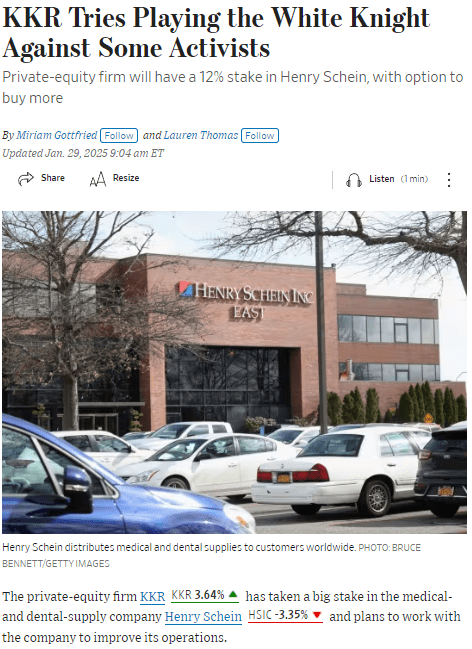
It is worth noting that prior to this announcement of the president's change, the "King of Mergers and Acquisitions," KKR Group, announced in January 2025 that it had strategically invested in Henry Schein.
With an investment of $250 million, KKR increased its shareholding ratio to 12%, becoming the largest non-index fund shareholder of the company.
Judging from the current departure of the president, it seems that KKR has officially taken control of Henry Schein, and Henry Schein has become another part of KKR's business landscape as a merger and acquisition fund.
A merger and acquisition fund is a type of private equity fund and is the main form of fund in Europe and the United States.
Simply put, it can be explained as a fund used to acquire asset targets. Usually, leverage is added. After obtaining control of the enterprise, the shares are exited through listing, or being acquired by a listed company, so as to achieve capital appreciation.
Currently, the four globally renowned private equity investment firms engaged in merger and acquisition fund business are, presumably, well-known to everyone: The Blackstone Group, Carlyle Group, Texas Pacific Group, and KKR mentioned above.
Today, we will analyze several classic merger and acquisition cases of KKR.
Let's first review the development history of KKR.

In its development history, there have been several famous merger and acquisition cases. The most famous one is the largest leveraged buyout in American history (ranking first in terms of acquisition amount even after excluding the factor of inflation) – the acquisition of RJRNabisco, the food and tobacco giant.
This malicious leveraged buyout, known as the "Buyout of the Century," has severely damaged the once-thriving RJRNabisco, and it still has difficulty recovering to this day.
As the second-largest tobacco manufacturer in the United States at that time, second only to Philip Morris, Reynolds could still generate a cash profit of $1 billion per year. However, the company's CEO, Ross Johnson, received a huge manager's allowance but paid little attention to the interests of shareholders.
On October 19th, 1988, with the support of investment banks such as American Express, Shearson Lehman Hutton, and Salomon Brothers, Johnson proposed a plan to acquire the company at a price of $75 per share.
However, due to the conflict between the shareholders representing the interests of Nabisco and Johnson, the vote on his proposed acquisition plan was postponed.
Soon, KKR, the "King of Leveraged Buyouts" on Wall Street, which caught wind of the situation, joined the acquisition battle of Reynolds.
On February 9th, 1989, KKR completed the acquisition of Reynolds at a sky-high price of $25 billion. More than 200 lawyers and bankers attended and signed the acquisition contract. Renowned Wall Street investment banks such as Merrill Lynch, Morgan Stanley, as well as Michael Milken, the "Junk Bond King," and Drexel Burnham Lambert were all involved.
Among the funds invested in the acquisition, the syndicated bank loan amounted to $14.5 billion; Drexel and Merrill Lynch provided a bridge loan of $5 billion; KKR itself provided $2 billion (with $1.5 billion as equity capital), and also provided $4.1 billion in preferred stock, $1.8 billion in convertible bonds, and assumed the $4.8 billion in foreign debt owed by RJR. In the entire acquisition case, KKR paid a very small price.
Since the company issued a large amount of junk bonds for financing and promised to repay the debt by selling the assets of the acquired company in the future, although the scale of the acquisition funds exceeded $25 billion, KKR used less than $2 billion in cash.
However, the high transaction amount did not bring the expected acquisition results. After the acquisition, Reynolds did not make a comeback but declined.
In the first half of 2003, Reynolds' sales decreased by 18% compared to the previous year, reaching only $2.6 billion, and its operating profit decreased by 59%, amounting to $275 million.
In 2005, KKR sold all of itsIn 2005, KKR sold all of its shares in RJRNabisco, with a mediocre rate of return.
This merger and acquisition has also become a classic case in the Harvard Business School.
This transaction involved a staggering $31 billion in funds, which was an astronomical figure at that time, and KKR was thus labeled as a "barbarian."
In recent days, the acquisition of Fujisoft has also made KKR famous again.
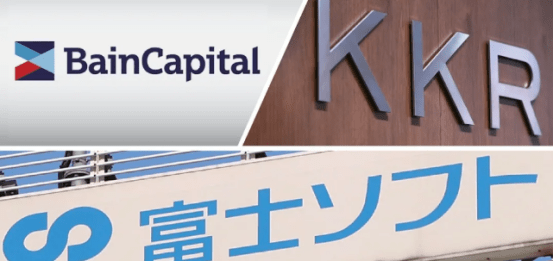
In 2024, Fujisoft in Japan was affected by the activities of the activist investor 3D Investment Partners from Singapore. It was required to sell real estate assets, etc., and 3D also solicited privatization proposals from private equity funds. KKR and Bain Capital engaged in a fierce competition to privatize Fujisoft.
KKR first launched a takeover offer in August 2024. Bain Capital increased its offer in October and won the support of Fujisoft's founder, but Fujisoft's board of directors supported KKR. In December, Bain launched a hostile takeover, and KKR requested Fujisoft to take legal action against Bain.
Founded in 1970, Fujisoft started by developing control software for communication equipment under commission and expanded its business scale through mergers and acquisitions.
As a leading system integrator in Japan, Fujisoft focuses on the research and development of embedded, control, and operation software and systems. The company has more than 10,000 system engineers and provides highly customized software solutions for clients including several major banks in Japan and many government agencies.
latest news,On March 9th, KKR announced that it had completed the TOB (Takeover Bid) of Fujisoft, a Japanese software giant, and successfully obtained more than half of the equity. The intense battle with another investment fund thus came to an end.
At the same time, KKR plans to subsequently forcefully acquire the shares of minority shareholders who did not respond to the offer to achieve full subsidiarization and ultimately complete the delisting for privatization.
This acquisition is expected to bring KKR a profit of over $1 billion.
Of course, the classic merger and acquisition cases of KKR are far more than these, and the legend of the "King of Mergers and Acquisitions" continues.
#Private Market: Unlocking Potential#privatemarket