
Abu Dhabi's ADQ and US private equity firm ECP bet $25 billion on powering US data centers.

Henry Tales
March 25, 2025
GoGPT Summarizes Articles
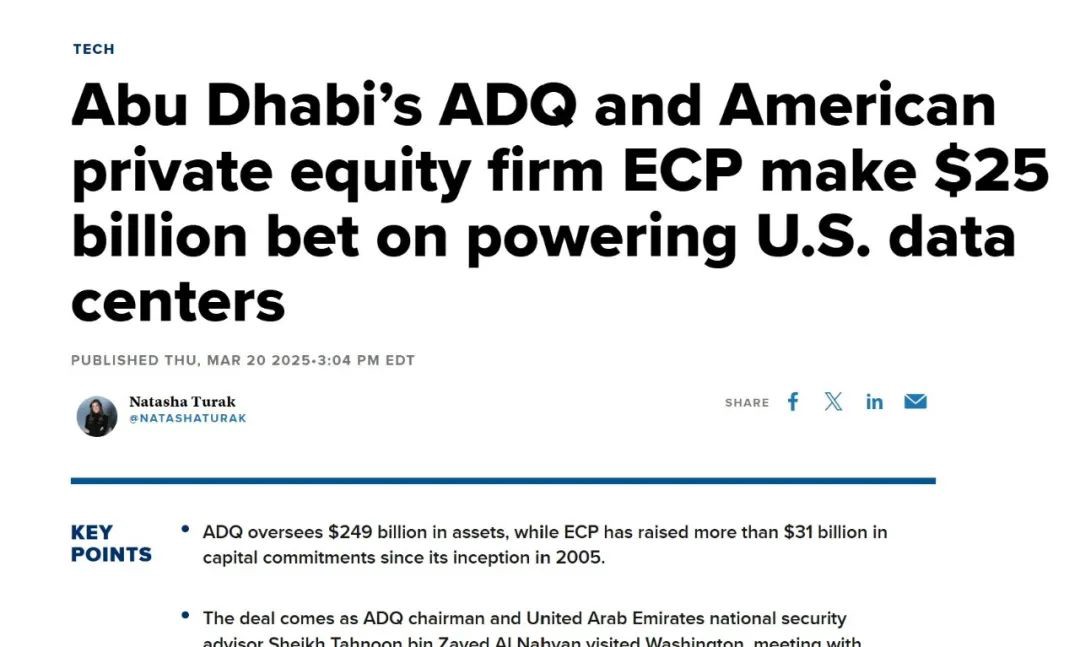
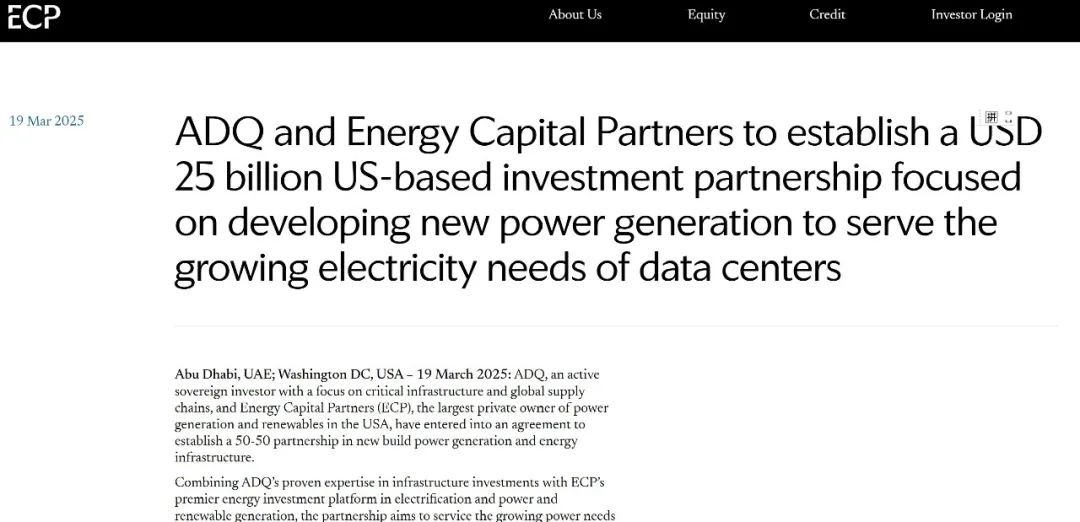
The sovereign wealth fund ADQ has signed an investment cooperation agreement worth $25 billion with the US private equity firm Energy Capital Partners (ECP for short). The agreement aims to increase power generation capacity, mainly within the United States, to meet the needs of data centers.
In a joint statement, the two companies said, "This cooperation is designed to meet the growing electricity demand of data centers, hyperscale cloud companies, and other energy-intensive industries. Since the continuity and quality of electricity supply are crucial for these high-growth industries, building self-owned power plants nearby is often a prerequisite. This cooperation focuses on meeting these needs in the long term."
The main plan this time is to invest over $25 billion in projects with a total capacity of 25 gigawatts through greenfield development, new construction projects, and the expansion of existing infrastructure.
Established in 2018 and headquartered in Abu Dhabi, the United Arab Emirates, ADQ focuses on investing in key infrastructure and the global supply chain. ECP claims to be the largest private owner of power and renewable energy assets in the United States. ADQ oversees assets worth $249 billion, while ECP has raised capital commitments of over $31 billion since its establishment in 2005.
The announcement of this partnership comes at a time when electricity demand is growing rapidly. Over the past approximately 15 years, the electricity demand in the United States has remained largely stable, but now, driven by the construction of new data centers, factories, electric vehicles, and hotter and longer summers, the electricity demand is expected to rise significantly.
As tech giants such as Microsoft, Amazon, and Google compete to take the lead in the artificial intelligence revolution, the energy consumption of data centers that support this rapidly developing technology is also increasing continuously.
In a report in December 2024, the US Department of Energy estimated that the load growth of data centers in the United States has tripled over the past decade, and it is expected that by 2028, the total electricity consumption of data centers will double or triple.
According to the "2024 International Energy Agency report on electricity," the data center industry in the United States is expected to account for more than one-third of the new electricity demand by 2026. Globally, the total electricity consumption of data centers is likely to exceed 1,000 terawatt-hours (TWh) in 2026. In comparison, the electricity consumption in 2022 was estimated to be 460 TWh. The IEA said that this consumption level is roughly equivalent to that of Japan.
This agreement was reached when Sheikh Tahnoon bin Zayed Al Nahyan, Chairman of ADQ and National Security Advisor of the United Arab Emirates, visited Washington and met with US President Donald Trump, Elon Musk, and other political and business leaders.
The United Arab Emirates has been committed to strengthening its ties with the United States in the field of artificial intelligence and seeking to acquire more US technologies to build its own infrastructure and diversify its economy away from its dependence on hydrocarbons.
This small but oil-rich Gulf emirate is actively seeking investments in artificial intelligence, data centers, and energy transition technologies as the competition for dominance in artificial intelligence is accelerating.
Last year, the UAE investment fund MGX partnered with Microsoft and Blackstone to form a consortium with an initial goal of investing over $30 billion in AI-related projects in the United States. Last Thursday, NVIDIA, a giant in US chip manufacturing, and xAI of Musk announced that they would join this project.#privatemarket
#Private Market: Unlocking Potential#privatemarket