
Tesla’s Stock Pauses Its Decline—But Is the Worst Over?

After nine straight weeks of decline, $TSLA’s stock has finally found some stability. But let’s not jump to conclusions—it’s still down 40% from its December 2024 peak. In the past two weeks, retail investors have poured $8 billion into Tesla, betting on a comeback.
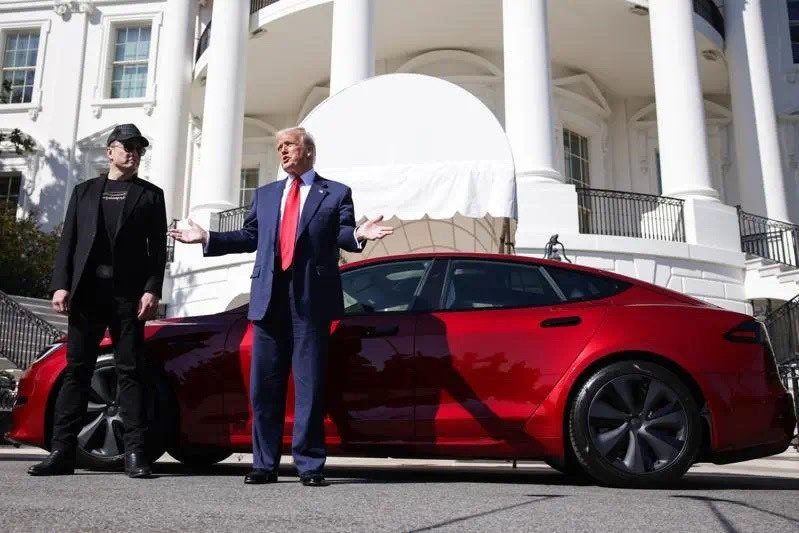
Adding to the intrigue, Donald Trump and his allies have publicly supported Musk, a development some see as a potential boost for Tesla’s stock.
Investor Sentiment: Confidence or Desperation?
Many retail investors are “buying the dip,” seeing this as a long-term opportunity. But the real test is coming soon—Tesla’s Q1 delivery numbers will be released on April 2. A disappointing result could shake this newfound optimism. Meanwhile, South Korean investors have been aggressively buying U.S. stocks, setting a new record with $10.2 billion in investments this quarter, much of it in Tesla. Some are even leveraging ETFs to amplify their bets.
Wall Street’s Take: Lower Expectations, Mixed Optimism
Analysts have slashed their delivery forecasts for Tesla’s Q1 numbers.
• JPMorgan now expects 355,000 units, significantly lower than the market’s 430,000-unit estimate.
• Morgan Stanley cut its forecast from 415,000 to 351,000 units and revised its full-year outlook to a 10% decline instead of growth. However, they still maintain a bullish stance, with a price target of $410—a 73.5% upside from current levels.
• Barclays predicts 350,000 units, keeping a “Hold” rating with a $325 price target.
Despite these downward revisions, some analysts believe Tesla’s upcoming budget EV in late 2025 could reignite growth.
Market Performance: Challenges in Key Regions
Europe: Weak Demand and Political Headwinds
Tesla’s European sales dropped 50% YoY in the first two months of 2025. In Germany, registrations plunged 76%, and Norway’s market share fell from 18.9% to 8.8%. The situation isn’t helped by EV subsidy cuts, making Tesla less price-competitive. If this trend continues, Tesla’s Q1 deliveries in Europe may fall below 25,000 units.
China: Sales Decline Despite New Model Y
In China, Tesla is struggling with competition and regulatory challenges. Sales in January and February dropped 28.7% YoY, despite increased Model Y production. Data privacy laws limit Tesla’s Full Self-Driving (FSD) system, making it less attractive than in the U.S. To counteract this, Tesla has introduced zero-interest loans and a slight price increase for the long-range Model Y to maintain its premium brand image. However, local competitors like BYD are pressing hard—its new Seagull EV, priced at just $9,000, is reshaping the market.
United States: Stable Deliveries, Political Controversy
Tesla delivered 92,200 vehicles in January-February, up 3% YoY but down 12% from the previous two months. However, Musk’s political involvement has led to consumer boycotts and protests at Tesla showrooms in cities like New York, Austin, and San Francisco.
The Big Question: Can Tesla Deliver on Self-Driving?
Tesla’s long-term success hinges on autonomous driving. Some analysts argue that if Tesla launches a robotaxi service by 2030, its valuation could reach $585 billion—65% higher than today. ARK Invest remains ultra-bullish, projecting a $2,600 stock price in five years, assuming Tesla’s robotaxi business takes off.
But skepticism remains. Analyst Boris Schlossberg warns that if Tesla fails to deliver on self-driving, the market may start valuing it as just another automaker, rather than a tech company. Tesla’s high valuation hinges on AI and automation, and without a breakthrough, its premium could erode.
Tesla has stopped its freefall, but whether this is a true reversal depends on its Q1 results and execution on self-driving technology. The stock is no longer just about EVs, it’s a bet on Musk’s ability to turn vision into reality.