
AI Compute Stocks Hammered by Report – What's Next for Investors?

Shearing sheep
March 27, 2025
GoGPT Summarizes Articles
The AI compute sector just got hit with a reality check. Last night, TD Cowen dropped a bombshell report revealing that Microsoft ($MSFT) is scaling back its data center ambitions, canceling or delaying leases totaling 2GW of power capacity across the US and Europe. The reason? Excess supply of compute clusters — a sign that even the biggest players might be overestimating near-term AI demand.
Meanwhile, Barclays released another report arguing that current global AI compute infrastructure might already be enough to support 1.5B–22B AI agents by 2025 — potentially meeting most of the U.S. and EU's needs. Their key takeaways:
-
The focus should shift from "meaningless performance benchmarks" to cost-effective inference, where open-source models like DeepSeek and Mistral are gaining ground.
-
AI agent economics matter: A single AI agent query can generate 25x more tokens than a chatbot, making low-cost inference critical for mass adoption.
Market Reaction
The fallout was immediate:
-
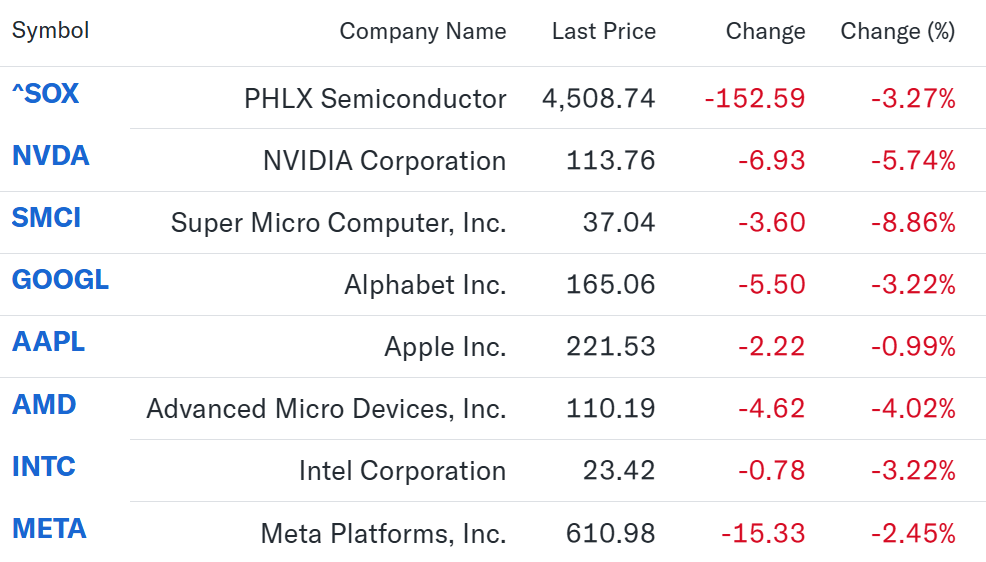
Philadelphia Semiconductor Index (SOX) fell 3.27%
-
Nvidia ($NVDA) dropped 5.74%, leading losses among the "Magnificent Seven"
-
Super Micro Computer ($SMCI) sank nearly 8.86%
AI-related stocks across the board tumbled as fears of slowing infrastructure growth spread.
However, Microsoft's pullback from new data center leases does not necessarily signal an AI slowdown.
TD Cowen's research indicates that Microsoft has significantly reduced its data center leasing across the U.S. and Europe over the past six months, canceling and delaying multiple data center leases. However, this move appears to be a reallocation rather than a retreat, with Microsoft focusing on optimizing its existing infrastructure instead of expanding aggressively. The decision is closely linked to OpenAI's evolving compute strategy, as the company shifts its focus toward inference workloads rather than just training massive models.
While Microsoft is stepping back, other major tech players are taking a different approach. Google ($GOOGL) has been expanding its global data center footprint, and Meta ($META) is increasing its compute infrastructure in the U.S., largely driven by its growing need for AI power to support Llama AI. This divergence suggests that while Microsoft is pulling back in some areas, the overall AI compute market is still expanding — just with different players leading the charge.
OpenAI's “Stargate” Ambitions
The report also points to OpenAI's growing ambition to secure its own compute resources, potentially developing multiple "Stargate" projects, each with a 1.5GW capacity, totaling over 6GW. If these projects come to fruition, it would signal that OpenAI is preparing to build massive AI infrastructure independently, further reshaping the AI compute landscape.
Meanwhile, as hyperscalers transition to higher-density architectures, AI hardware procurement has been delayed:
-
Microsoft is finalizing direct-to-chip liquid cooling.
-
Google is optimizing its AI clusters.
This has caused a 1–2 quarter delay in AI hardware orders, pressuring suppliers like Vertiv in the short term.
My Take
Despite the market's negative reaction, this is not an AI bubble bursting — it's a correction that reflects a more rational allocation of resources. Companies are adjusting their AI infrastructure strategies, but the long-term demand for compute power remains strong.
In this environment, some players are better positioned than others. Google and Meta stand to benefit from their continued expansion of AI data centers, while open-source AI models like DeepSeek and Mistral could gain further traction due to their cost efficiency. Additionally, liquid cooling and power efficiency technologies are emerging as crucial enablers of next-generation AI infrastructure.
On the other hand, some companies face increased risks. AI hardware vendors with delayed orders, such as Vertiv, could struggle in the near term, while overleveraged cloud startups, including CoreWeave, may face challenges if AI spending slows down temporarily.
Looking ahead, if OpenAI's Stargate projects move forward as expected, we could see a renewed wave of AI infrastructure investment—but that wave isn't expected to arrive until at least 2026. For now, the key question for investors is whether the current market reaction is an overcorrection or a sign of deeper structural shifts in AI computing demand. #stockmarket #aichip #microsoft
#stockmarket#aichip#microsoft#$Nvidia Corp(NVDA)#$Super Micro Computer Inc. Common Stock(SMCI)#$Microsoft Corp(MSFT)#$Alphabet Inc. Class A Common Stock(GOOGL)#$Meta Platforms Inc. Class A Common Stock(META)