
Trump's "Reciprocal Tariff" Plan: How Far Will It Go?

Shearing sheep
March 28, 2025
GoGPT Summarizes Articles
In recent weeks, the U.S. government has announced a series of new tariffs aimed at protecting domestic industries, and the ripple effects are being felt worldwide.
-
Feb 4: A 10% additional tariff on all Chinese imports (including Hong Kong), pushing some rates to 35%. The $800 de minimis exemption was scrapped, requiring full customs clearance.
-
Mar 4: Tariffs hit Canada (25% on most goods, 10% on energy) and Mexico (25% across the board). Trump’s Executive Order doubled the China tariff to 20%.
-
Mar 12: Steel and aluminum tariffs reinstated—up to 25%—affecting the EU and others, extending to household and mixed-metal products.
-
Apr 2: U.S. set to announce "Reciprocal Tariffs," and Trump calls it "Liberation Day."
International Countermeasures
The global response has been swift and severe. The EU announced up to €26 billion in retaliatory tariffs against U.S. products, including bourbon, jeans, and motorcycles. EU President Ursula von der Leyen condemned the U.S. measures as “unjustified trade restrictions,” signaling a tough stance.
Canada, the largest supplier of steel and aluminum to the U.S., responded with 25% tariffs on steel and higher taxes on tools, computers, servers, display monitors, and cast-iron products. The EU’s countermeasures strategically target products from both Republican and Democratic states to exert political pressure while minimizing economic damage within Europe.
China joined in with up to 15% tariffs on U.S. farm goods like chicken and pork, warning that further retaliation could follow. Meanwhile, the U.S. is considering additional tariffs on lumber and pharmaceuticals, signaling an increasingly broad trade conflict. As tensions rise, global markets brace for more disruptions.
Three Key Questions: Scope, Rate, and Exemptions
With "Reciprocal Tariffs" on the horizon, let’s break down the key issues:
1. Which countries will be targeted?
Trump is likely to focus on the biggest U.S. trade deficit sources—China, the EU, Mexico, South Korea, and India. These economies already impose higher tariffs and VATs on American goods, making them prime targets. While Mexico and Canada could secure exemptions under USMCA, they may face pressure for renegotiation.
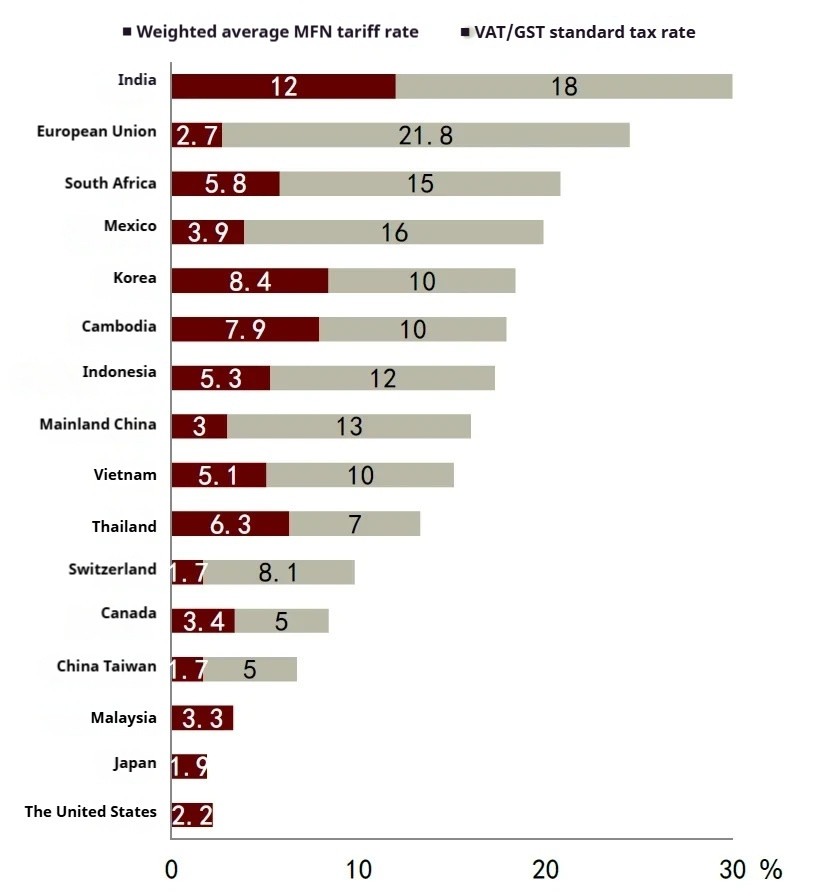
Source: https://www.dits.deloitte.com/#DomesticRatesSubMenu, WTO, Research Department of China International Capital Corporation.
2. How high will the tariffs be?
According to research from CICC, there are a few possible scenarios:
- Baseline case: Tariffs jump from 2.4% to 16.3%, factoring in VAT adjustments.
- Moderate case: Tariffs rise to 13.3% without VAT considerations.
- Extreme case: They hit 20.2%—the highest since the infamous 1930s Smoot-Hawley Tariff Act, which worsened the Great Depression.
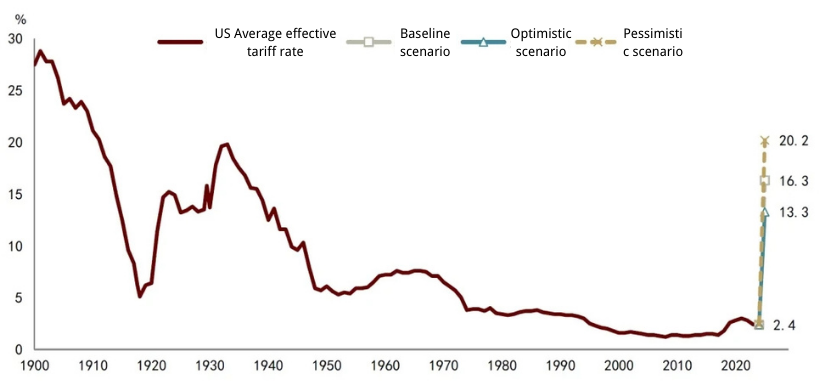
Sources: USITC, Wind, China International Capital Corporation Research Department.
3. Who gets exemptions?
While Trump has hinted at flexibility, his Treasury Secretary suggested the policy will target countries with large U.S. trade surpluses. That puts India, the EU, South Korea, and Mexico in the firing line. Interestingly, China might see a smaller impact since it's already facing steep U.S. tariffs.
What This Means for Markets
- Inflation is getting a boost
Higher tariffs mean pricier imports, and about half of that cost could hit American consumers. The baseline case suggests this could add 1.1 percentage points to PCE inflation—a headache for the Fed, which is already juggling rate cut decisions.
- GDP growth takes a hit
Tariffs disrupt trade efficiency and supply chains. The baseline scenario could shave 0.8 percentage points off U.S. GDP growth, while the extreme case could push it down by 1%. A stronger dollar might soften the blow, but if it weakens, expect deeper economic pain.
- Negotiation tool or economic drag?
Trump’s playbook is clear—tariffs as leverage to extract trade concessions. It’s already working—Hyundai just pledged $21 billion in U.S. investments after his auto tariff threat. But will this strategy genuinely boost American industry, or will it fuel inflation without fixing trade imbalances?
According to CICC’s research, assuming 50% of tariff costs are passed on to U.S. consumers, the economic impact of the tariffs on the U.S. economy is as follows:

Wildcard: The Dollar
The strength of the U.S. dollar could either mitigate or amplify the effects of these tariffs, making currency fluctuations an important factor to watch. If the USD strengthens by 5%, inflation and GDP drag soften (e.g., baseline → +0.7% PCE, -0.5% GDP). If the USD weakens, pain intensifies.
My Take
While these protectionist measures might offer short-term relief for some U.S. industries, the long-term effects could be damaging. Increased tariffs tend to trigger retaliatory actions, leading to higher prices and disrupted supply chains. This creates uncertainty for investors and risks the overall health of the U.S. economy.
If this turns into a trade war, markets will react negatively—especially with inflation concerns. The best-case scenario is Trump using tariffs as leverage for better trade deals, while the worst-case scenario is higher prices and stagnated growth.
Countries like Canada, Mexico, and the EU are already opposing these measures, signaling potential risks to long-standing trade agreements. This is more than just a tariff battle—it’s a shift in trade policy that could reshape global economic relations. Whether diplomacy can resolve this or we’re heading into a prolonged trade war remains to be seen. #trump
#Trump’s Tariff Play vs. Powell’s Patience#trump