
The Era of AI: Chinese Descent Executives' Historical Struggle Against Indians in Silicon Valley Comes to an End - Part 1
Part 1 — Today's Mainstay
14 days after taking office, Lip-Bu Tan made his first public appearance as Intel's CEO at the Intel Vision 2025 event, delivering a 30-minute speech that conveyed his determination to revitalize the veteran chip giant. He announced plans to divest non-core assets and bet on AI chips and foundry business.
With this, the "decision-makers" of the four major U.S. chip giants - NVIDIA, AMD, Broadcom, and Intel - are now all of Chinese descent. The influence and voice of Chinese descent in Silicon Valley have reached an unprecedented peak.
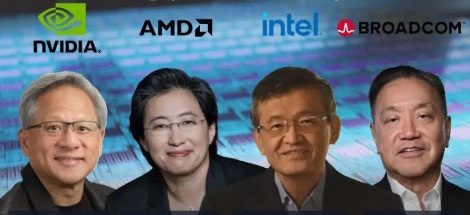
As Chinese descent CEOs rise, the power structure in Silicon Valley, once dominated by Indian CEOs, is undergoing a new change.
The milestone event of Indians taking control in Silicon Valley occurred in 2014 when 46-year-old Satya Nadella succeeded Steve Ballmer to lead Microsoft, becoming the first Indian CEO to lead a global tech giant. In fact, when Nadella took over Microsoft, Indian CEOs already occupied one-third of the top positions in Silicon Valley tech giants.
The rise of Indian CEOs to the power center of Silicon Valley is both a compound interest of time and a footnote of the era.
Since the 1980s, Indian engineers who entered Silicon Valley as technical immigrants started as entry-level programmers and gradually rose to middle and senior management positions, beginning to lead key company projects.
In 2014, during the overlap of the mobile internet boom and cloud computing transformation, Indian executives who had been lying low in key positions for years welcomed a historic opportunity. Nadella had been deeply involved in cloud services for nine years before taking the helm at Microsoft; Pichai built Google's billion-user ecosystem through the Chrome browser; and Arvind Krishna laid the foundation for hybrid cloud by leading IBM's acquisition of Red Hat.
At that time, Chinese descent engineers were still trapped in the stereotype of being a "model minority." An InfoQ survey showed that over 78% of Chinese descent professionals in Silicon Valley were stagnant at the technical backbone level.
The advent of the AI era has rewritten this situation. Chip companies like NVIDIA and AMD, once on the periphery of the industry chain, have become the mainstay of global AI computing power, giving Chinese descent CEOs the opportunity to enter Silicon Valley's inner circle.
Jensen Huang's experience illustrates this change. In the early days of his entrepreneurship, Huang traveled around selling chips, meeting with Microsoft daily to seek opportunities, and even stood beside Lei Jun, shouting "I'm a Mi fan too!" in Chinese to seek long-term cooperation.
Now, in the fever of the AI arms race, tech giants like Microsoft, Google, Meta, Amazon, and Tesla are rushing to "make friends" with Huang, just to gain priority supply rights for NVIDIA chips.
Lisa Su of AMD and Hock Tan of Broadcom have also become "honored guests" of Silicon Valley tech giants. Last June, Microsoft CEO Nadella personally endorsed Su's launch of the AMD Ryzen AI 300 chip, with Microsoft believing the chip's performance exceeds the requirements for Copilot+PC.
In this round of AI revolution, another very obvious trend is that beyond CEOs, the proportion of Chinese among engineers and entrepreneurs in Silicon Valley is also reaching new highs.
Chinese are increasingly becoming an important force in reshaping the power structure of Silicon Valley.