
Trump's Reciprocal Tariff Calculation Method Exposed: Simplistic and Breaking Promises

Trump's reciprocal tariffs officially took effect on Wednesday local time. According to the White House, these tariffs should be based on other countries' tariffs and trade barriers. However, calculations reveal that the Trump administration's method for determining the new round of tariffs is primarily based on existing trade deficits.
The Office of the U.S. Trade Representative (USTR) released a statement late Wednesday detailing the formula for calculating reciprocal tariffs.
At first glance, the formula appears complex, but the USTR helpfully explained that the product of the two parameters ε and φ is 1. This means the calculation method is actually very simple: divide a country's trade surplus with the U.S. by its total exports to the U.S., then divide that ratio by 2 to obtain the corresponding reciprocal tariff rate.

For example, with Japan, the total value of U.S. imports from Japan in 2024 is approximately $148.2 billion, with a trade deficit of $68.5 billion. Dividing the U.S. trade deficit with Japan by the total import value yields 46.2%. The White House announced a 24% reciprocal tariff rate for Japan on Wednesday, roughly half of this figure.
For countries with which the U.S. has a trade deficit, Trump imposes a uniform 10% tariff, such as on the UK, Australia, and Brazil.
The USTR stated that while it's technically possible to calculate actual trade barriers for each country, this method achieves Trump's goal of reducing trade deficits.
"While calculating the impact of thousands of tariffs, regulations, taxes, and other policies on trade deficits for each country is complex and nearly impossible, their combined effect can be approximated by calculating a tariff level consistent with reducing bilateral trade deficits to zero," the USTR said.
However, this approach doesn't align with the Trump administration's initial promises. According to the White House statement in February, reciprocal tariffs would be customized for each trading partner based on five different aspects: their tariffs on U.S. products, unfair taxes, costs imposed on U.S. businesses and consumers by their policies, currency situations, and any other unfair trade practices identified by the USTR.
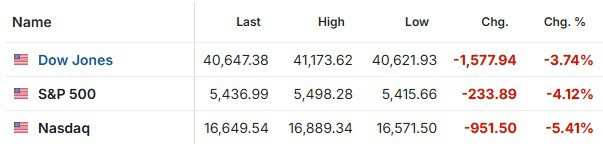
Today's sharp decline in the U.S. stock market at opening is Wall Street's response to Trump's announcement of reciprocal tariffs.