
Mastering Private Market Asset Allocation: Balancing Risk, Return, and Liquidity

Kevin Insights
April 4, 2025
GoGPT Summarizes Articles

In institutional investing, asset allocation is often cited as the primary driver of long-term portfolio performance. While public market investors rely on well-established allocation models, private market investors face a more complex challenge: constructing a resilient allocation strategy amid liquidity constraints, valuation uncertainties, and extended investment horizons.
For limited partners (LPs), private capital allocation is not just about selecting top-performing funds—it requires a structured approach to balancing risk, return, and diversification. This article explores the core principles of effective private market asset allocation, common strategies employed by institutional investors, and key considerations for optimizing portfolio construction.
Defining the Role of Private Capital in a Portfolio
Before allocating to private markets, investors must determine their strategic objectives. Private market investments typically serve one or more of the following roles:
-
Enhancing long-term returns: Private equity has historically outperformed public markets, albeit with higher illiquidity risks.
-
Diversification: Private assets often exhibit low correlation with traditional asset classes, reducing overall portfolio volatility.
-
Income generation: Private debt and infrastructure investments can provide stable cash flows, particularly in a low-yield environment.
-
Inflation protection: Real assets, such as real estate and infrastructure, serve as a hedge against inflationary pressures.
Institutional investors tailor their allocations based on these factors, balancing liquidity needs with return expectations. The challenge lies in structuring a portfolio that optimizes these benefits while managing risks inherent to private investments.
Key Considerations in Private Market Allocation
Unlike public markets, private investments demand long-term capital commitments, making allocation decisions critical. Three key factors influence private market allocation strategies:
1. Liquidity Management
Private assets are inherently illiquid, requiring investors to carefully balance their exposure. A well-structured allocation strategy includes:
-
Liquidity buffers: Maintaining an allocation to liquid assets to meet short-term obligations.
-
Secondary market planning: Considering exit strategies through secondary sales in case of unexpected liquidity needs.
-
Vintage year diversification: Staggering commitments across different fund vintages to smooth capital calls and distributions over time.
2. Diversification Within Private Markets
While private markets offer diversification from public assets, internal diversification is equally important. A well-structured portfolio should allocate across:
-
Asset classes: Private equity, private debt, real estate, infrastructure, and venture capital.
-
Geographies: Developed and emerging markets, considering regional economic cycles.
-
Investment strategies: Buyouts, growth equity, distressed investments, and credit strategies.
Overconcentration in a single asset class or region can expose investors to idiosyncratic risks, particularly in cyclical downturns.
For example, while venture capital outperformed private debt over the long term (Fig. 1), private debt funds outperformed venture capital funds post-pandemic (Fig. 2). Investors who concentrated too heavily in venture capital in 2021 would have faced significant underperformance.
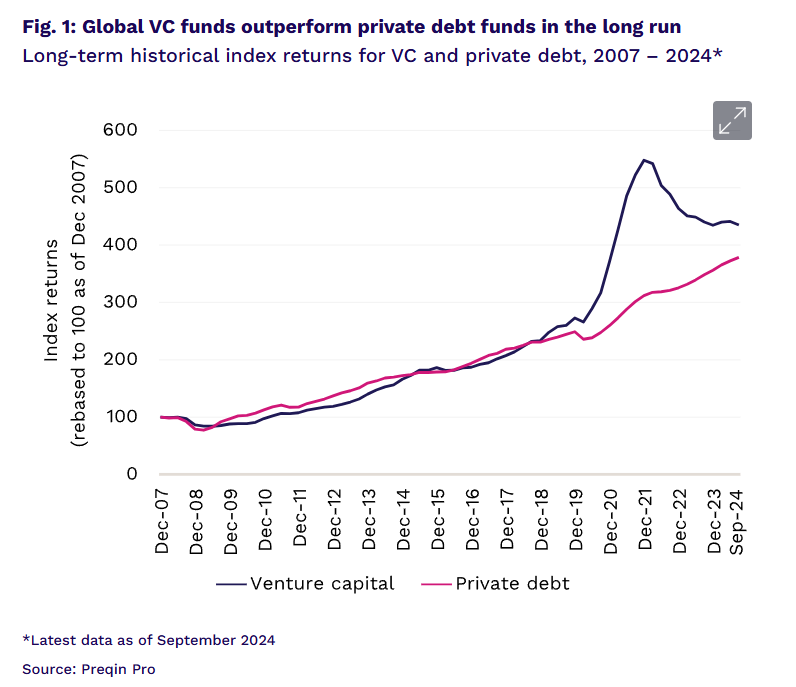
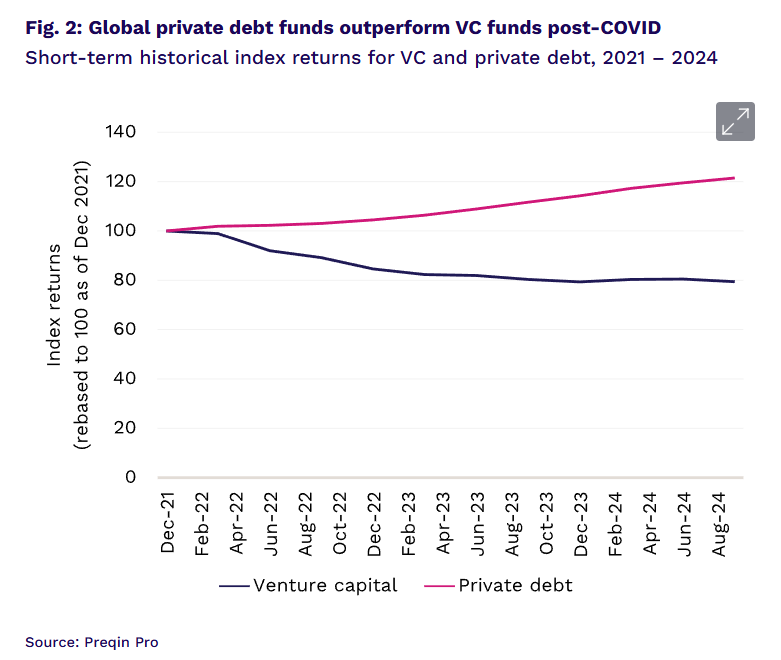
By analyzing different time periods, strategies, and regional investment performance, investors can better assess the true risk profile of each asset class and adjust allocation strategies accordingly.
3. Manager Selection and Performance Dispersion
A defining characteristic of private markets is the wide dispersion of returns across managers. Unlike public equity indices, where performance tends to cluster, top-quartile private funds significantly outperform their peers. Selecting the right managers is just as important as determining allocation size.
Key factors in manager selection include:
-
Track record consistency across market cycles.
-
Sector expertise and value creation strategies.
-
Alignment of interest between the GP and LPs.
-
Fee structures and net return expectations.
Approaches to Private Market Asset Allocation
Institutional investors employ different allocation models depending on their risk tolerance, investment horizon, and return objectives. The three most common approaches are:
1. Core-Satellite Strategy
A balanced approach that combines stable, income-generating assets (core) with higher-risk, higher-return investments (satellite).
-
Core Allocation: Established private equity funds, private credit, core real estate.
-
Satellite Allocation: Venture capital, opportunistic real estate, distressed debt.
Example: A pension fund allocating 60% of its private market exposure to buyouts and private credit, while reserving 40% for venture capital and special situations.
2. Benchmark-Based Allocation
Some investors allocate capital in line with market benchmarks, such as Cambridge Associates’ Private Equity Index or Burgiss Private Capital Index. This approach provides diversified exposure to market trends and reduces the risk of overweighting specific strategies.
A typical benchmark-driven allocation for private equity might look like:
-
50% Buyout
-
20% Growth Equity
-
20% Venture Capital
-
10% Distressed/Special Situations
3. Opportunistic and Bottom-Up Approach
Rather than adhering to fixed allocation targets, some investors adopt a bottom-up approach, selecting investments based on emerging opportunities. This is particularly relevant for:
-
Family offices seeking high-conviction bets.
-
Sovereign wealth funds with flexibility to adapt to changing market conditions.
-
Investors targeting dislocations, such as distressed assets during downturns.
The downside of this approach is higher volatility and reliance on active decision-making, but it can generate excess returns in inefficient markets.
Balancing Risk and Return in Private Market Portfolios
Private market allocation is not static—it requires ongoing monitoring and rebalancing based on market conditions and portfolio performance. Best practices include:
-
Periodic stress testing to assess liquidity risks in downturns.
-
Adjusting allocation targets based on macroeconomic trends.
-
Utilizing secondaries strategically to optimize liquidity and portfolio construction.
A well-designed private market allocation strategy provides stability, return enhancement, and diversification—but only when executed with disciplined capital planning and robust risk management.
Final Thoughts
Institutional investors today face a dynamic investment landscape, with rising interest rates, economic uncertainty, and evolving market structures reshaping private capital markets. Effective asset allocation in private markets is not just about targeting returns—it’s about constructing a resilient portfolio that balances liquidity, diversification, and manager selection.
As capital commitments extend over decades, success in private market investing hinges on a structured yet flexible approach. Investors who master this balance will be best positioned to navigate uncertainty and capture long-term value.
#Private Market: Unlocking Potential#privatemarket#assetallocation