
Global Highlights This Week: An Epic Trade War Ignites, and the Global Financial Markets Prepare for More Turbulence

Magical Investor
April 6, 2025
GoGPT Summarizes Articles
After Trump announced comprehensive tariff hikes on trading partners, and multiple countries subsequently introduced countermeasures, an epic trade war has officially broken out. The global financial markets have witnessed a “calamity,” leaving investors with almost nowhere to escape, and this might just be the beginning.
The sudden escalation of the trade war has intensified market sell-offs. The Nasdaq Composite Index has dropped by 20% from its peak and entered the bear market territory.
The tariff turmoil caused a record loss of $6.6 trillion in the market value of the U.S. stock market during the two trading days last week. Meanwhile, the oil price has plummeted to its lowest level in nearly four years, and the safe-haven gold has also retreated from its historical high.
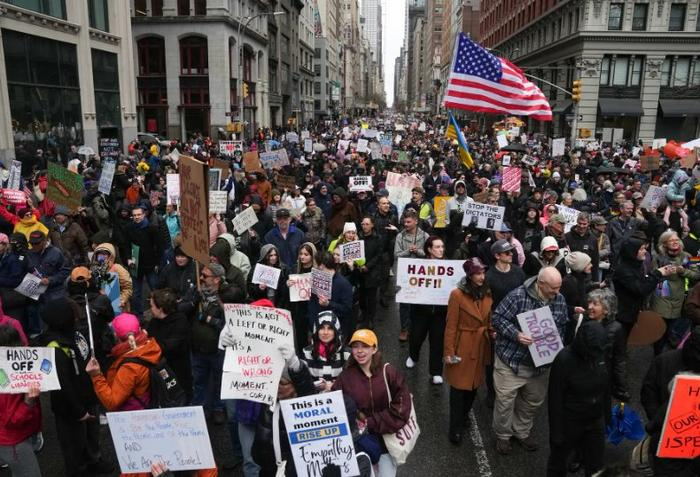
Currently, Trump's 10% global benchmark tariff rate has officially taken effect, and the more impactful reciprocal tariffs will come into force in the early morning of April 9th, Eastern Time in the United States. This is likely to lead to even more drastic market fluctuations.
Jeffrey Palma, Head of Multi-Asset Solutions at Cohen & Steers, believes that the strategies for dealing with tariffs are extremely unclear for everyone. Trump's tariffs and retaliatory measures have made things even more complicated, and no one knows what the final outcome will be.
Analysts point out that Trump's tariffs have created the highest trade barriers in more than a century, which will have a significant impact on the economies of the United States and the world. China has launched a counterattack against Trump's tariff measures, imposing a 34% tariff on all goods imported from the United States.
This has led traders to lower their expectations for the economy and earnings. Analysts at JPMorgan Chase raised the probability of a global economic recession to 60% last Thursday.
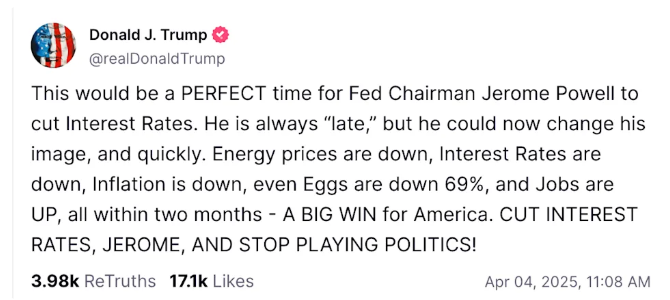
Some investors still hold out hope that Trump will negotiate agreements with some countries in the next few days and cancel some tariffs. However, most people doubt whether Trump will make any concessions. Trump posted on Truth Social last Friday that his “policies will never change.”
Scott Chronert, a strategist at Citigroup, pointed out that although Trump has the opportunity to change course, they are clearly aware that the window of opportunity is narrowing. Regardless of the final negotiation outcome, consumer and business confidence has already been somewhat damaged.
A pessimistic sign is that the Wall Street fear gauge, the VIX index, soared by 46% to 45.31 last Friday, reaching its highest closing level since April 2020. In addition, a survey by the American Association of Individual Investors showed that the bearish sentiment towards U.S. stocks has reached 61.9%, the highest level since the 2009 financial crisis.
Due to the shadow cast by tariffs on the outlook, investors are cautious about corporate earnings forecasts. The Q1 earnings season for U.S. stocks kicks off this week, and bank stocks such as JPMorgan Chase, Wells Fargo, Morgan Stanley, and BlackRock will be the first to release their earnings reports.$JPM $WFC
Strategists at RBC Capital Markets said in a report, “Currently, we see a lot of uncertainties in the earnings outlook.” They lowered their earnings expectations for the S&P 500 index in 2025 in the report.
This Thursday's CPI report can provide a reference point to help us understand what the inflation level in the United States was before the implementation of the tariff policy.
Even if this inflation report is better than expected, it may be ignored by the market, just like last week's non-farm payrolls data.
After the announcement of the tariff policy, traders have increased their bets on interest rate cuts this year. They believe that the Federal Reserve will have to take action to boost the economy. According to data from the CME Group, the market expects the Federal Reserve to start making substantial interest rate cuts in June, and by the end of this year, the Federal Reserve will cut interest rates by at least 100 basis points.
However, Federal Reserve Chairman Jerome Powell said last Friday that Trump's tariffs will drive up inflation and reduce economic growth, but it is “too early” to adjust monetary policy at present.
Analyst Palma pointed out that it is crucial for the market to show some stability in the next few days. “We have just experienced two extremely turbulent trading days. The last thing we want to see is that this kind of severe volatility starts to trigger a vicious cycle, thereby undermining the stability of the entire financial system.”
Some analysts also believe that this calamity in the market may just be the beginning. If the largest-scale tariff actions in the United States since the 1950s lead to an economic contraction, there is still a large room for the U.S. stock market and U.S. Treasury bond yields to decline.
Overview of Important Events This Week:
- Monday: Germany's Seasonally Adjusted Trade Balance in February, the UK's Halifax Seasonally Adjusted House Price Index Monthly Rate in March, the Eurozone's Sentix Investor Confidence Index in April, and the Eurozone's Retail Sales Monthly Rate in February.
- Tuesday : Japan's Trade Balance in February, France's Trade Balance in February, the U.S. NFIB Small Business Optimism Index in March.
- Wednesday : U.S. API Crude Oil Inventories for the Week Ended April 4th, the Reserve Bank of New Zealand's Interest Rate Decision as of April 9th, the U.S. Wholesale Sales Monthly Rate in February, U.S. EIA Crude Oil Inventories for the Week Ended April 4th, U.S. EIA Strategic Petroleum Reserve Inventories for the Week Ended April 4th, San Francisco Fed President Mary Daly gives a speech, Reserve Bank of New Zealand Governor Adrian Orr holds a monetary policy press conference, and Bank of Japan Governor Kazuo Ueda gives a speech.
- Thursday: U.S. 10-Year Treasury Note Auction as of April 9th, China's CPI Annual Rate in March, the U.S. Unadjusted CPI Annual Rate in March, the U.S. Seasonally Adjusted CPI Monthly Rate in March, the U.S. Seasonally Adjusted Core CPI Monthly Rate in March, Initial Jobless Claims in the United States for the Week Ended April 5th, China's M2 Money Supply Annual Rate in March, the Federal Reserve releases the minutes of its March monetary policy meeting, and Reserve Bank of Australia Governor Michele Bullock gives a speech.
- Friday: Germany's Final CPI Monthly Rate in March, the UK's Three-Month GDP Monthly Rate in February, the UK's Seasonally Adjusted Goods Trade Balance in February, the U.S. PPI Annual Rate in March, the U.S. PPI Monthly Rate in March, the U.S. Initial One-Year Inflation Rate Expectation in April, the University of Michigan Consumer Sentiment Index Preliminary Reading in April, Chicago Fed President Austan Goolsbee gives a speech at the Economic Club of New York, European Central Bank President Christine Lagarde gives a speech at a press conference of the Eurogroup, and New York Fed President John Williams gives a speech on the economic outlook and monetary policy.
#$JPMorgan Chase & Co.(JPM)#$Wells Fargo & Co.(WFC)