
The Monetary Authority of Singapore plans to open up private equity fund investments to retail investors

Magical Investor
April 6, 2025
GoGPT Summarizes Articles
Recently, the Monetary Authority of Singapore (MAS) announced a major policy: it plans to relax the restrictions on retail investors' investments in private equity funds.
This measure will bring new opportunities for wealth appreciation to a large number of investors and also means that the private equity market will witness higher levels of activity.
what exactly does this policy mean? Let's briefly discuss it today.
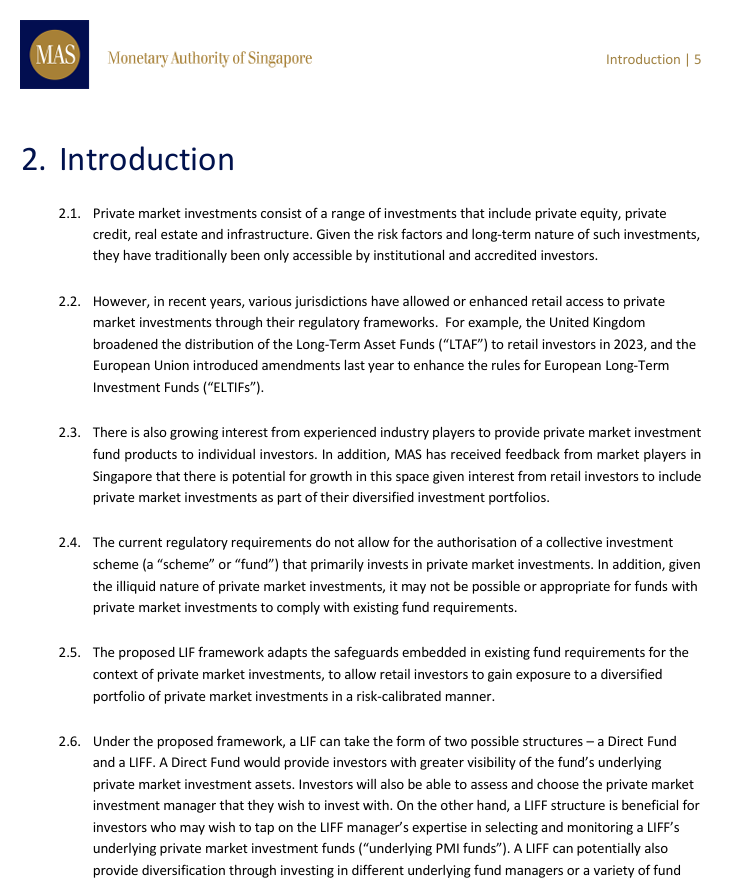
According to the current draft for public consultation, the MAS hopes that "retail investors" can participate in private equity market investments through "authorised long-term investment funds". After research and analysis, we can understand the nature of such funds as "recorded funds" that meet certain "retail listing" standards.
The MAS has proposed two types of fund structures to meet the preferences of different investors. The first type is the LIF, which is a direct investment fund, and the other is the fund of funds (LIFF), through which "retail investors" can participate in the private equity market.
For both the direct investment fund (LIF) and the fund of funds (LIFF), the MAS is considering setting standards from three major dimensions: fund managers, products, and disclosure requirements.
However, regarding the specific threshold indicators or requirements, the MAS has not provided very clear standards at present. Instead, it has chosen to pose questions to the public, analyze the pros and cons, and listen to subsequent feedback from the industry.
For example, for the direct investment fund (LIF), regulatory requirements state that the fund manager should have sufficient professional knowledge and experience, a track record (such as using the assets under management (AUM) as a threshold indicator), and should be a Retail Licensed Fund Management Company (Retail LFMC).
At the product level, the regulator is also seeking opinions from the outside world, such as the minimum proportion of the fund manager's contribution to the fund (Is there a need to set a minimum requirement?), whether there should be a certain proportion of institutional funds (smart money, which is equivalent to the "endorsement" of professional institutional investors) in the direct investment fund, the investment scope of the direct investment fund (such as whether there should be certain restrictions on project valuation and minimum revenue (to control risks), prohibited investment areas, etc.), and project concentration limits. In terms of information disclosure, risk warnings, prospectuses, and regular reports are required.
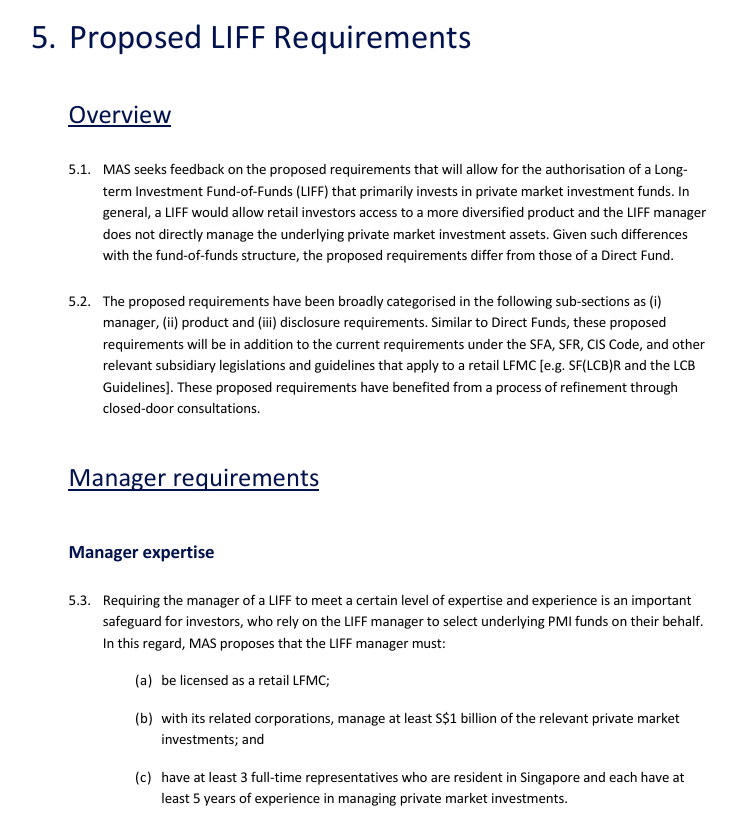
For the fund of funds (LIFF), the regulatory framework is more explicit compared to the direct investment fund. For example, in terms of the fund manager, the manager must be a Retail Licensed Fund Management Company (Retail LFMC), manage at least S$1 billion (including affiliated institutions), have at least three full-time employees residing in Singapore, and each person should have at least five years of private equity investment experience.
In addition, at the product level, the regulator is also seeking opinions from the outside world, such as whether the fund manager of the fund of funds (LIFF) can co-invest with the fund of funds (LIFF), whether the fund manager of the fund of funds should contribute to the fund and the minimum contribution proportion requirement, whether there should be a certain proportion of institutional funds (smart money) in the fund of funds (LIFF) and the minimum proportion, the concentration limits of the fund of funds, and investment restrictions. In terms of information disclosure, the fund of funds (LIFF) needs to be independently valued at least once a year, and risk warnings, prospectuses, and regular reports are required.
Regarding the liquidity issue of the funds, the MAS seems to have also referred to the trends in the UK and the US. For the direct investment fund (LIF), the regulator is considering requiring the fund to offer a certain ratio of redemption quotas to "retail investors" every year.
For the LIFF, the regulatory framework is more explicit. It is considered that the fund should allow its "retail investors" at least one redemption opportunity every year and provide a redemption quota of at least 10% of the fund's total assets each year (that is, the annual redemption limit of the fund is 10%, and it can be 5% for semi-annual redemptions).
In this framework document, there is no proposal for a minimum investment threshold for "retail investors" because in Singapore, when a Retail Licensed Fund Management Company issues a private equity investment fund, there are no restrictions on "qualified investors" for investors, and the fund manager/fund manager can set the minimum subscription amount by themselves.
Also according to this framework document, the MAS stated that "The MAS aims to achieve a good balance between regulation and product diversity through the proposed framework and provide a strong and sustainable market for retail private equity investment funds.
This framework seeks to provide "retail investors" with a wider range of investment options while exploring the possibility of allowing private equity investment funds to be "listed" on the exchange."
In my opinion, to some extent, the regulatory framework proposed by the MAS this time is precisely a major measure that combines the current widely expected rapid expansion of the private equity investment market, the increasingly mature and widespread "retail" private equity fund products in the UK and the US, and also takes into account the previous initiative of the Securities and Futures Commission of Hong Kong to facilitate the listing of "closed-end alternative asset funds" on the Stock Exchange of Hong Kong.
#Private Market: Unlocking Potential