
Trump's "Wild Chess Move": Is Market Turmoil a Calculated Plan? Let's Dive In

This week, global markets took a nosedive. Why? Well, the Trump administration announced retaliatory tariffs. The $SPX and European indices dropped by over 5%. AJ Bell analysts reckon around $4.9 trillion in global equity value just vanished. And the FT reported that U.S. stocks alone lost $5.9 trillion in just two days.
Now, here's something really unexpected. President Trump shared a viral TikTok video that claims this market crash was actually intentional.
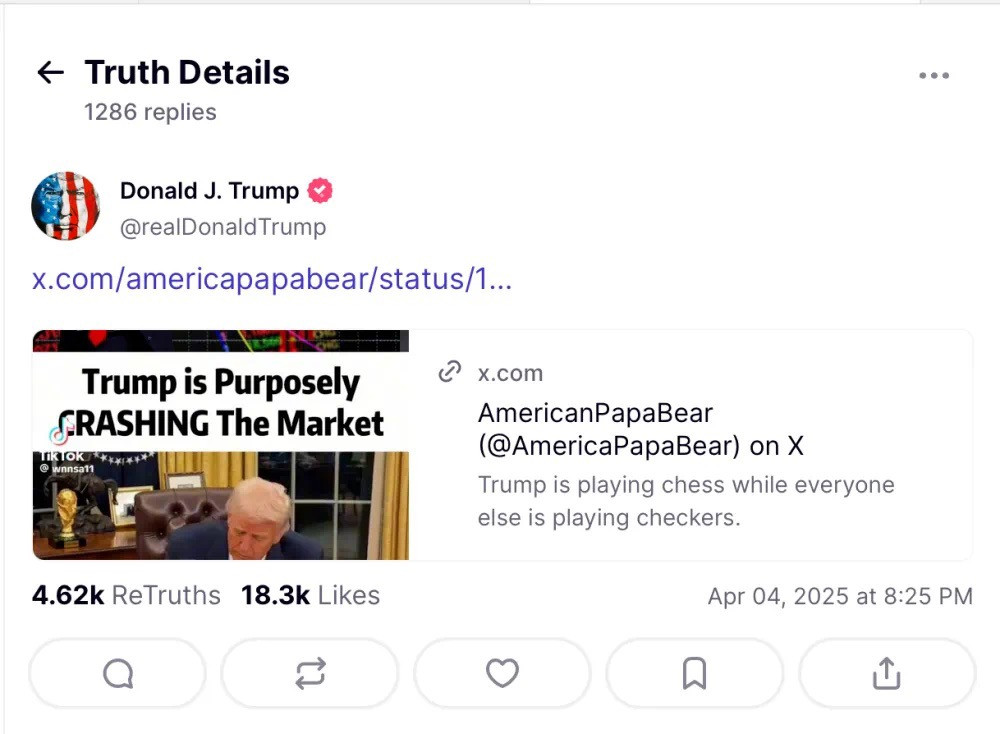
The video argues that tariffs will be good for middle-class Americans in several ways.
- First, it says tariffs will force companies to bring production back to the U.S.
- Second, it claims redirected agricultural sales will lower food prices.
- And third, as capital rushes to Treasuries, it will pressure the Fed to cut rates.
The video even says, "It’s a wild chess move, but it’s working," hinting at a strategic devaluation of the dollar and mortgage rates.
But hold on a second. I don't think it's that simple. Yale’s Budget Lab projects that tariffs could push U.S. inflation up by 2.3% in 2025. That means each household could be hit with an extra $3,800 a year because of rising food prices (up 2.8%) and auto prices (up 8.4%).
In my opinion, while Trump is trying to frame this as an "economic revolution," we really need to look closely at how this all works.
Take the rate cut gamble, for example. The video assumes that as stocks fall, the Fed will be forced to ease policy. But they're ignoring the stubborn 4.2% core PCE inflation. I think Powell and his team might be willing to let the market feel some pain rather than risk losing their credibility on price stability.
Then there are the dollar dynamics. A weaker dollar might seem like a good thing for bringing production back, but it could actually backfire. Imports will get more expensive, which could cancel out any benefits from tariffs driving reshoring. I'm keeping a close eye on whether the DXY breaks below 100 support; that could be a big deal.
When it comes to sector winners and losers, I think defense contractors, especially those with increased "Buy American" mandates, and mid-cap industrials with domestic supply chains could do well. On the other hand, I'd avoid multinational consumer staples like $PG and $KO. They're going to face margin compression because of currency and input cost pressures.
And don't forget about the protests. Nationwide demonstrations against Trump-Musk policies are adding a political risk premium.
This isn't like the random trade wars in 2018. It seems like Trump's team is ready to accept short-term market chaos to reset the long-term economic structure. If you're a trader, you might want to play the volatility. Consider structured products when the VIX spikes above 30. And if you're an investor, it makes sense to shift into inflation-resistant assets like TIPs and energy infrastructure and avoid sectors that are sensitive to duration until the Fed's May meeting gives us more clarity.
So, what are you going to do in this high-stakes game? Let's talk about it in the comments.