
Under Trump's tariff bludgeon, how much more turbulence will the global financial market face?How should we allocate our assets?

Magical Investor
April 7, 2025
GoGPT Summarizes Articles
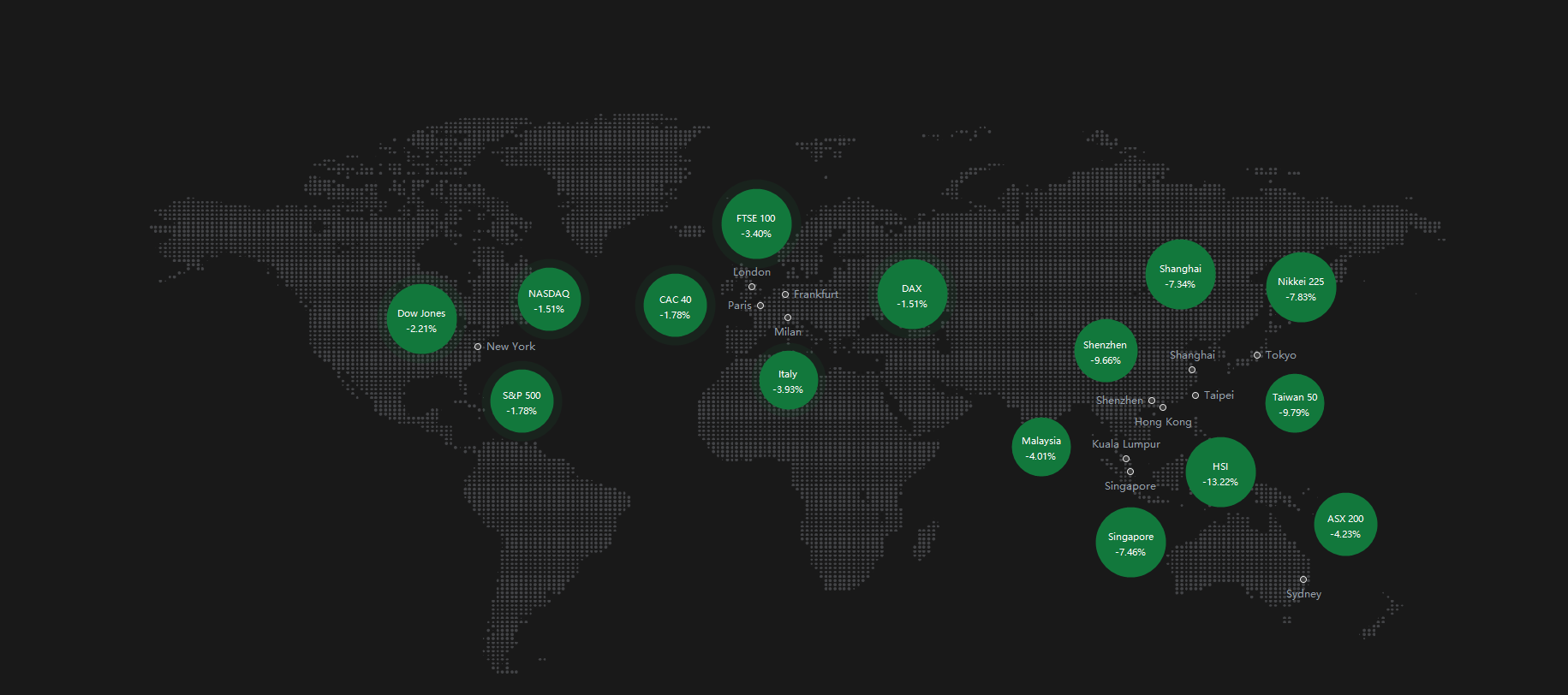
On April 7th, the U.S. tariff policy has shocked the global financial market. U.S. stocks continued to plunge. As of the time of writing, the Dow Jones Industrial Average was down 2.21%, the Nasdaq Composite Index was down 1.51%, and the S&P 500 Index was down 1.78%.
The S&P 500 Index has dropped 20% from its record high and is moving towards a technical bear market. Previously, the Nasdaq Composite Index entered a technical bear market, having fallen 25% from its peak.
In fact, I should have discussed the impact of Trump's tariff policy with you a long time ago, but I haven't had the time. Today, I finally have the opportunity to have a good discussion with you.
During the Asia-Pacific trading session today, many major Asia-Pacific stock indexes and stock index futures plummeted, and situations such as trading halts and circuit breakers even occurred.
U.S. stocks lost about $6.6 trillion in market value during the last two trading days of last week. After setting a historical record high, during today's Asia-Pacific trading session, the three major stock index futures continued to decline by 4% to 5%.
I believe that this tariff policy will have a profound impact on the global economic outlook and the trade pattern, and as investors, we need to adjust our investment layout accordingly.
The Global Economy under the Shockwave of Reciprocal Tariffs
Local time on April 2nd, the White House of the United States issued a statement saying that Trump declared a national emergency to enhance the United States' competitive edge, protect American sovereignty, and strengthen the United States' national and economic security.
At the same time, a series of Trump's tariffs came into effect at midnight on April 2nd. Note that this time the United States imposed tariffs ranging from 10% to 50% on all countries in the world. Although Canada is temporarily excluded, the 25% tariff on automobiles imposed by the United States is implemented globally, and Canada is not immune either.
Why has the global economy collapsed because of this tariff war?
The most fundamental reason lies in the fact that the tariff war has weakened the pricing power of the U.S. dollar, and global assets will be revalued.
Before the situation becomes clear, major capitals are all in a panic mood and can only flee first.
Trump's clear goal of the tariff war has been put forward, which is to zero out, or even reverse, the U.S. trade deficit. In the future, the United States will reduce the export of U.S. dollars and shift to exporting products.
Why is the United States the world's largest country with a trade deficit? The root cause is that the United States does not produce goods but produces U.S. dollars.
It sounds very good, but the side effects are great, and we won't go into details here. All in all, in the future, Americans will also enter factories, tighten screws, and manufacture iPhones.
Such an era will come soon. If the United States stops exporting U.S. dollars and switches to exporting goods, the U.S. dollar is bound to depreciate. Because a strong U.S. dollar is not conducive to exports. Therefore, all assets priced in U.S. dollars will face a deep revaluation.
Shehriyar Antia, the head of the Prudential's thematic research department, said: "The reality is far more complicated than it appears on the surface. Even if the United States expands the scope of its protected industries, about 80% of global trade still occurs outside the United States, and companies within major industries will still continue to pursue free trade and competitive advantages."
At the same time, some analysts said that this reciprocal tariff is the first wave of firepower launched by the Trump team in the global trade disputes, and it is reasonable to maximize the first move.
If the tariffs in the Asian region are not lowered, rebalancing will mean that a large amount of goods that would have been shipped to the United States will be transferred to other parts of the world. This will impose a huge burden on U.S. consumers and businesses, and the total demand is likely to decline. This undoubtedly increases the risk of stagflation in the United States.
And many trade diversion routes to the U.S. market - Vietnam, Cambodia, Laos, Thailand, Indonesia - will be affected by the tariffs. However, this is not the final result of the tariff policy, and it is expected that countries will start negotiations with the United States to reduce tariffs.
At the same time, I expect that central banks in Asia may cut interest rates by a larger margin than expected to support the fundamentals of economic growth.
Global Market Turbulence: How Should We Allocate Assets?
 Despite the challenging market background, we believe that there are still areas that can help withstand fluctuations, including gold and high-quality bonds.
I think high-quality bonds are very attractive. The market's expectations for growth may be lowered in the coming weeks, which will be beneficial to high-quality bonds.
However, under the base case scenario, the attractiveness of bonds will come more from helping to diversify the investment portfolio rather than the prospects of absolute returns.
At the same time, I also expect that the price of gold may reach $3,200 per ounce by the end of the year.
If the risks related to tariffs or geopolitical risks rise, that is, under the upside scenario, the price of gold may even reach $3,500 per ounce.
In the long run, from the perspective of diversification, maintaining a gold allocation of about 5% in a U.S. dollar-balanced investment portfolio is the best choice.
It should be noted that since the announcement of the reciprocal tariffs, the U.S. dollar has weakened significantly. Taken alone, tariffs are beneficial to the U.S. dollar, and traditionally the U.S. dollar also rises when risk aversion increases.
However, the tariffs on Mexico and Canada being lower than expected, the market's downward adjustment of expectations for U.S. economic growth and interest rates being greater than in other regions, investors starting to factor in potential countermeasures from the European Union and other major economies, and political uncertainties causing more funds to seek asset diversification outside the U.S. dollar, all these factors will weaken the safe-haven demand for the U.S. dollar.
With the offsetting of positive and negative factors, the U.S. dollar is expected to trade in a range in the coming months. If the downside risks to the growth outlook are accompanied by the Federal Reserve cutting interest rates more than expected, the U.S. dollar may weaken in the long term.
Finally, don't forget that in the short term, we also need to reduce our holdings of various stocks and keep sufficient cash on hand to deal with various emergencies.