
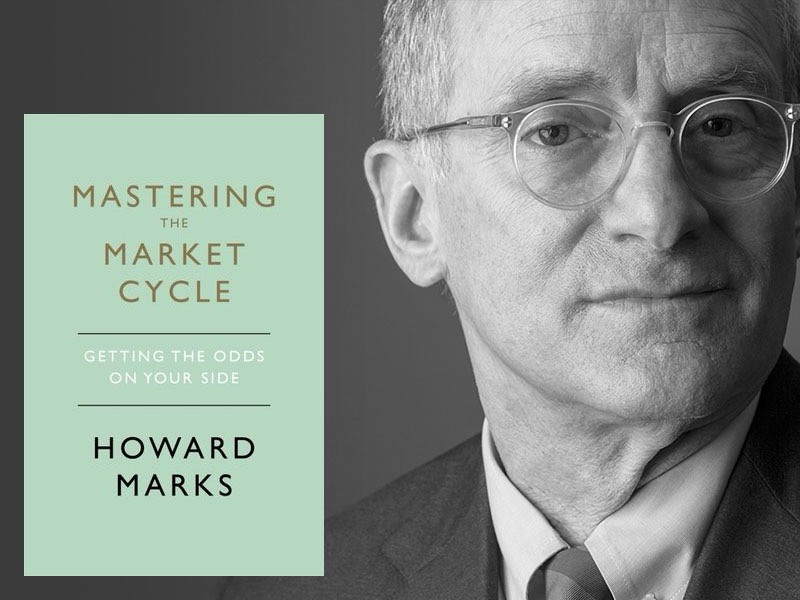
Howard Marks' Investment Philosophy in "Mastering the Market Cycle"

I. The Pendulum Theory: The Eternal Oscillation of Market Sentiment
In the investment world, there's an eternal truth: the market swings like a pendulum, forever oscillating between greed and fear. Howard Marks, founder of Oaktree Capital, in his book "Mastering the Market Cycle," uses the elegant metaphor of the "emotional pendulum" to reveal the essence of market fluctuations. He points out that investors' psychology and emotions are like a pendulum, rarely staying at the rational midpoint, but constantly swinging from one extreme to another—from excitement to depression, from optimism to pessimism, from risk appetite to risk aversion. This oscillation not only affects market prices but also shapes the ups and downs of economic cycles and corporate earnings.
Marks believes that the market's "normal level" is actually abnormal. Historical data shows that in his 47-year investment career, his annualized returns fell within the normal range (10% ± 2%) only three times. This implies that significant market fluctuations are not accidental, but the inevitable result of emotional drivers. For example, when economic data is favorable and corporate earnings are growing, investors often fall into collective euphoria, pushing stock prices far beyond fundamentals. Conversely, when negative events occur, panic emotions can trigger a selling spree, causing prices to plummet. This phenomenon is particularly evident in China's A-shares market, with the alternation of the 2015 bull market and stock market crash being a typical case of the emotional pendulum swinging violently.
II. Three Traps of the Emotional Cycle
Cognitive Bias: Over-interpretation and Selective Memory
Investors tend to overreact to positive or negative events. For instance, a Fed rate cut might be interpreted as a signal of economic recovery or as a warning of recession, depending on the prevailing market sentiment. Moreover, investors often selectively remember successful cases and ignore failed lessons, leading to the repetition of history.
Herd Mentality: The Vortex of Collective Irrationality
When the market rises, the fear of missing out prompts investors to rush in, forming a "herd effect." The 2020 GameStop frenzy among U.S. retail investors is an extreme manifestation of this psychology. Conversely, when the market falls, panic emotions can trigger a stampede of selling, further amplifying losses.
Valuation Anchoring: The Dangerous Game of Price Detaching from Value
During periods of high sentiment, investors are willing to pay a premium for "stories," leading to valuation bubbles. During low sentiment, they underestimate the intrinsic value of assets. For example, the PE ratio of the new energy sector once exceeded 100 times in 2022, while after the correction in 2022, some high-quality companies' valuations provided a margin of safety.
III. Contrarian Thinking: The Way to Survive Through Cycles
Facing the violent fluctuations of emotional cycles, Marks offers three core strategies:
Second-Level Thinking: Looking Beyond Consensus to See the Essence
Ordinary investors focus on "what is now," while exceptional investors consider "what most people think it is." For example, when the market unanimously expects a rise, contrarian investors are alert to potential risks; when the market is pessimistic, they look for undervalued opportunities. This thinking requires investors to make independent judgments, unswayed by short-term emotions.
Valuation Discipline: Using Rationality to Counter Impulse
Marks emphasizes that the core of investing is "buying quality assets at reasonable prices." During periods of high sentiment, one must strictly adhere to valuation discipline to avoid chasing high prices; during periods of low sentiment, one should dare to invest against the trend. For instance, during the 2008 financial crisis, Warren Buffett bought large quantities of financial stocks based on a deep understanding of the companies' intrinsic value.
Risk Control: Finding Certainty in Uncertainty
Investors should always prioritize risk control. Marks suggests reducing the impact of emotional fluctuations on decision-making through diversification, setting stop-loss points, etc. At the same time, one should be alert to "black swan" events and maintain adequate cash flow to deal with extreme situations.
IV. Conclusion: Dancing with Emotions, Not Being Devoured by Them
Howard Marks' theory of emotional cycles reveals a harsh reality: the market is always an amplifier of human weaknesses. However, it is precisely these fluctuations that create opportunities for rational investors to generate excess returns. As Marks says, "Exceptional investors are mature, rational, analytical, objective, and not swayed by emotions."
In a market full of uncertainties, only by understanding the patterns of emotional cycles, maintaining independent thinking, and adhering to valuation discipline can one navigate steadily through the volatility. The key to success lies in recognizing the emotional swings of the market and using them to one's advantage, rather than being controlled by them.
Marks' insights remind us that investing is not just about numbers and charts, but also about understanding human psychology and behavior. By mastering the art of emotional intelligence in investing, one can potentially turn market volatility from a threat into an opportunity.
In essence, the goal is to dance with market emotions – to be aware of them, to understand their influence, but not to be consumed by them. This approach allows investors to maintain a clear head when others are losing theirs, potentially leading to better decision-making and, ultimately, superior long-term returns.