
Introduction to Private Credit

Go Private Market Guide
April 10, 2025
GoGPT Summarizes Articles
Private credit (also known as private debt) is a financing method where specialized lenders outside traditional banks provide tailored loans to companies that cannot access standard bank financing. Unlike conventional bank loans—which follow fixed terms and are publicly accessible—private credit operates through customized agreements negotiated directly between borrowers and non-bank lenders. These loans are not traded on public markets and typically require repayment of the borrowed amount (principal) plus interest over a specific timeframe.
Over the past decade, the private credit market has experienced rapid growth as banks retreat from riskier lending segments, opening opportunities for specialized funds to fill the gap. For example, the asset class, as commonly measured, totaled nearly $1.5 trillion by the start of 2024, reflecting both the expanding appetite for yield and the evolution of credit strategies. Private credit managers are responsible for structuring a variety of loans—from senior secured facilities and unitranche loans to mezzanine debt—with an emphasis on robust underwriting and active monitoring.

Types of Private Credit
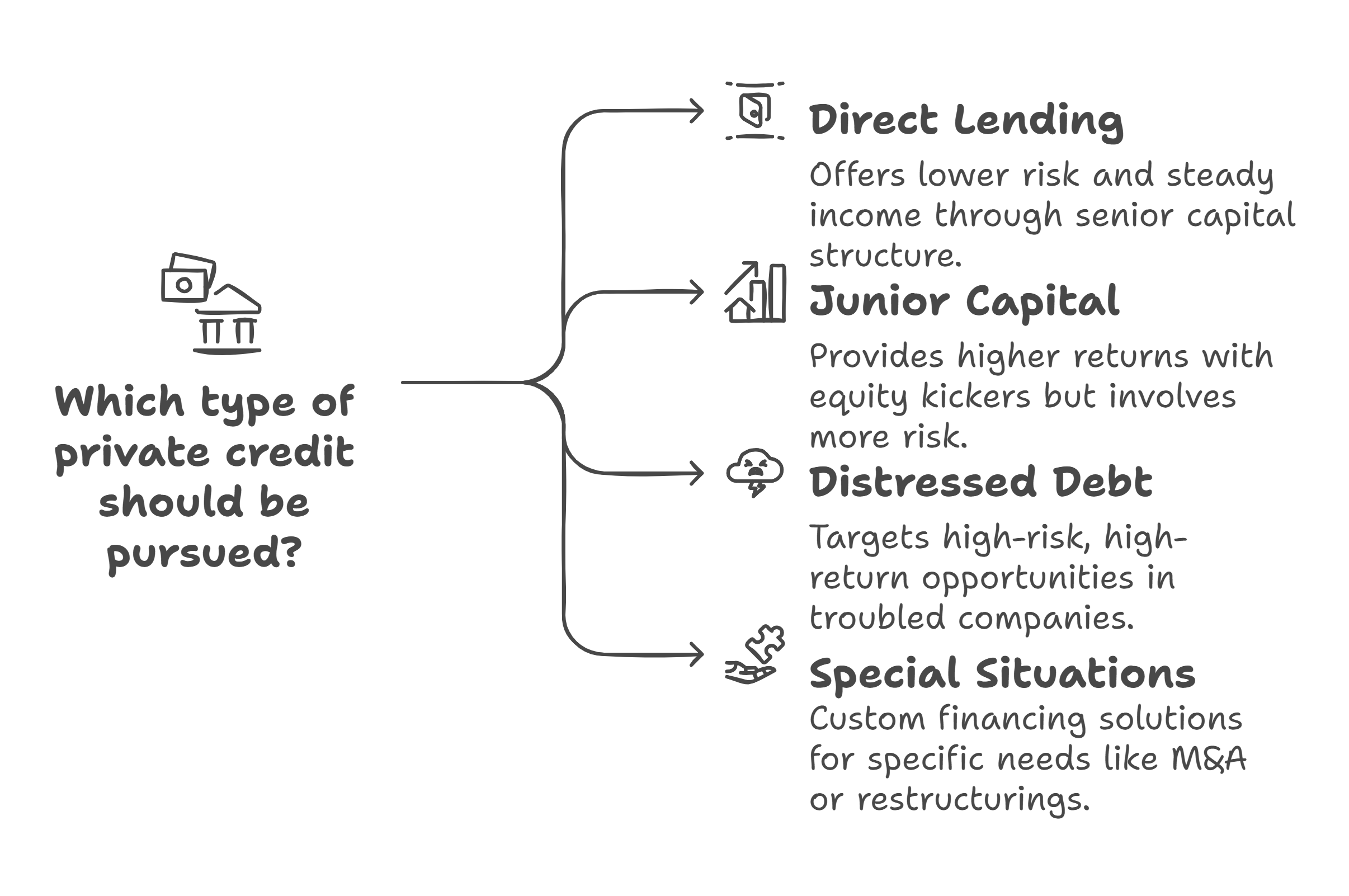
Private credit is a form of lending outside of the traditional banking system, where lenders negotiate and originate privately held loans not traded in public markets. Since the 2008 Global Financial Crisis, it has filled a lending gap left by banks. There are four commonly recognized types of private credit:
- Direct Lending: These strategies target private, non-investment-grade companies and typically invest in the most senior part of the capital structure through first-lien senior-secured loans, offering potentially steady income with lower risk.
-
Mezzanine, Second Lien Debt, and Preferred Equity: Known collectively as "junior capital," these instruments rank below senior loans and are usually unsecured. They often include equity kickers to enhance total return potential, balancing risk with potentially equity-like returns.
-
Distressed Debt: Targeting companies in financial distress, these strategies involve operational turnarounds and debt restructuring. They carry higher risk but offer the potential for outsized returns, especially during downturns.
-
Special Situations: These encompass complex, non-standard corporate events such as M&A activity, spinoffs, or restructurings that require tailored financing structures.
How Private Credit Works
-
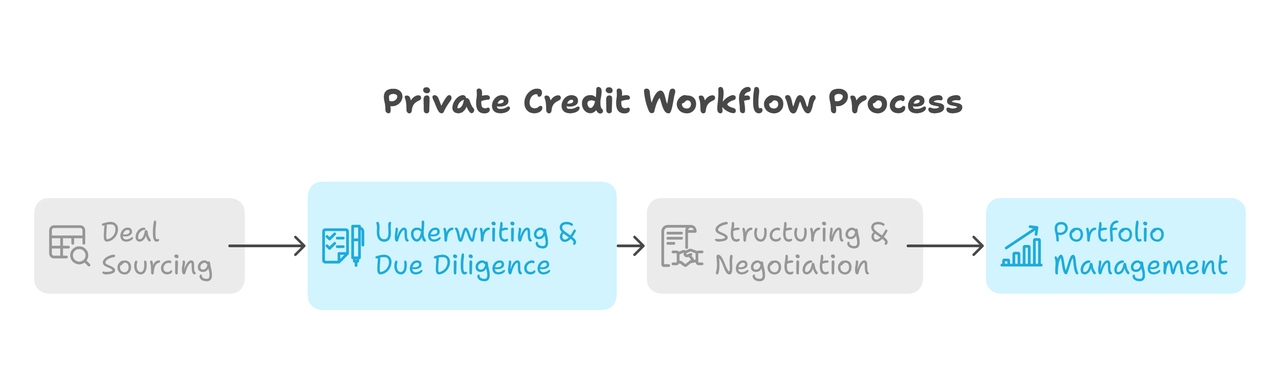
Deal Sourcing: Investment managers identify borrowers in niche segments such as mid-market companies, infrastructure projects, or emerging growth sectors. This process relies on deep market knowledge and extensive relationship building. Research notes that approximately 20% of the leveraged finance market—encompassing high-yield bonds and leveraged loans—is now attributable to private credit, with growth in the sector projected to persist in the years ahead.
-
Underwriting and Due Diligence: Managers conduct rigorous credit analyses and due diligence, evaluating borrower financials, industry trends, and potential risks. Customized metrics and stress testing are vital components of this process. According to research by the Federal Reserve, well-structured private credit transactions typically exhibit default rates below 5%, underlining the effectiveness of robust underwriting standards.
-
Structuring and Negotiation: Loans are structured with tailored terms, including covenants, collateral arrangements, and flexible repayment schedules to protect investor interests while meeting borrower needs.
-
Portfolio Management: Active monitoring, periodic reviews, and timely risk adjustments ensure the resilience of the portfolio amid changing market conditions. Managers may also implement workout strategies if borrowers encounter difficulties. Insights from ADDX reveal that active portfolio management in private credit funds has been a key driver of stable cash flows, even during economic downturns.
Advantages of Private Credit
-
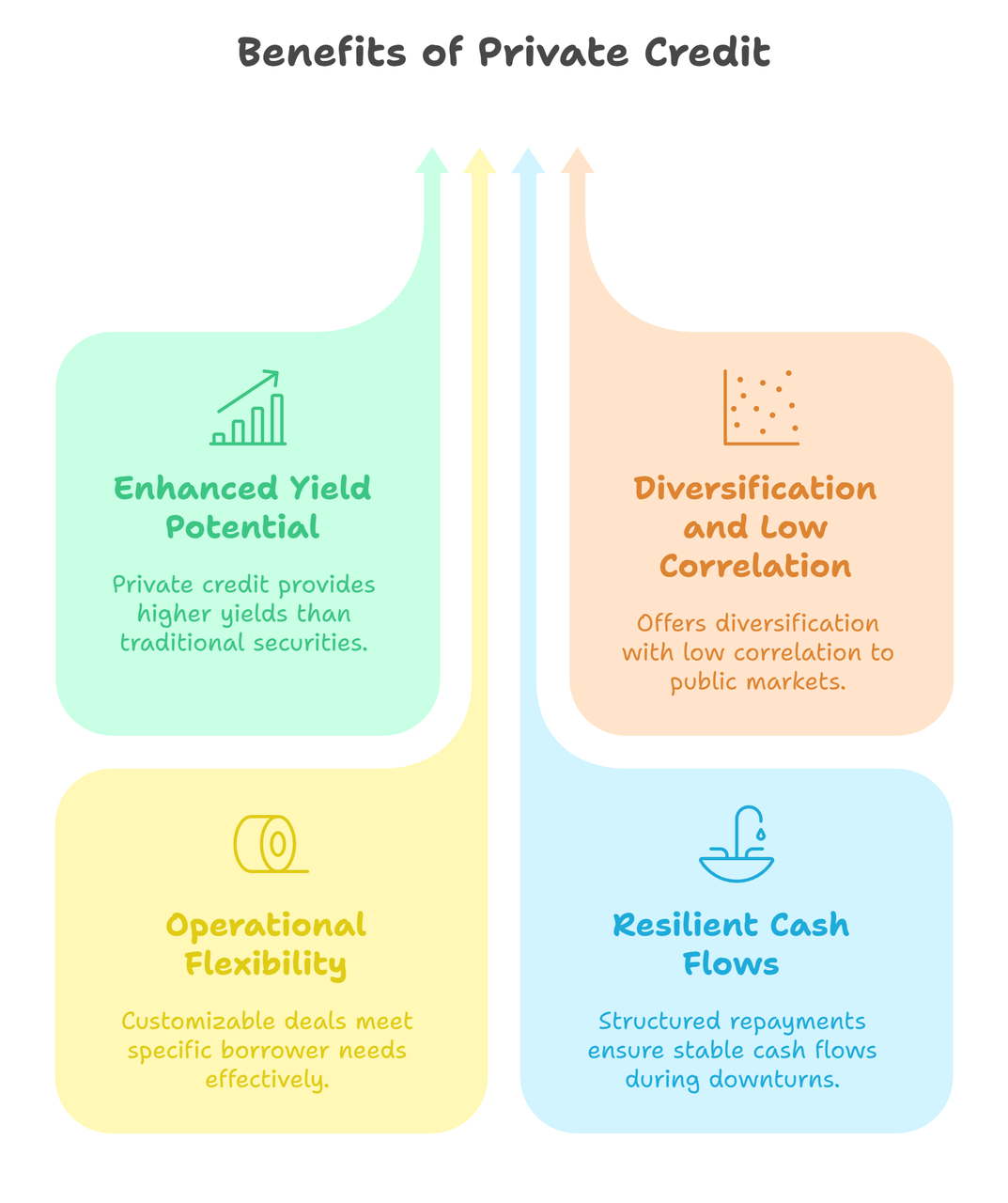
Enhanced Yield Potential: With bespoke deal structures and premium risk-adjusted returns, private credit often provides yields that can exceed those of traditional fixed-income securities. For instance, JP Morgan asset management data shows that private credit strategies have been able to offer returns significantly above conventional benchmarks.
-
Diversification and Low Correlation: Because private credit is less exposed to public market volatility, it offers diversification benefits within a broader investment portfolio.
-
Operational Flexibility: Unlike conventional bank loans or public bonds, private credit deals can be finely tuned to the specific needs of borrowers, offering managers the ability to mitigate risk through customized covenants and collateral arrangements.
-
Resilient Cash Flows: The structured repayment terms and robust underwriting process help deliver stable cash flows even during economic downturns.
Disadvantages and Considerations
-
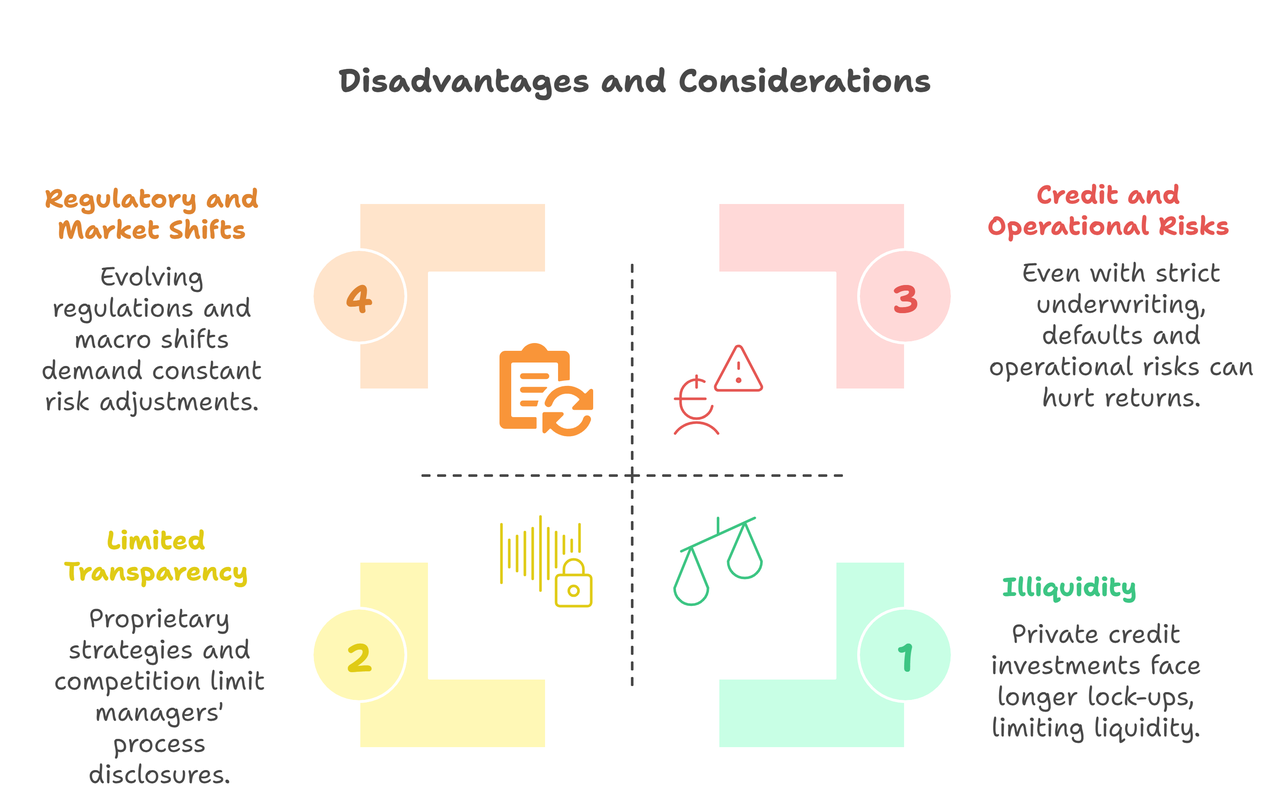
Illiquidity: Investments in private credit are typically locked in for longer periods compared to public market instruments, reducing liquidity.
-
Limited Transparency: Due to proprietary strategies and competitive pressures, fund managers may disclose minimal information on their underlying processes.
-
Credit and Operational Risks: Despite stringent underwriting, defaults or adverse borrower performance can impact returns. Additionally, operational challenges and cost pressures may affect outcomes.
-
Regulatory and Market Shifts: Evolving regulatory frameworks and macroeconomic factors can alter risk profiles and require ongoing adjustments by managers.
Despite these challenges, private credit’s value proposition—pricing transparency and faster access to capital during periods of economic volatility and constrained bank credit—has propelled its growth. The market, which expanded from 1 trillion in 2020 to 1.5 trillion in early 2024, is now on track to nearly double to $2.8 trillion by 2028, translating to a 16.9% annualized growth rate over the next four years.
Overall, private credit offers you a compelling alternative for achieving attractive returns and diversification. Its systematic process, from deal sourcing to portfolio management, underscores the importance of skilled management and rigorous risk controls in today’s complex credit environment.