
Reports Decoded – How Private Equity Is Navigating a Shifting Global Landscape

Kevin Insights
April 14, 2025
GoGPT Summarizes Articles
As we navigate through the first quarter of 2025, the private equity (PE) landscape is experiencing a unique blend of challenges and opportunities. The recent report from UBS, titled "CIO View: Private Equity," offers valuable insights into how PE sponsors are adapting to the current market dynamics, and why this asset class remains a compelling investment opportunity despite the uncertainties.
What’s going on with private equity in 2025?
The first quarter of 2025 kicked off with some serious turbulence. The U.S. administration’s aggressive tariffs—confirmed on April 2—are starting to ripple through both public and private markets. Add in policy shifts and a hesitant rate-cut timeline, and it’s no surprise that dealmakers are pausing.
According to Pitchbook data cited by UBS, PE deal activity in the U.S. is down ~20% in Q1 2025 compared to the same period last year. Sponsors are treading carefully, holding back on both acquisitions and exits until there’s more clarity on the operating environment.
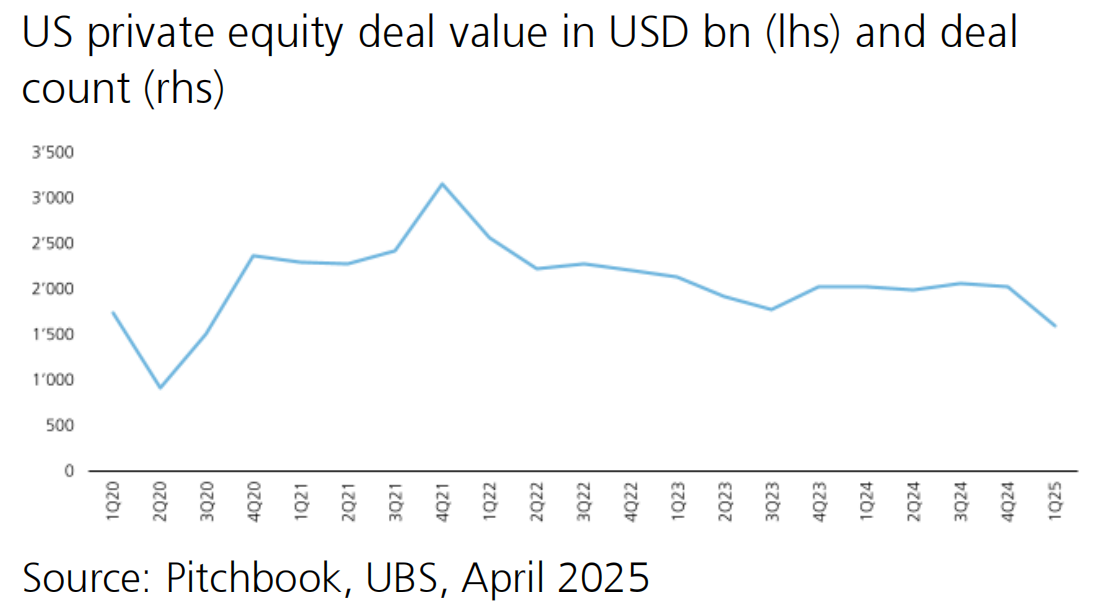
U.S. PE deal value and count have both dropped significantly
Notably, these moments of hesitation often lay the groundwork for outperformance later. Historically, “crisis vintages”—PE funds launched during downturns—have delivered higher long-term returns. So while things feel slow now, seasoned managers know that patience can pay off.
Why private equity still makes sense
Despite the noise, there are several reasons to stay bullish on PE:
1. Valuations are staying sane.
While public markets soared to new highs in 2023, private equity entry multiples stayed much more grounded—hovering around 12x EBITDA as of Q3 2024. That’s attractive relative to the inflated public comps.
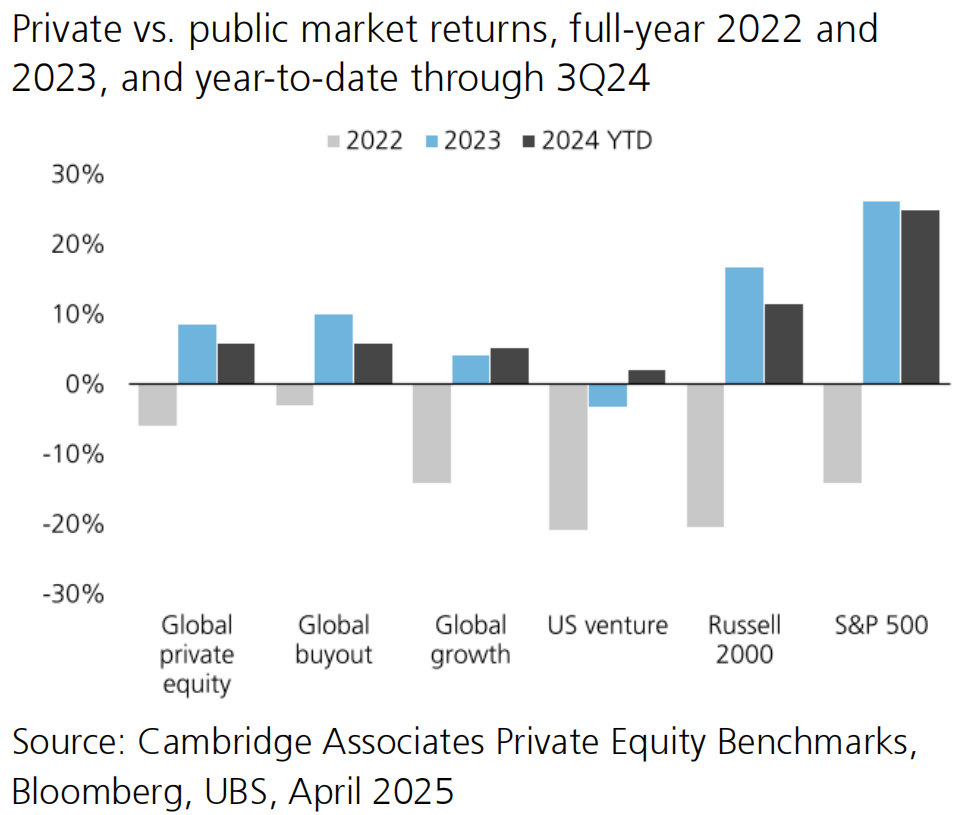
Private equity valuations have remained relatively stable over the past 24 months, in contrast to the heightened volatility in public markets.
2. More domestic focus = less tariff pain.
PE-owned companies tend to be more locally oriented. That’s a plus when global trade gets messy. Those in mission-critical enterprise services, for example, are more insulated than exporters of consumer goods.
Firms operating in mission-critical enterprise services
3. Middle-market strength.
UBS still favors middle-market managers—those dealing with companies too small for public investors, but large enough to scale. These firms often rely less on leverage and are more nimble, especially when supply chains shift.
4. Secondaries are heating up.
As LPs scramble for liquidity in this environment, secondary PE markets are starting to see discounted deals. That creates opportunities for savvy investors to buy into quality assets at a markdown.
Risks to keep in mind
Of course, it’s not all smooth sailing. There are some real headwinds:
-
Recession risk is rising, especially if tariffs choke off economic growth.
-
Delayed rate cuts mean financing stays tight.
-
Political noise continues to weigh on decision-making.
-
Exits are bottlenecked, which could stretch fund timelines and impact IRRs.
UBS notes that “PE sponsors have historically demonstrated an ability to adapt.” They’ve navigated COVID, the 2008 crisis, and countless political swings. This time won’t be any different.
What should investors do?
For allocators looking at PE right now, here’s the playbook UBS suggests:
-
Stick with experienced managers—especially those skilled in carve-outs and complex deals.
-
Watch the secondaries space for discounted entry points.
-
Focus on mid-market strategies with domestic exposure.
-
Revisit your portfolio’s risk/return profile and liquidity assumptions—because illiquidity cuts both ways.
Final thoughts
Yes, deal activity has slowed. But the fundamentals of private equity—its ability to find inefficiencies, support portfolio companies in tough times, and generate outsized returns—remain intact.
While short-term challenges persist, disciplined allocation to private equity—particularly via experienced managers and differentiated strategies—remains a prudent long-term play for sophisticated investors.
#Private Market: Unlocking Potential#privatemarket#privateequity