
NVIDIA: The First Domino in the US Tech Stock Plunge?

In the past 24 hours, NVIDIA's options order flow has shown unusual movements. The concentrated surge in high-premium put option purchases indicates more than a simple sector rotation—it reflects investors' coordinated hedging operations against systemic volatility in the US market, and may even herald a repricing of the entire AI-driven stock portfolio in US equities.
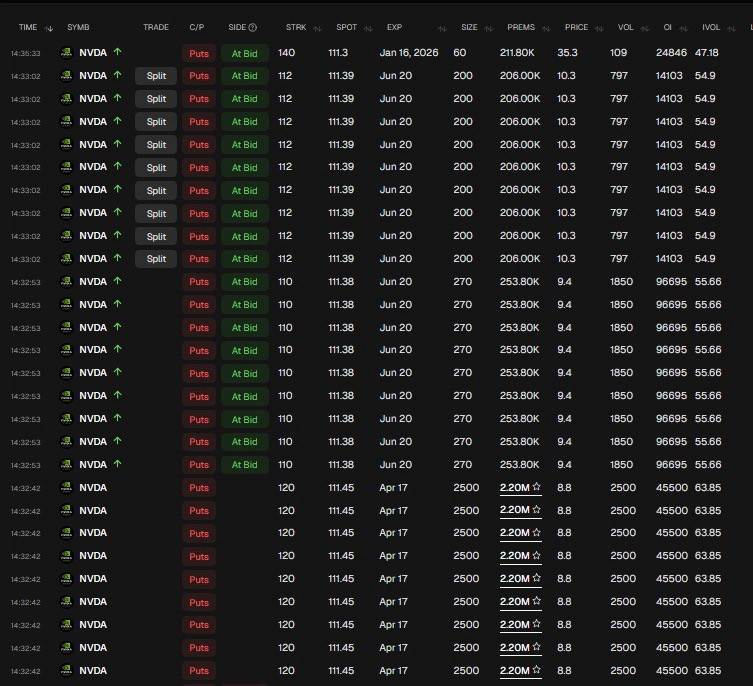
Structured put option flows targeting NVIDIA's downside risk are concentrated in three different time frames (short-term April 17, mid-term June 20, long-term January 2026), involving millions of dollars in premium expenditure:
April 17 expiry, $120 strike put options: 2,500 contracts, premium size $2.2 million. These short-term contracts expiring within 72 hours indicate traders' high confidence in near-term US market volatility events. Notably, these "filled at ask" trades show their essence as aggressive protection rather than speculation on the options themselves.
June 20 expiry, $110-112 strike range block trades: 200-270 contracts each. This mid-term hedging window highly coincides with Fed policy shifts, macro data surprises (CPI/PPI), and summer liquidity contraction risks. Similar strike prices and repeated contract sizes suggest forward-looking pricing for earnings volatility or volatility convexity.
January 2026 expiry, $140 strike put options: 60 contracts, forming a deep out-of-the-money long-term volatility position. This "sleeper position," though far from current price, can effectively capture gains from long-term declines or ultimate crashes (e.g., post-election or debt spiral repricing). It reflects concerns about the durability of US macro institutions rather than mere earnings risk.
Given the amounts involved, while not massive purchases, these don't appear to be random speculative moves by US retail investors. They likely represent institutional-level risk positioning strategies—tactically precise, time-calibrated, building multi-layered protection through different expiry dates, specifically designed to hedge against potential reflexive declines in US tech benchmark stocks driven by liquidity issues.
Why NVIDIA? Why now?
Because NVIDIA is no longer just a US semiconductor company; it has become a synthetic carrier of US stock AI frenzy, speculative leverage, and institutional crowded trades. Any macro or micro-level misstep could trigger the collapse of hundreds of billions of dollars in notional risk. Such massive trading volume implies a "failure is not an option" hedging strategy, typically characteristic of funds guarding against black swan events.
Looking at the background, multiple potential triggers are currently resonating in the US market:
Trump's chaotic tariff policy: Trump's back-and-forth on electronic product policies has injected great volatility and uncertainty into the US market, ultimately collapsing into pessimism about the US market and overall US policy landscape.
Macro volatility catalysts: Japanese 30-year bond yield breakthrough (now approaching 2.85%) suggests BOJ's yield curve control failure, impacting global risk asset pricing.
US bond market pressure: Weak Treasury auction coverage ratios, short-term yield distortions, and potential foreign selling could create a stock market liquidity vacuum.
Forex pressure points: Dollar index decline and Japan's potential forex intervention are catalyzing cross-market stock hedging activities.
So, this is unrelated to NVIDIA's corporate fundamentals, but rather institutions viewing it as a macro barometer and liquidity anchor for the US market. The precision and hierarchical structure of cross-term put options indicate that the world's smartest money is capturing a fragile time window—a volatility corridor from 72 hours to 90 days, where the long-accumulated AI bubble in US stocks could potentially collapse under macro pressure.
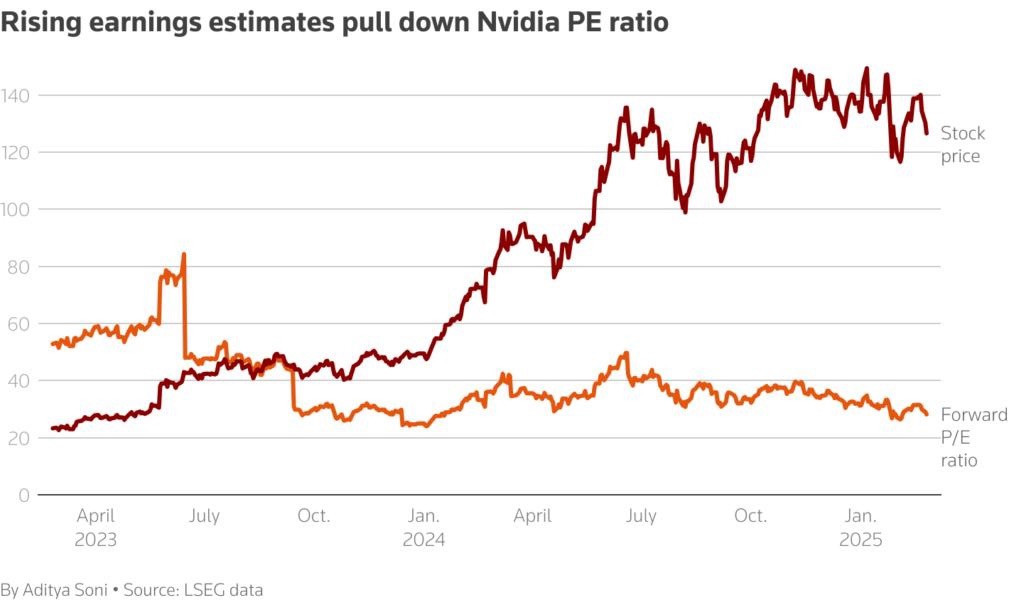
If this judgment ultimately holds, NVIDIA will become the first domino in the US tech stock plunge—not because of any specific operational strategy failure, but because the valuation injected over time has become too high to sustain under the current valuation system.