
Private Debt: Navigating the Current Landscape Amid Tariffs and Market Uncertainty – Reports Decoded

Kevin Insights
April 15, 2025
GoGPT Summarizes Articles
2025 began with positive economic sentiment, but recent developments—particularly the newly announced tariffs from the US administration—are now casting a shadow over the private lending environment. With these changes, private debt investors face a mixed outlook: while opportunities are emerging for alternative lenders, risks have also risen, especially in sectors exposed to global trade flows.
According to a new report from UBS, titled “CIO View: Private Debt,” the current environment is defined by a tug-of-war between reduced bank lending—which opens the door for private capital—and increasing sector-specific vulnerabilities. Here’s what investors need to know.
Economic Pressures & Tariffs: Risks for Private Lenders
The introduction of fresh tariffs is likely to have significant implications for borrower credit risk. Sectors heavily dependent on imports and exports—such as automotive and retail—are expected to feel the most pressure. In contrast, domestic and non-cyclical businesses could be better shielded, particularly those involved in supply chain reshoring.
While the outlook remains uncertain, market data shows private debt spreads tightening, from 525 basis points at the end of December 2024 to 500bps as of February 2025. However, this compression may reverse if credit risk increases. Investors will need to factor in these macro headwinds—along with the challenge of managing defaults and loan repricing—in their portfolio strategies.
Cautious Lending Amid Volatility
Heightened uncertainty has already triggered a notable slowdown in lending activity. Private equity (PE)–backed leveraged buyout (LBO) deals, a key source of direct lending activity, have dropped off sharply. Sponsor-backed direct loan issuance declined 24% in Q1 2025 compared to Q4 2024. More selective PE deployment and longer due diligence cycles underscore a rising sense of caution in dealmaking.
This retrenchment poses both risks and opportunities. On one hand, it reduces overall deal flow. On the other, it creates room for nimble, well-capitalized alternative lenders to step in and fill the void left by traditional banks.
The Risk/Reward Equation: Focus on Quality
In a market clouded by macro and political uncertainty, UBS recommends an “up-in-quality” approach. That means prioritizing sponsor-backed loans in the upper-middle-market and large-cap segments, which tend to be more insulated from cyclical headwinds. Direct lending, with its short duration and senior-secured structure, also offers a degree of protection against market swings.
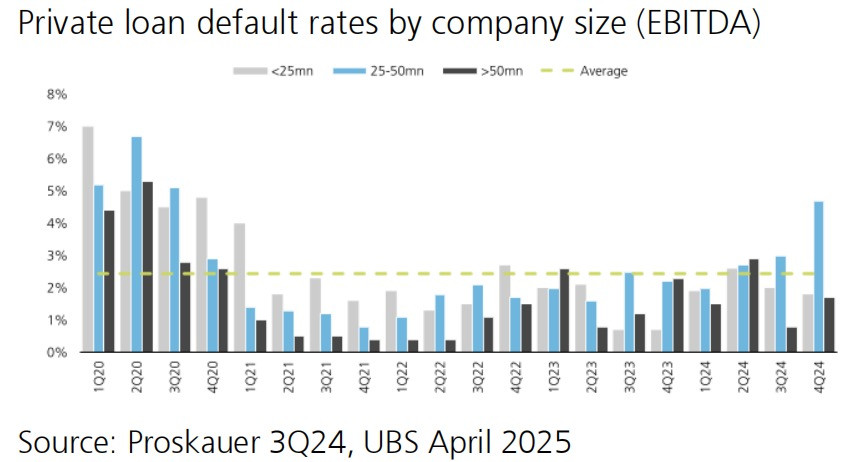
Still, risks persist—particularly in the lower-middle-market, where firms often have weaker pricing power, thinner margins, and higher exposure to tariff-related shocks. While rate cuts by the Federal Reserve may ease some pressure on debt servicing, default risk remains a key concern.
Key Drivers and Outlook: The Private Debt Market in 2025
Despite these headwinds, several tailwinds continue to support the private debt space:
-
Elevated Dry Powder Lenders are sitting on ample capital reserves, enabling them to take advantage of dislocations and step in where traditional banks hesitate.
-
Slowing Bank Lending With banks pulling back from riskier deals, alternative lenders are in a prime position to capture greater lending share.
-
Favorable Pricing Environment In the current climate, lenders are securing better terms—wider spreads, lower leverage, and tighter covenants.
-
Default Risk Stabilization Default rates appear to be plateauing, helped in part by expected rate cuts. But stress is still evident in the lower-middle market, where UBS suggests investors remain cautious. Their preference remains on upper-market sponsor-backed deals with stronger structural protections.
Looking Ahead: A More Selective Market
The outlook for private debt in 2025 is defined by contrast: opportunity and risk, expansion and caution. As economic tailwinds soften, selectivity will be paramount. Investors need to assess not only the quality of each borrower but also the resilience of the sectors in which they operate.
In this environment, targeting high-quality, sponsor-backed borrowers in less cyclical industries could be the key to consistent returns. The private debt space still offers compelling value—but navigating it will require a sharper lens, deeper diligence, and a defensive mindset.
#Private Market: Unlocking Potential#privatemarket#PrivateDebt