
U.S. Treasury Shock: Where Lies the Risk?

Former U.S. Treasury Secretary Yellen participated in a CNBC live talk yesterday, Yellen told CNBC television that last week's surge in yields on U.S. Treasury debt, which move inversely to prices, was troublesome given their traditional safe-haven status and called into question "the safety of what is the bedrock of the global financial system, namely U.S. Treasuries."
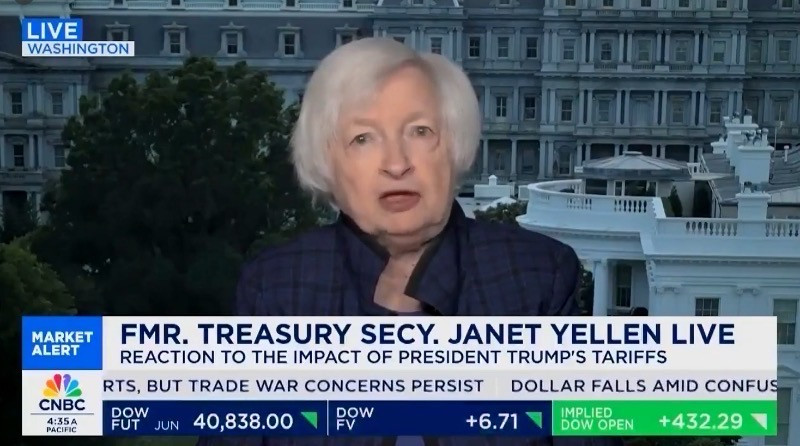
In fact, the core of her message was similar to what I've been discussing recently.
The global bond market is casting a unanimous vote of no confidence in the U.S. sovereign balance sheet. What's happening now is not a steepening of the term spread due to reflation, but a collective sell-off of long-term U.S. bonds. Investors are fleeing the long end of the U.S. government bond curve.
The essence of this crisis is not an inflation problem, but a fundamental questioning of repayment risk, rollover risk, and capital accountability mechanisms. The steepening of the U.S. Treasury yield curve, accompanied by exploding deficits, has finally led global investors to price U.S. sovereign risk like they would assess corporate credit, and then: "WTF!"
The surge in SOFR repo trading volume, deeply inverted swap spreads, and continued selling of long-term U.S. Treasuries not only reflect technical financing pressures but also reveal an accelerating loss of confidence in U.S. sovereign credit among global real money accounts. Combined with the continued decline in the Dollar Index (DXY), gold prices steadily above $3,200, and the collapse of the University of Michigan Consumer Financial Expectations Index, the signals are increasingly clear: both institutional investors and ordinary households are pricing in U.S. structural vulnerabilities rather than cyclical fluctuations.
This rejection of long-term U.S. bonds stems not from rate expectations or confidence in a U.S. economic soft landing, but from a collapse in trust in the U.S. government's long-term solvency and monetary discipline.
Repo market pressure, inverted swap spreads, and sovereign debt curve steepening have occurred in isolation in U.S. history, but rarely coincide with a dollar crash, gold surge, and household financial expectations falling to historic lows. This resonance points to a multi-level de-risking—not just short-term behavior by speculators, but also a systemic move by institutions to quietly hedge U.S. debt exposure through underlying market mechanisms (such as repos and derivatives).
Global institutions are slowly withdrawing capital from U.S. sovereign debt assets through a "silent migration," the impact of which will affect financing costs, Fed policy space, and even geopolitical dynamics.
Yes, while the current predicament may also be structural market noise, as Yellen said, if most market participants believe a U.S. sovereign credit trust crisis is highly likely, then under this liquidity paradigm, market consensus certainly has self-fulfilling properties. If the Fed fails to quickly contain the out-of-control long-term rates, the U.S. market's pricing of U.S. fiscal risk may accelerate, turning technical dysfunction into a full-blown sovereign credit crisis.
Yesterday's U.S. Treasury auction provided a key window into the deeper dynamics of the U.S. financial system: The U.S. Treasury just completed the issuance of $80 billion in 3-month bills and $71 billion in 6-month bills. The winning rates for both auctions were higher than previous ones—3-month bills climbed to 4.225%, and 6-month bills reached 4.060%, meaning the U.S. government still needs to slightly raise yields to attract buyers.
The anomaly lies in the fact that market demand remains strong. The bid-to-cover ratio, which measures bidding intensity, showed 2.96 for 3-month bills and 2.80 for 6-month bills, both higher than previous auction levels. Notably, for 3-month bills, only 2.22% of bids were awarded at the highest yield, suggesting institutional funds are fiercely competing for positions in short-term U.S. Treasuries.
Investors' frenzied pursuit of ultra-short-term U.S. Treasuries typically occurs when there's significant uncertainty about inflation trajectories, interest rate policies, or systemic volatility. Such operations are essentially seeking high-liquidity safe havens, maintaining tactical flexibility while holding cash equivalents. This is by no means a sign of rising U.S. risk appetite, but a defensive posture—often indicating that "smart money" in the market has sensed storm precursors.
When Wall Street giants collectively rush into short-term U.S. Treasuries, it is by no means an optimistic signal, but rather preparation for potential shocks. The short end of the U.S. bond market (3 months to 1 year) often senses liquidity undercurrents first. Wall Street investors are already preparing for potential market turbulence brought by Trump by reducing risk exposure and increasing holdings of cash-like assets.