
Is the Japanese Bond Market Experiencing Passive Selling?

According to Bloomberg data: The yield on 30-year Japanese government bonds is climbing faster than U.S. Treasuries. Since April 2, the 30-year Japanese yield has risen by 33 basis points, while the U.S. 30-year yield has only increased by 29 basis points in the same period.
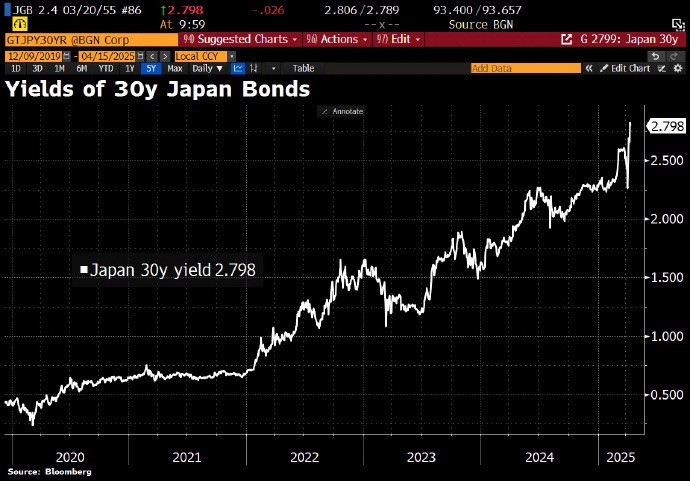
As the Trump administration introduces reciprocal tariffs, there's speculation that the Japanese government will begin implementing fiscal expansion policies. Bond selling triggered by fiscal risk concerns is spreading, especially for ultra-long-term bonds. The yield on 30-year Japanese government bonds has soared to 2.798%, with its rate of increase surpassing the long end of U.S. Treasuries, releasing a key signal—the global bond market is losing its most stable "anchor." The spread between 30-year and 5-year Japanese bond yields has widened to its highest level in nearly two decades.
Japan has long been an international creditor nation and the largest holder of U.S. Treasuries. As of January, Japan held $1.79 trillion in U.S. Treasuries (approximately 156.455 trillion yen, calculated at an exchange rate of 145 yen per dollar). Moreover, for decades, Japan's ultra-low yields have supported global arbitrage trades and suppressed volatility, especially in developed markets, supporting increased risk-taking in financial markets.
However, this violent fluctuation suggests that the Bank of Japan may be quietly exiting yield curve control (YCC), or the Japanese bond market is experiencing passive selling under global pressure.
The Japanese have been quite worried about this lately.
Japan has the world's largest international investment position, with substantial funds invested in various markets. The trend of rising ultra-long-term Japanese government bond yields could incentivize Japanese funds to sell their overseas bond holdings and yen-denominated risk arbitrage trades, repatriating capital. Consequently, volatility in the U.S. Treasury market could intensify, the yen could strengthen, further exacerbating risk aversion sentiment, dismantling global portfolio hedging strategies, and signaling deeper instability in sovereign debt markets.
If this is not a one-time liquidity event, it may mark the beginning of a wave of global long-term risk repricing.