
Is Global Overexposure to U.S. Assets a Ticking Time Bomb?

Investors and policymakers now face a stark warning: global exposure to U.S. assets has surged to record levels, heightening risks for both the dollar and global financial markets. According to Deutsche Bank’s latest research, foreign investors hold approximately $18.4 trillion in U.S. equities and $7.3 trillion in U.S. bonds. Such concentration has created significant foreign exchange (FX) risk, as many institutions are either partially or entirely unhedged, leaving them vulnerable to sudden shifts in currency values.
How Did We Get Here? A Decade of Chasing U.S. Outperformance
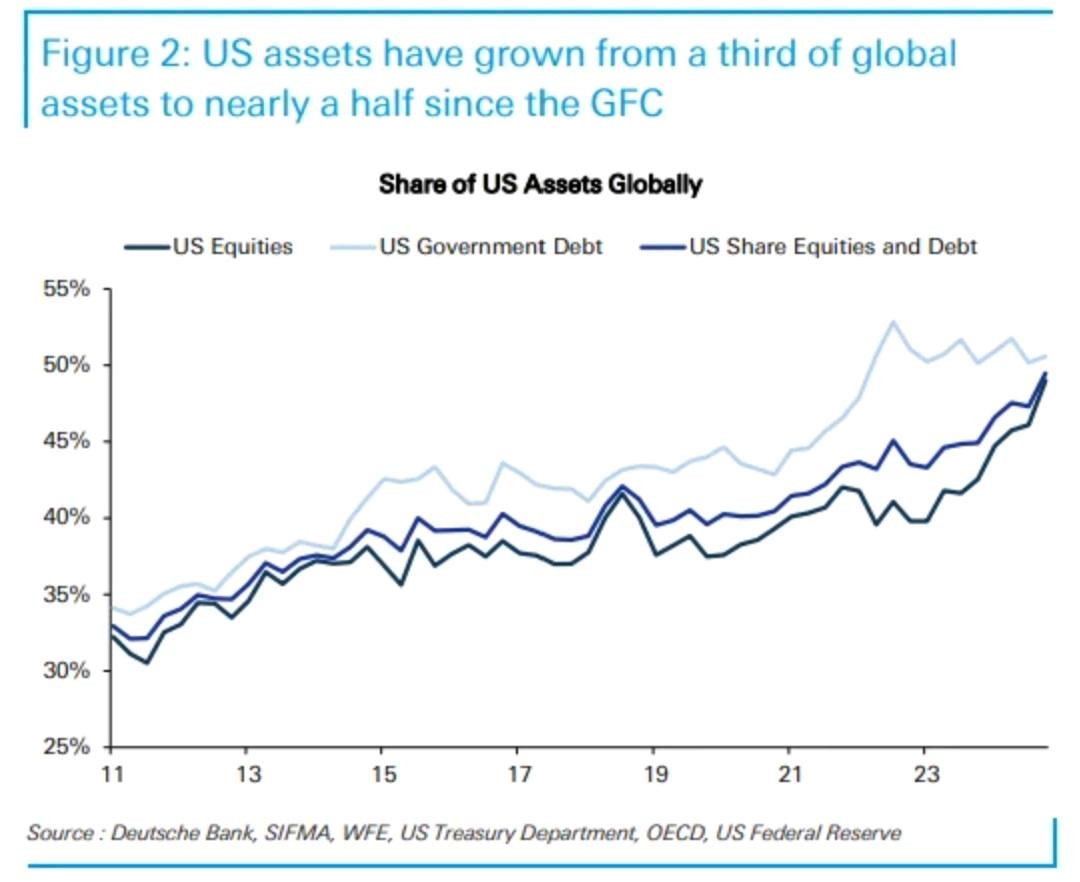
In its report released on April 15, Deutsche Bank highlighted the dramatic growth in foreign holdings of U.S. securities over the past decade. The study notes that since the financial crisis, both U.S. stocks and bonds have increased substantially in absolute size and as a proportion of global financial assets. Data from SIFMA and the World Federation of Exchanges show that, as of Q4 2024, the market capitalization of U.S. listed equities has surpassed $60 trillion—accounting for more than 50% of global listed equities, up from about one-third in 2011. Similarly, U.S. Treasuries now make up 50% of OECD governments’ debt.
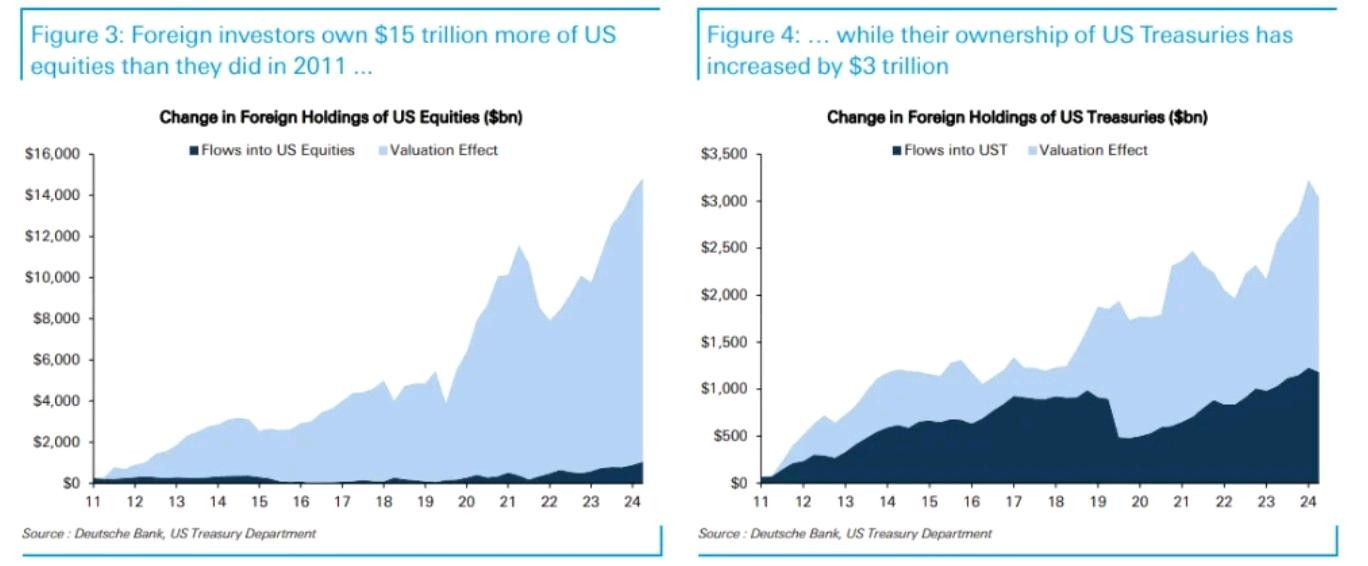
Remarkably, while foreign holdings of U.S. bonds have almost doubled—adding about $3 trillion since 2010—foreign holdings in U.S. equities have increased by around $15 trillion, reflecting a sixfold growth. Deutsche Bank emphasizes that 90% of this increase is due to the appreciation of asset values, rather than fresh capital inflows, which means that the risk is more about valuation adjustments than new investment volumes.
Europe and Japan: Driving the Trend
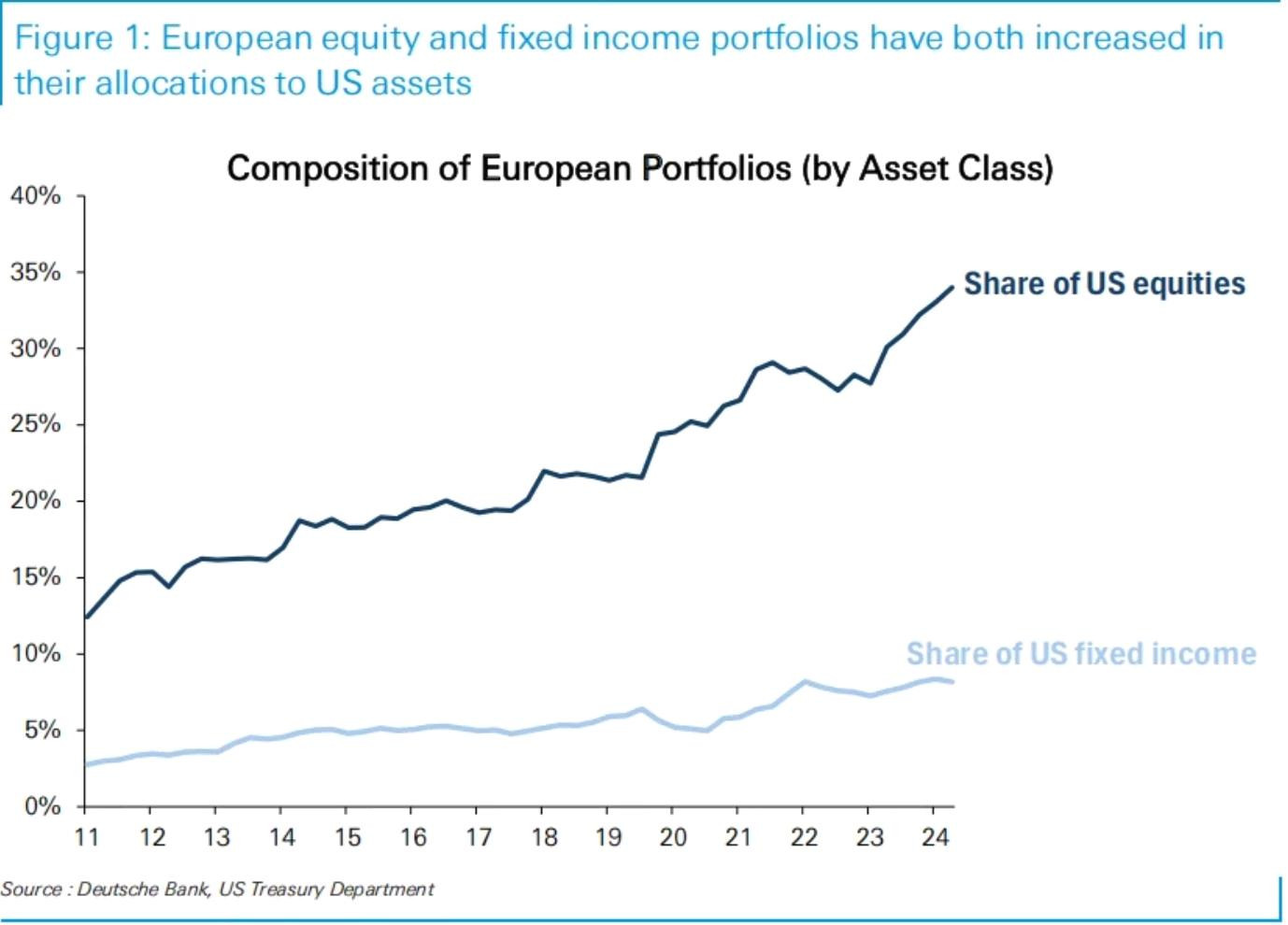
The surge in foreign exposure to U.S. assets is especially pronounced in Europe and Japan. Over the last 15 years, European investors’ allocation to U.S. assets has quadrupled from 5% to 20%. In the case of U.S. stocks, European investors have boosted their holdings from about 10% in 2011 to 35% today. The appetite for U.S. bonds has similarly grown, with European exposure rising from less than 3% to nearly 10% of their total allocations.
Japan has also significantly increased its exposure, with the allocation to U.S. assets rising from 7% to 14%. While Japanese investments in U.S. equities have doubled from 8% to 16%, the overall shift in market share remains less dramatic than that seen in Europe. When it comes to U.S. Treasuries, Japanese holdings have increased slightly since 2015, but the pace has lagged behind the rapid expansion of the U.S. bond market, resulting in a gradual decline in Japan’s relative market share.
Rising FX Risk in an Unhedged World
Perhaps the most alarming finding is the growing foreign exchange risk linked to this overconcentration. Deutsche Bank's analysis shows that as non-U.S. investors pile into American assets, many are not fully hedging their currency exposures. In regions such as Japan, Sweden, and across the Eurozone, some large institutional investors—including prominent public pension funds—are exposed to dollar fluctuations at levels not seen in the past decade. This unhedged position means that if the U.S. dollar weakens or if U.S. asset prices decline, these investors could incur severe losses on two fronts: the declining asset values and the adverse movements in currency exchange rates.
One striking estimate from the report suggests that a mere 1% increase in the hedging ratio across these foreign portfolios could trigger a sell-off of approximately $260 billion in dollars. This figure is nearly equivalent to the total net inflows into U.S. equities and bonds over the past two years, indicating that even small adjustments in hedging behavior could cause outsized market disruptions.
What Happens if the Tide Turns?
Deutsche Bank warns that these dynamics could set the stage for significant negative flows if foreign investors start rebalancing their U.S. asset allocations back to more “normal” levels. Investors may begin to shift their capital towards other markets if they anticipate structural changes in U.S. trade policy or if the unique attributes of the U.S. market become less attractive. Such a shift would not only undermine the current dominance of U.S. assets but could also lead to abrupt and severe pressure on the U.S. dollar.
The impact of this potential “de-dollarization” is twofold. First, global financial stability could be jeopardized, as large-scale shifts in FX hedging activities might outweigh even the moves in the underlying asset markets. Second, if the trend reverses rapidly, the resulting negative dollar flows could amplify market volatility and precipitate a broader crisis in global capital markets.
The Broader Implications for Global Finance
Despite much of the discourse around “de-dollarization” suggesting that the world is gradually moving away from the greenback, this report makes it clear that global investors remain heavily committed to U.S. assets. The current structure of global investments shows that the U.S. market still plays a central role in the global financial system. However, this concentration of investments poses risks that might not be fully appreciated until market conditions change abruptly.
The potential for a sudden pivot in foreign allocation preferences raises important questions for policymakers and investors alike. If significant U.S. assets are offloaded too quickly, the resulting market turmoil could test the resilience of the dollar and have broader implications for economic growth and financial stability worldwide.
Final Thoughts
Global investors are betting big on the United States—and the numbers speak for themselves. But as Deutsche Bank cautions, this heavy concentration is a double-edged sword. The risk of unhedged FX exposure and the potential for abrupt reversals in U.S. asset allocations could spell trouble not just for the dollar but for the global financial system. In these uncertain times, the challenge will be managing these risks while maintaining the delicate balance of a truly global investment portfolio.
This content is provided for informational or educational purposes only and does not constitute investment advice.