
Looking Ahead to US Stock Earnings Reports: TSMC, Which Is Still Worth Buying Under the Heavy Pressure of Tariffs

Magical Investor
April 16, 2025
GoGPT Summarizes Articles
Warren Buffett once said that Taiwan Semiconductor Manufacturing Company (TSMC) is one of the best-managed and most important companies in the world.
I have been a long-term follower of TSMC even before the AI craze swept the market.
This time, with Trump's tariffs stirring up the global situation, TSMC's earnings conference call scheduled for April 17 will be quite intriguing, especially the management's views on the tariff policies and the risk of an economic recession in the United States.
There is an interesting perspective in the market. If both TSMC and ASML were domestic companies in the United States, we might be talking about the "Magnificent Nine" instead of the "Big Seven Tech Giants of US Stocks" now.
Is the profit expected to grow by 54% in the first quarter?
According to the predictions of 17 analysts compiled by the London Stock Exchange, TSMC is expected to report a net profit of NT$347.8 billion (US$10.7 billion) in the first quarter, representing a 54% increase. This profit is higher compared to NT$225.5 billion (US$7 billion) in the same period last year.
As a major supplier to companies such as Apple and NVIDIA, TSMC benefits from the increasing use of artificial intelligence applications in their products.
Analysts believe that these investments may help reduce geopolitical risks, but they may have a slight impact on the gross profit margin over the next five years.
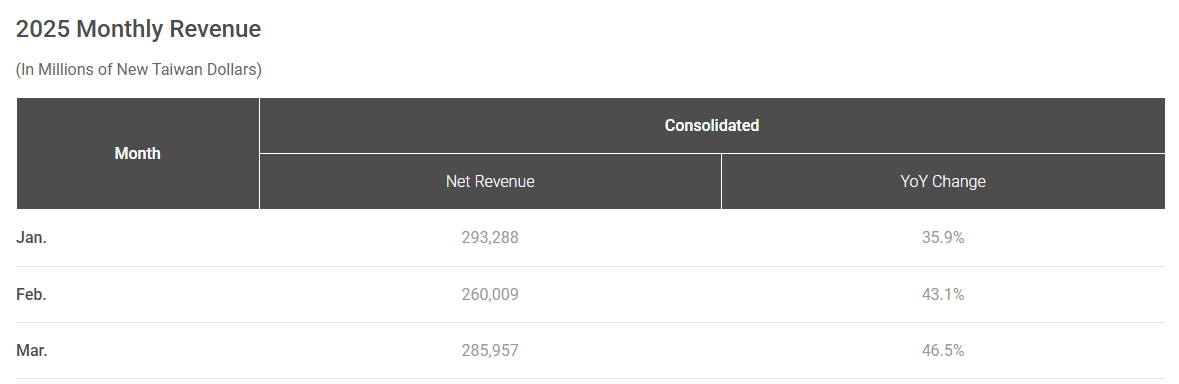
Judging from TSMC's monthly revenue data, the Q1 report is indeed expected to be better than anticipated.
Meanwhile, data shows that the global semiconductor industry's sales are expected to reach US$697 billion in 2025, among which the sales of generative AI chips will exceed US$150 billion, bringing huge growth momentum to the industry.
This also clearly reveals the obvious polarization in the semiconductor market: the demand in traditional sectors such as chips for personal computers and mobile devices is relatively sluggish, while the manufacturing sector centered around artificial intelligence is experiencing explosive growth.
This enables TSMC to maintain high prices despite the macroeconomic headwinds.
Tariff threats, building factories in the US, and price increases?
TSMC (TSM.US) is the largest foundry for the most cutting-edge AI chips. The factories where TSMC produces the most advanced wafers are mainly located in Taiwan, China.The United States imposes high tariffs on China, and it will significantly increase the cost of TSMC's wafers imported into the United States.
According to a report by Taiwan's United Daily News on April 14, in order to avoid the severe impact of future chip tariffs, TSMC is accelerating the construction of its factories in the United States.
In addition to the third-phase wafer factory in Arizona, which will break ground in June ahead of schedule, at least one year earlier than the original internal plan, TSMC will also establish two advanced packaging factories in the United States and has already started placing orders for a new batch of equipment from relevant equipment manufacturers.
Previously, former US President Donald Trump claimed that he had informed TSMC that if it did not build a factory in the United States, it would face a tariff as high as 100%.
In fact, the key point highlighted by these tariffs is that the United States is highly dependent on TSMC's manufacturing capabilities while also seeking to reduce this dependence.
Many of the United States' leading technology giants, such as Apple, NVIDIA, and AMD, rely heavily on TSMC's advanced manufacturing processes to enhance the performance and competitiveness of their products.
These companies have strong chip design capabilities but lack advanced manufacturing capabilities.
TSMC fills this gap, meeting their demand for high-performance chips and supporting the United States' development advantages in multiple cutting-edge fields such as artificial intelligence, high-performance computing, and consumer electronics.
However, it is not an easy task for US domestic semiconductor manufacturing enterprises to catch up with TSMC's advanced manufacturing process level.
Chip manufacturing technology is extremely complex, requiring long-term technological accumulation and huge capital investment from research and development to mass production.
Although Intel has a deep foundation in the semiconductor field, it still faces many technical bottlenecks in the competition with TSMC's advanced processes. It will take a long research and development cycle and a large amount of resource investment to achieve a breakthrough and reach TSMC's current technical level.
In addition, TSMC is not just passively accepting the impact of tariffs.
According to sources in the supply chain, TSMC is about to raise prices. Due to the influx of orders from multiple customers, TSMC's chip factories in the United States are accelerating capacity expansion and are expected to increase the foundry quotation by 30%. This will undoubtedly increase the burden on semiconductor design original manufacturers worldwide.
And relevant sources said that driven by the strong demand for the N4/N5 and N3 processes, some urgent orders for older processes, and the continuous growth of the advanced packaging business, TSMC's revenue in the second quarter of this year is expected to increase by 5% to 8% quarter on quarter.
Does TSMC still have investment value?
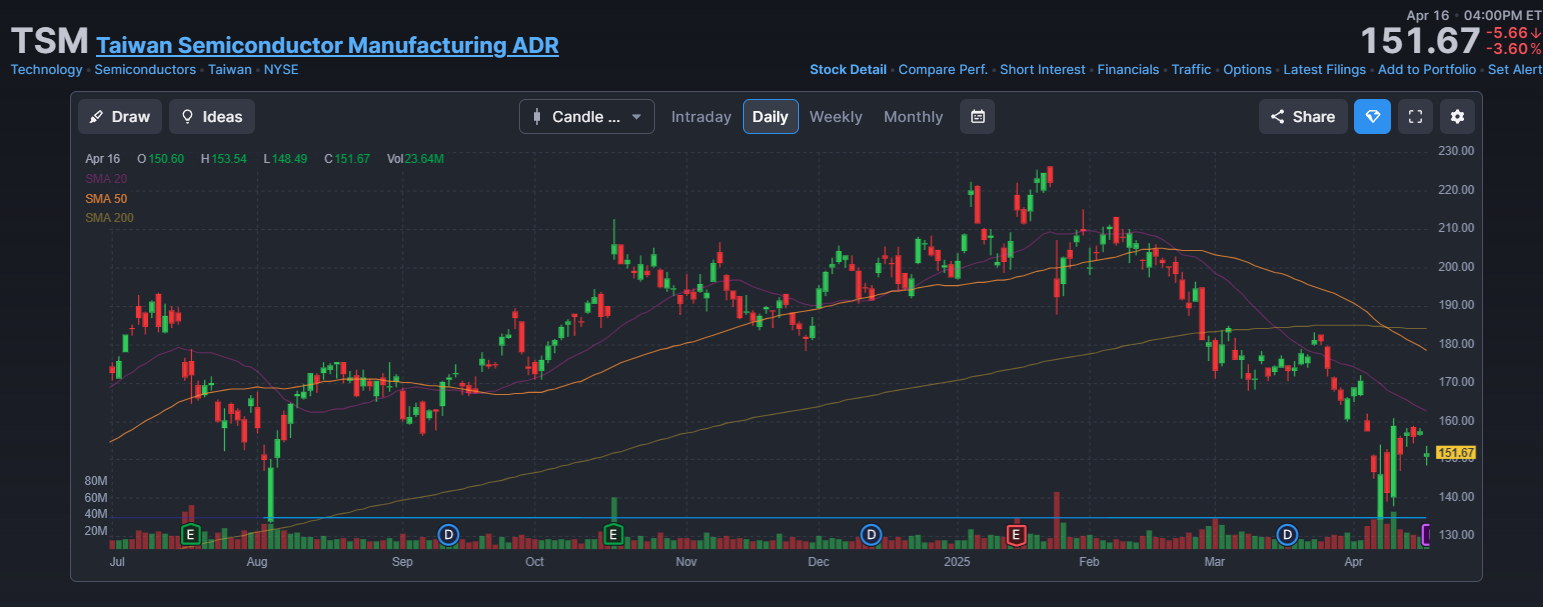
As of April 17, 2025, the ADR trading price of TSMC in the United States was US$151.67.
Considering the company's long-term growth position in the AI boom, I believe this is a stock that is seriously undervalued.
Currently, the direction of tariffs remains highly uncertain, with new developments emerging almost every day. Overall, this is a negative factor for TSMC, and the biggest risk still lies in geopolitics.
In addition, there are also execution risks associated with the mass production of the N2 node and the global expansion of production lines. Exchange rates, regulations, tariffs, etc. may also pose uncertainties.
More alarmingly, US consumers have shown signs of fatigue. If the sales of smartphones and PCs slow down, it will also impact the company's business.
However, I still believe that it is very difficult to find a company globally that has such strong financial performance, a potential annual growth rate of 20%, technological leadership, and deep moats, yet has a price-to-earnings ratio of less than 20 times. Even more significantly, if its industrial chain were to be disrupted, the entire global technology industrial chain would be affected.$TSM
#Your Top Q1 Earnings Pick Amid Trump Tariff Uncertainty#$Taiwan Semiconductor Manufacturing Company Ltd.(TSM)