
UnitedHealth's Massive 22% Drop: What’s Really Behind the Struggles in the Medicare Advantage Space?

Shearing sheep
April 18, 2025
GoGPT Summarizes Articles
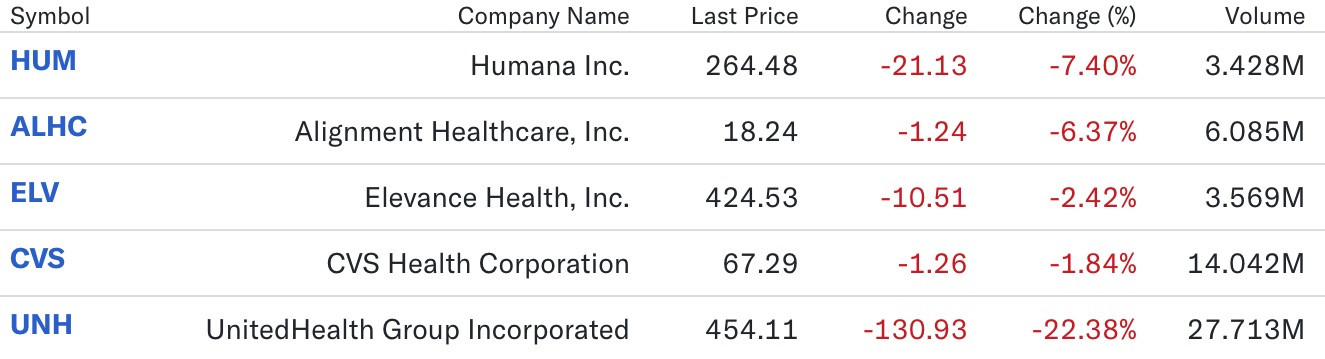
UnitedHealth’s ($UNH) stock took a serious hit on Thursday, sinking by 22.38% after its disappointing Q1 earnings. While the healthcare giant’s revenue was up 9.8% to $109.6 billion, it still fell short of analyst expectations of $111.6 billion. Adjusted earnings per share came in at $7.20, lower than the expected $7.29.
One key factor in UnitedHealth’s underperformance was the Medicare Advantage division. Healthcare utilization rates for seniors and disabled individuals have surged far beyond expectations, putting pressure on UnitedHealth’s cost structure.
Medicare Advantage plans, which provide healthcare services for millions of older Americans, are facing mounting pressures due to higher-than-expected demand and, more importantly, cuts to Medicare reimbursements under the Biden administration, the impact of which has exceeded expectations.
While revenue in the UnitedHealthcare segment did well, growing by 12% to $84.6 billion, the increased medical utilization hit the bottom line hard.
Optum, another major division of UnitedHealth, also posted slower-than-expected growth. Optum’s revenue grew by just 4.7% to $63.9 billion, falling short of the expected $67.17 billion. This adds further concern to the company’s overall outlook.
Even more troubling was the company’s decision to slash its 2025 earnings guidance, dropping the forecast from $29.50–$30 per share to just $26–$26.50 per share. This move had the biggest impact on its stock price.
UnitedHealth is clearly expecting these Medicare-related issues to persist, especially with ongoing reforms and funding reductions from the government. If the healthcare system continues to see such high demand without corresponding reimbursement increases, leading to higher costs, it could be tough for companies like UnitedHealth to hit their targets in the short term.
CEO Andrew Witty said the company had grown to serve more people more comprehensively but "did not perform up to our expectations" during the quarter. Still, the company considers headwinds related to Medicare to be "highly addressable" over the course of the year and into 2026.
The knock-on effect from UnitedHealth’s poor results didn’t just hit their stock. Other major healthcare stocks took a hit as well.
Alignment Healthcare ($ALHC) dropped 6.37%, Humana ($HUM) dropped 7.40%, Elevance Health ($ELV) saw a 2.42% decline, and CVS Health ($CVS) wasn’t spared, dropping almost 2%.
But let’s not forget, UnitedHealth is still a dominant force in the healthcare market. Despite these setbacks, it remains one of the few stocks that investors can consider "tariff-proof" due to its strong presence in the domestic U.S. healthcare system.
The stock has had an impressive recovery this year, outperforming its peers, even as the broader market struggles. As of Wednesday’s close, the stock has gained nearly 16% this year, while the S&P 500 and Dow Jones Industrial Average have fallen 10% and 6.8%, respectively.
The long-term growth prospects are still there, especially if the company can navigate these Medicare issues effectively.
The real question for investors is whether UnitedHealth can bounce back from this Q1 disappointment. The healthcare sector is facing significant challenges, with higher demand for services and stricter government policies.
However, recent changes to Medicare reimbursement rates under the Trump administration could provide a boost. A 5.06% increase in Medicare rates next year could bring in over $25 billion in extra revenue across the healthcare industry. If UnitedHealth can take advantage of this, we might see a recovery in the stock later this year.
My Take
I’m cautiously optimistic about UnitedHealth’s future, but the short-term outlook is murky.
The Medicare Advantage business is clearly a pain point, and the company’s ability to manage costs will be key. They’re also going to need to adapt to the new regulatory environment, especially as Medicare funding is squeezed.
While the 2025 guidance cut is disappointing, it’s not necessarily a death knell for the stock. There’s still a lot of upside potential if they can weather this storm.
For now, if you’re holding onto UnitedHealth shares, you might want to brace for some volatility. If you’re looking to buy, I’d be cautious and wait for a clearer picture to emerge regarding the Medicare landscape.
Long-term, this might be a buying opportunity if you believe the company can turn things around. But be prepared for a bumpy ride in the short term. #Q1EarningsInsight
#Your Top Q1 Earnings Pick Amid Trump Tariff Uncertainty#Q1EarningsInsight#$UNITEDHEALTH GROUP INCORPORATED (Delaware)(UNH)#$Alignment Healthcare Inc. Common Stock(ALHC)#$Humana Inc.(HUM)#$Elevance Health Inc.(ELV)#$CVS HEALTH CORPORATION(CVS)