
Talk About U.S. Treasury Bonds Again

There's been a persistent online rumor that Japan led the way in selling off U.S. Treasury bonds, followed by China partially selling off as well. Looking at the data, Japan holds around $1 trillion in U.S. Treasuries, while China holds about $800 billion, give or take. However, the daily trading volume of U.S. Treasuries is about $1 trillion, so even if all were sold in a single day, the market could absorb it.
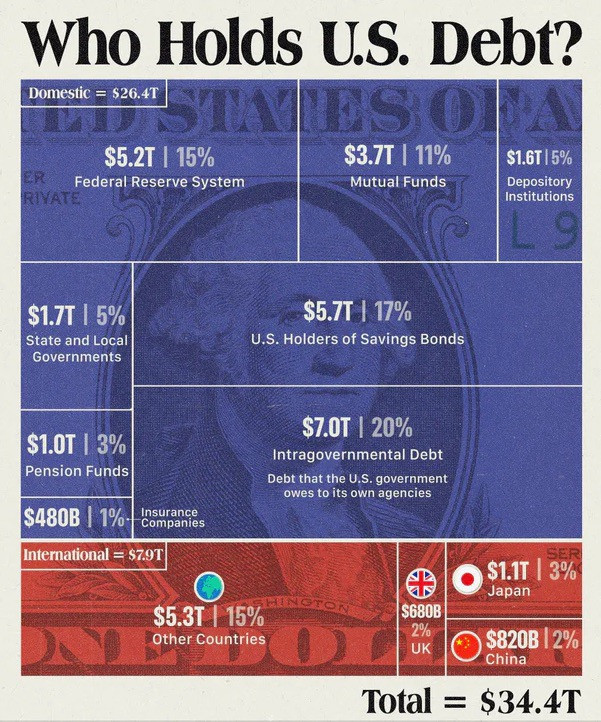
Does the reduction in holdings or non-participation in new bond auctions by sovereign nations like China affect U.S. Treasury issuance? Certainly, and the impact is significant, but it's primarily reflected in interest rates. With less participation in bidding, bond yields must rise.
The main impact on the U.S. government currently is that annual interest payments on bonds have exceeded $1 trillion, surpassing major expenditures like military spending and social welfare combined, which is clearly too burdensome. To reduce interest costs, rates need to be lowered, which requires Federal Reserve action (otherwise, the government would have to suppress 10-year Treasury yields on its own, as this affects 30-year mortgage rates and 5-year auto loan rates).
However, the Fed's monetary policy is independent of White House administrative power, which is fundamental to the U.S. financial system. If Trump were to challenge Powell, especially by attempting to control Fed monetary policy through Supreme Court rulings, the entire financial system could collapse.
The law requires the Fed to balance both inflation and economic growth indicators (unlike the European Central Bank, which only needs to focus on inflation). According to New York Fed President John Williams, the Fed currently expects less than 1% growth and over 4% inflation this year. Powell's stance is that the Fed is more concerned about whether temporary inflation caused by higher-than-expected tariffs will become long-term, and is currently adopting a wait-and-see approach. If inflation does show signs of becoming long-term, the Fed's next move might be to raise rates rather than lower them.
During the Biden administration, due to high interest rates, more short-term bonds with slightly lower interest rates were issued. As a result, about $9 trillion in debt needs to be refinanced this year. Because the debt ceiling has been repeatedly breached, this inevitably leads to political struggles between the two parties to adjust the ceiling, typically resolved just hours before a government shutdown.
The notion that the U.S. government might confiscate Treasury bonds is far-fetched. Many people tend to think in populist terms, but in financial markets, credibility is paramount. Would you really destroy centuries of financial credibility, built since the first Treasury Secretary Alexander Hamilton, for short-term gains?
Even without external funding participation, the central bank can purchase Treasury bonds as a last resort. For instance, in Japan, where bond yields are essentially zero and there's little interest in buying, the Bank of Japan steps in. You might call this monetary financing of fiscal policy, but would it lead to inflation due to excessive money supply?
Think about it - if that were true, wouldn't it be laughable? Japan has been in deflation for many years.
During the 2008 financial crisis, an incident occurred where the U.S. said it could only return about 70% of China's investments in the U.S. money market - a 30 cent loss on every dollar. China disagreed, and the U.S. cited free market principles, stating that investments carry risks, even in money markets. The Chinese side then said that, following the same free market principles, they would sell $500 billion in U.S. Treasuries within 24 hours. After a few hours of deliberation, the U.S. agreed to a 100% return. The reason this free market transaction would have been so severe is that the system was in a state of collapse at the time.
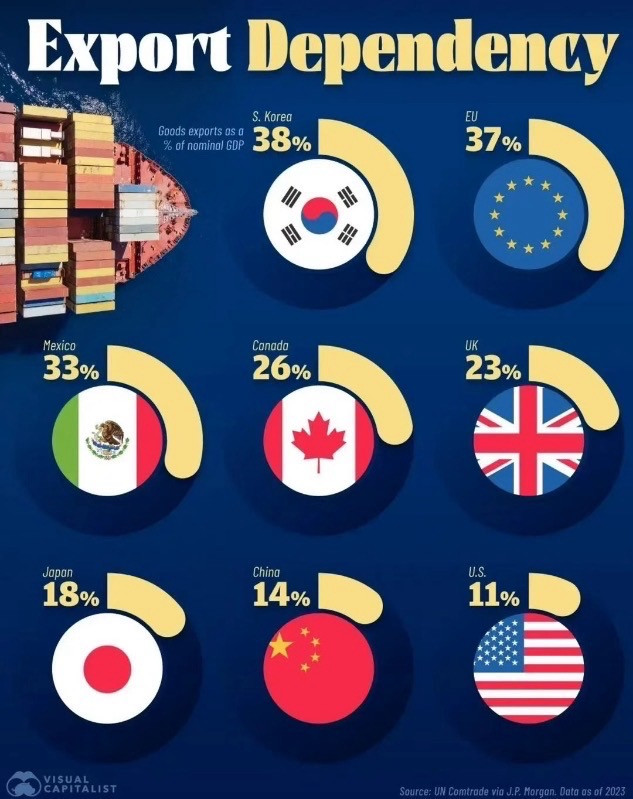
A significant increase in global tariffs would have the greatest impact on export-oriented economies with high dependence on foreign trade. From this perspective, the EU is actually more affected than China and the U.S.