
“Bretton Woods 3.0” Enters Its Second Phase As Foreign Capital Retreats?

Data from Bank of America shows that foreign investors withdrew $65 billion from U.S. stock funds in a single week, marking the second-largest capital outflow in history, second only to the banking crisis in March 2023. This is far from mere market noise in the U.S.
When foreign investors holding $18.5 trillion in U.S. stocks, $7.2 trillion in Treasury bonds, and $4.6 trillion in corporate bonds begin to accelerate the sale of U.S. assets, it signals comprehensive pressure - nearly $30 trillion in foreign exposure could potentially exit at a pace surpassing the reaction speed of U.S. domestic institutions.
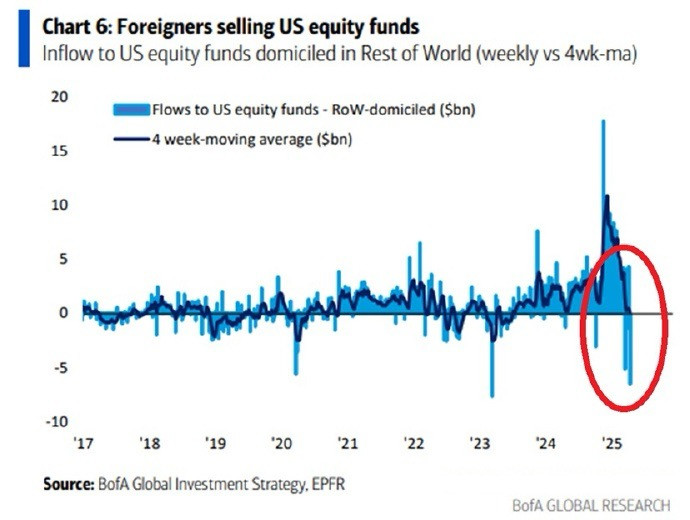
Bank of America's chart vividly illustrates this trend: global funds' exposure to U.S. stocks shows an almost vertical selling trajectory. This scene unfolds amidst increased market volatility, escalation of U.S. tariff policies, and internal fractures in the bond market (deeply inverted swap spreads, sharply steepening yield curves).
The key question is no longer about "correction" or "manipulation disputes," but rather: What are foreign investors preemptively avoiding in the U.S.? Is it the rising refinancing risk? Trump's continued policy missteps? Or an escalation of U.S. monetary warfare?
In fact, this could be the beginning of a structural reallocation in the U.S. market - foreign institutions are repositioning due to the weaponization of the dollar, intensifying geopolitical frictions, and increasingly unpredictable U.S. fiscal and foreign policies.
Trump's public declaration of readiness to dismiss Powell may be intended as a policy signal for deterrence rather than a substantive action to trigger financial panic. However, the U.S. market is already in a highly unstable state: U.S. Treasury yields are soaring, swap spreads are collapsing, and confidence in Treasury liquidity is diluting. At this juncture, such attacks and intimidation against Powell could potentially trigger a legitimacy crisis for the Federal Reserve, igniting chaos in the U.S. bond market - similar to a replay of the 2022 UK gilt crisis or the 1971 Nixon gold shock.
If Powell were actually fired, it would signal to foreign holders of U.S. Treasuries that the Fed is no longer an independent institution but a political tool of fiscal strategy. This would accelerate de-dollarization and foreign capital withdrawal from U.S. bonds.
Truman's game with the Fed during the Korean War in 1951 and Nixon's pressure campaign before closing the gold window in 1971 both triggered structural changes - the former ended the Fed-Treasury Accord, while the latter buried the Bretton Woods system. Could this be the second phase transition of "Bretton Woods 3.0"?
Perhaps the essence of Trump's verbal game is not to fire Powell, but to test how far the U.S. executive branch can push the Fed before the U.S. capital market retaliates. Unless accompanied by structural actions (executive orders, overstepping interest rate policy authority, legislative challenges to Fed independence), this is likely a rehearsal for the endgame of the debt supercycle in 2025-2026.
However, like every ideal plan in Trump's cabinet, developments are always dynamic. Each of Trump's moves is eroding foreign investors' confidence in U.S. sovereign credit and debt repayment capacity. Foreign investors in the U.S. market are not panic selling; they are strategically repositioning. If an exodus occurs, it will likely be a forward-looking, coordinated action.
The Trump administration has likely seen the signals of external capital withdrawal, which might explain why Trump is repeatedly softening his stance.