
Unlocking Income in the 'Golden Age' of Fixed Income – Reports Decoded

Kevin Insights
April 18, 2025
GoGPT Summarizes Articles
The start of 2025 has already brought challenges for fixed-income investors. Political turbulence, economic volatility, and evolving policies have made navigating the bond markets tricky. However, as highlighted in BlackRock’s EMEA Fixed Income Q2 2025 Outlook, titled Capitalising on Bonds: Unlocking Income in the ‘Golden Age’, we are in what can be considered a 'Golden Age of Fixed Income.' Despite the mixed returns from the past year, there are still plenty of opportunities for bond investors to capitalize on.
Bonds in a New Era
For much of the last 40 years, bonds served as a stabilizing force in portfolios, with a negative correlation to equities. This traditional role has been challenged in recent years, especially as interest rates spiked and inflation remained sticky. In 2024, the Bloomberg Global Aggregate Bond Index recorded a -1.7% return, clearly showing that bonds haven’t been the safe haven many were accustomed to.
Despite these setbacks, a closer look at the bond market today reveals that real yields—after factoring in inflation—are historically attractive. Bonds remain a core component of diversified portfolios. While the landscape has shifted, the ability to actively manage bond portfolios across different sectors, regions, and currencies has opened up substantial income opportunities.
Cash Allocation vs. Bond Investments
With cash levels at multi-year highs, now could be the time to move from cash to bonds. According to Bloomberg, as of early March 2025, U.S. and EU money market assets sat at $7 trillion and $1.3 trillion, respectively. With interest rates at elevated levels, the opportunity to lock in high yields is ripe. The key takeaway here is that bonds now offer both income and stability in a way that hasn't been available for years.
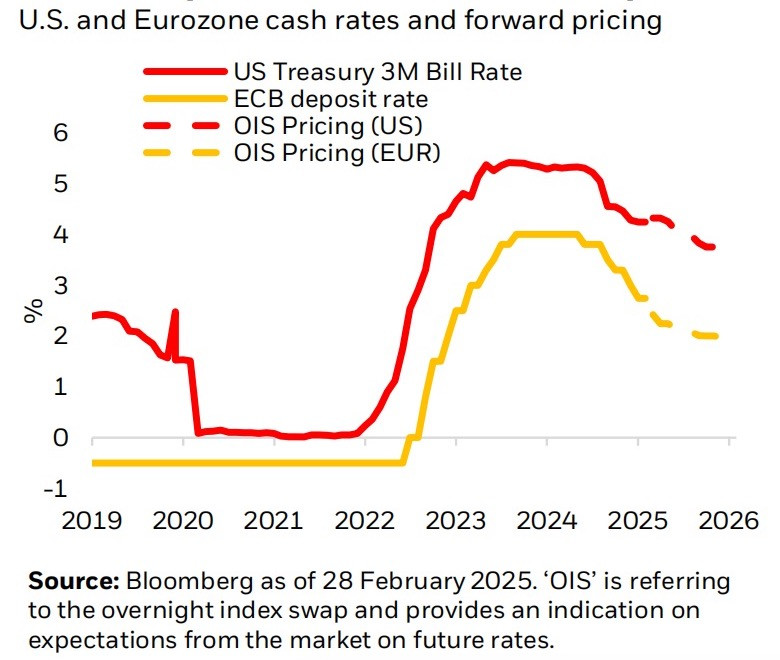
Looking at historical data, it’s evident that both U.S. and Eurozone cash rates have been relatively high. Forward expectations indicate that these rates will likely remain stable or even decrease, which could be a boon for fixed-income investors seeking long-term returns.
The Power of Income
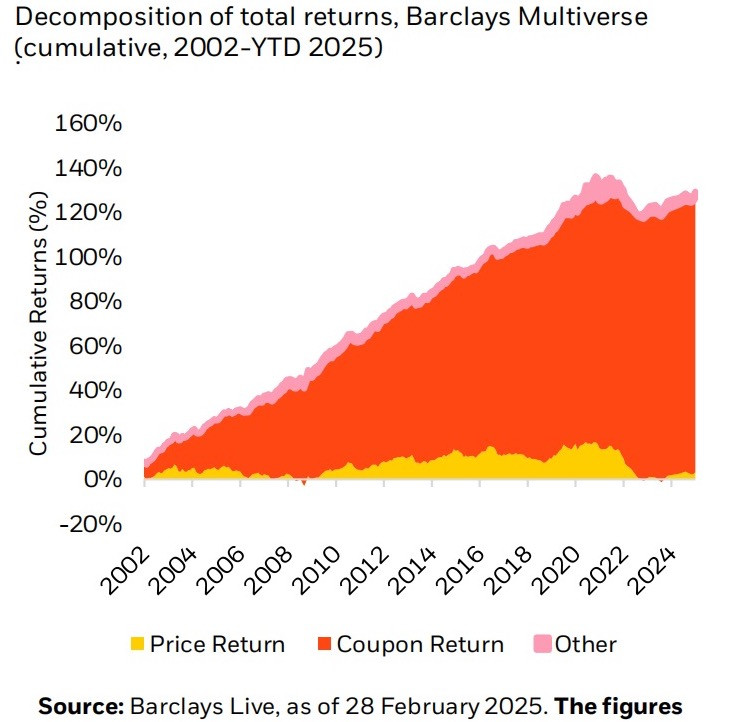
Returns from fixed income are primarily driven by income (coupon returns) rather than price appreciation. Even during periods of suppressed yields (2010–2021), income was the key contributor to returns. With bond yields now higher, income generation is not just a nice-to-have—it’s a critical part of a successful investment strategy.
Dispersion Across Sectors and Regions
Higher income is a common theme, but increasing political instability, trade tensions, and economic sanctions are leading to substantial dispersion across sectors.
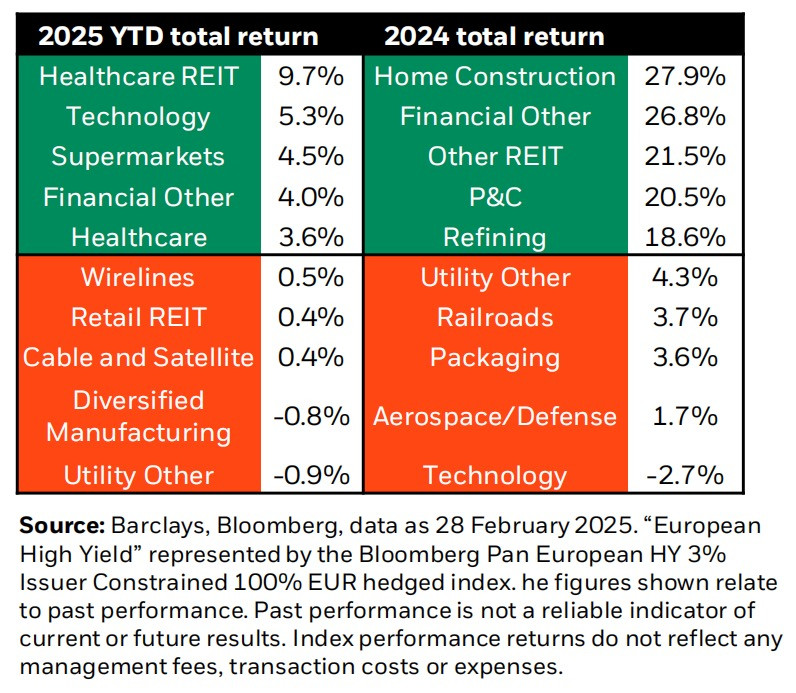
For example, within the European high-yield bond market, there are stark differences in sector performance. In 2024, sectors like Home Construction, Financials, and REITs (Real Estate Investment Trusts) performed strongly, while in 2025, Retail REITs have become one of the worst performers, while Healthcare REITs, Technology, and Supermarkets have led the pack.
This is where active management becomes invaluable. As the bond market continues to experience volatility, those who can pick the right sectors and securities stand to benefit. For example, focusing on financials or the growing energy transition could offer attractive returns without stretching into riskier assets.
Strategies for 2025 and Beyond
-
Focus on Active Management: With continued political uncertainty and divergent monetary policies across regions, a dynamic, active approach to managing fixed-income portfolios is crucial. Investors should look beyond core bond holdings and consider high-yield credit, securitized assets, and emerging market debt for enhanced returns.
-
Diversification is Key: Given the ongoing volatility, it’s important to ensure diversified exposure to various bond sectors, regions, and credit qualities. A balanced approach can help mitigate risks and capitalize on income-generating opportunities.
-
Credit Fundamentals Remain Strong: Despite ongoing spread compression, the credit outlook remains solid, supported by strong corporate earnings and low default rates.
Conclusion
The current fixed-income market offers a wealth of opportunities for those willing to actively manage their portfolios. As high yields persist and sectors diverge, there’s potential to earn attractive risk-adjusted returns. Whether you’re looking to “clip the coupon” or actively navigate sectoral opportunities, now is the time to consider increasing allocations to bonds.
The fixed-income landscape has undoubtedly changed, but with careful, active management, the potential for income and capital appreciation is higher than it has been for years. Now more than ever, navigating the bond market with an active strategy can truly set investors apart.
#Private Market: Unlocking Potential#privatemarket