
A New “Subprime” Crisis Brewing? Harvard, Yale at the Eye of a Private Equity Storm

Go Private Market Pulse
April 21, 2025
GoGPT Summarizes Articles
America’s elite universities, long considered bastions of long-term, stable capital, are now at the center of what some analysts are calling a “perfect storm” in the private equity world. As political tensions mount between the Trump administration and Ivy League institutions, the massive endowment funds of schools like Harvard and Yale—often seen as bellwethers for private market trends—are coming under pressure.
Over the weekend, media reports cited insiders saying Yale University is now preparing to offload as much as $6 billion worth of its private equity holdings—roughly 15% of its $41.4 billion endowment—in what would be its first-ever secondaries sale. The decision comes amid political heat: the Trump administration has threatened to revoke tax-exempt status for elite universities that refuse to comply with federal demands for structural reform.
Harvard University, facing similar threats, recently had $2.26 billion in federal funding frozen and was stripped of over $2.7 million in Homeland Security grants. Should its tax-exempt status be revoked, analysts warn Harvard may be forced to liquidate its most liquid assets—public equities—and possibly issue more debt. Reports suggest Harvard’s endowment is already heavily exposed to private equity, with nearly 40% of its portfolio tied up in illiquid investments.
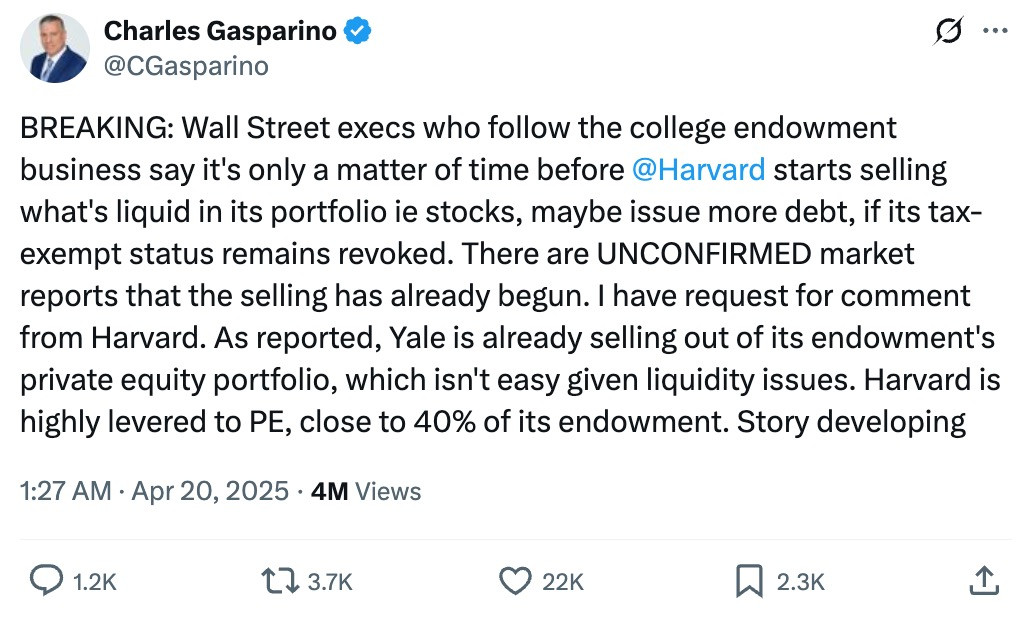
In the broader context, these moves could send shockwaves across financial markets. Ivy League endowments are among the largest institutional investors in private equity, and their sudden retreat signals a shift in market sentiment. If these schools start selling at scale, it could trigger valuation markdowns, secondary market dislocation, and a cascading effect on hedge funds and venture capital firms that rely on university capital.
The End of the “Permanent Capital” Myth?
The issue isn’t just size—Harvard’s $52 billion endowment rivals the GDP of small nations—but the very structure of these funds. Designed for long-term investment, endowments have traditionally enjoyed tax advantages, low liquidity requirements, and insulation from political pressures. That insulation may now be cracking.
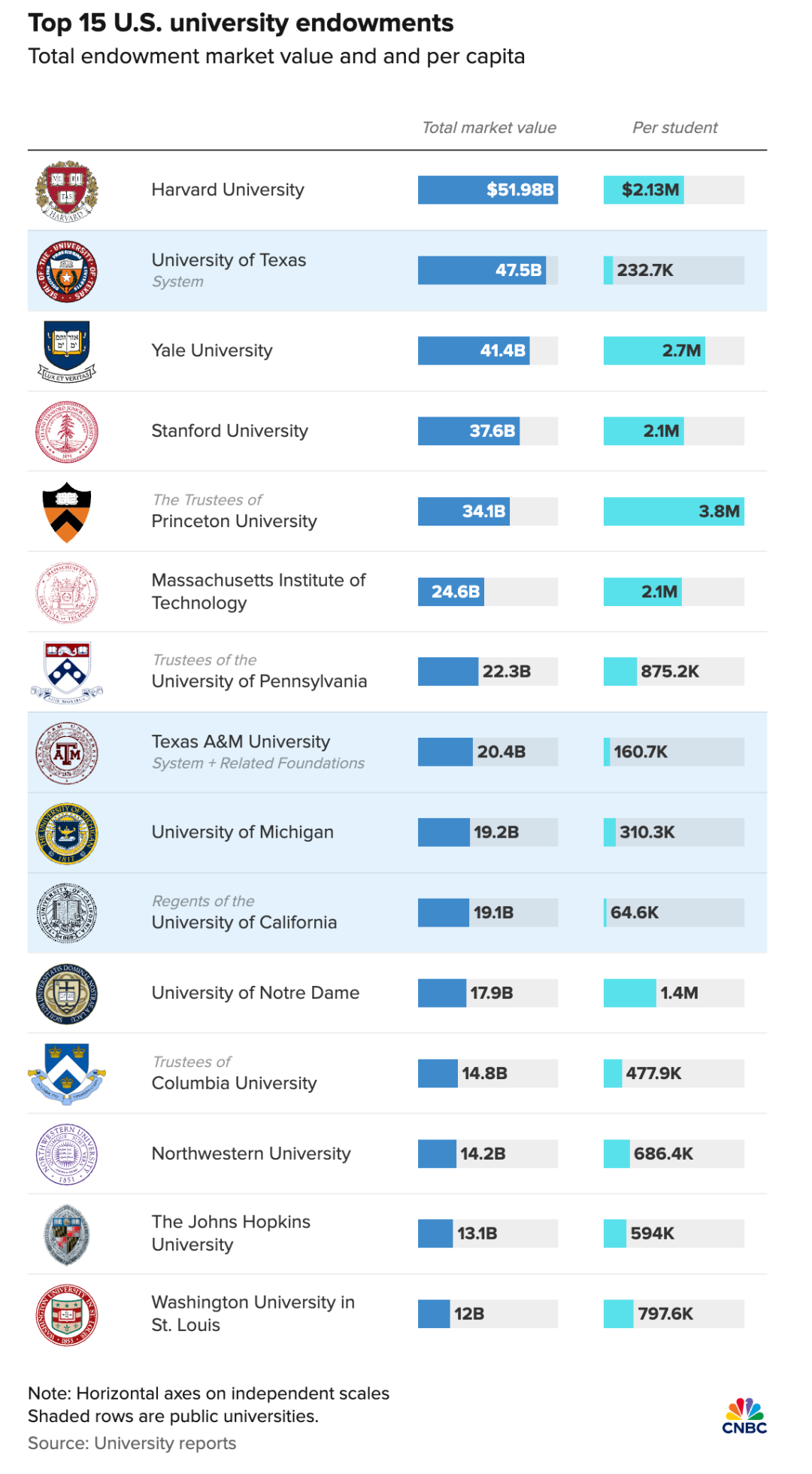
Yale pioneered the “Yale Model” in the 1990s—under legendary CIO David Swensen—emphasizing diversification and heavy allocations to alternative assets like private equity. Yale now ranks among the top 30 private equity investors globally, with over $20 billion in that asset class. Harvard followed suit, slashing its exposure to real assets and boosting private equity investments in recent years.
Yet such strategies depend heavily on what’s known as the liquidity premium: the idea that long-term investors can afford to take on illiquid positions in exchange for higher returns. But in today’s environment, illiquidity has become a liability.
In February, Harvard issued $244 million in tax-exempt bonds and is now preparing a $750 million taxable bond issuance maturing in 2035. Other schools like Princeton and Colgate have also turned to the bond market to shore up finances. Though Moody’s still rates Harvard’s debt AAA, it downgraded its overall higher education outlook to negative in March.
Private Markets Under Siege
Wall Street’s private equity giants—Apollo, Blackstone, KKR—have seen their stock prices plunge more than 20% this year, significantly underperforming the S&P 500. Stuck in a stalemate of frozen deal flow and impaired valuations, private markets are facing their worst liquidity crunch in years.

“New Bond King” Jeffrey Gundlach recently warned that U.S. markets may be on the cusp of a new subprime-like crisis, with risks in the private markets dangerously underestimated. J.P. Morgan strategist Marko Kolanovic echoed this sentiment, noting that private asset volatility has been masked for years by central bank liquidity, but may now resurface with force.
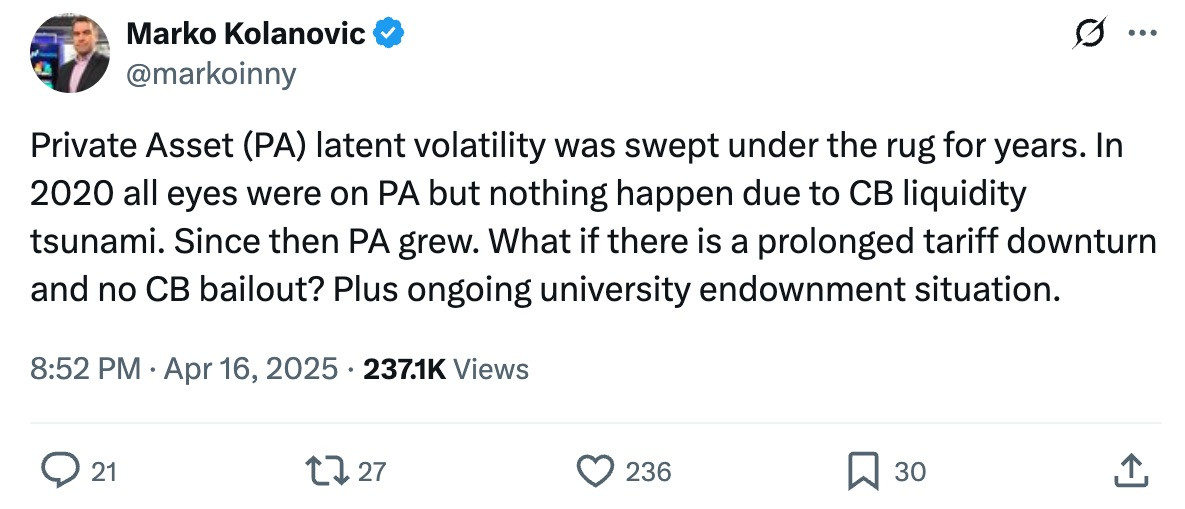
The Yale and Harvard fire sales—if fully realized—could catalyze that reckoning. In the event of a prolonged downturn without Fed support, private assets may face mass repricing.
A Crisis of Confidence in Institutional Capital?
EndGame Macro, a prominent macro research firm, says the deeper issue isn’t leverage, but reputation. For decades, endowments like Harvard and Yale were viewed as models of prudent, long-term investing. Now, political interference is introducing new fragility.
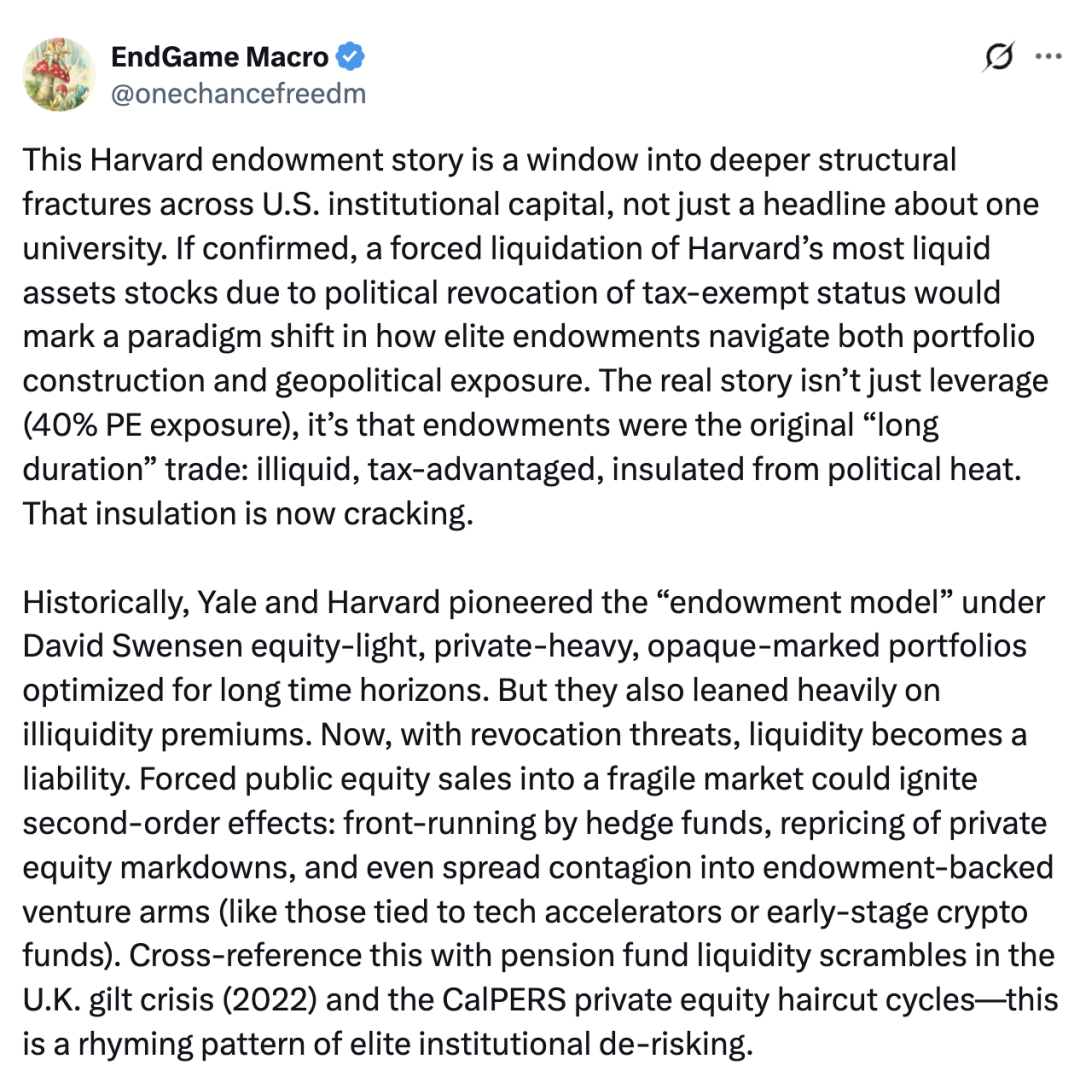
The fear is not just that these institutions are being forced to sell—but that they’re sending a signal to the market: that even “permanent capital” is now under pressure. Should Harvard dump stocks under political duress, it could trigger a wave of defensive repositioning, disintermediation of risk, and a full-blown crisis of confidence in private equity valuation models.
What’s more, the ripple effects could extend to venture capital—especially firms seeded or supported by university funds.
This situation is drawing comparisons to the 2022 UK gilt crisis, where pension funds scrambled for liquidity in a volatile bond market. Much like back then, institutional allocators are now finding that their fortress-like portfolios may be more vulnerable than expected.
In a world where even Harvard is forced to raise cash, the message is clear: no one is immune.
#Private Market: Unlocking Potential#privatemarket