
Gold Price Breaks $3,500, Tolling the Death Knell for Dollar Hegemony

Unsurprisingly, Spot Gold and New York Gold Futures Prices Further Break $3,500/oz on Tuesday.
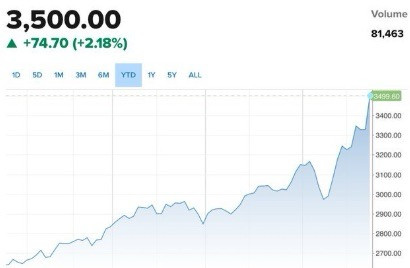
Since April 8 (when gold was still below $3,000), international gold prices have been crossing $100 "milestones" roughly every two trading days.
Given the ongoing turmoil in U.S. stock, bond, and currency markets during the same period, more investors and industry insiders are speculating whether the long-standing dollar-dominated global financial system is facing deeper issues.
Gold Telegraph analyst Alex Deluce recently wrote that the global financial system is not only changing but the old order is beginning to collapse. The dollar's status as the global reserve currency is no longer unquestionable.
For years, Deluce has documented the growing dangers of the West's over-reliance on financial weapons, including sanctions, reserve freezes, and weaponization of the SWIFT system. Deluce believes these are not diplomatic strategy tools but early signs of deeper issues: desperation, vulnerability, and a crumbling world order.
Deluce states that in just the past year, the dollar's purchasing power against gold has decreased by over 35%, driven by record central bank gold purchases. This is not a trend, but a signal.
Meanwhile, BRICS countries are strengthening coordination, while rifts among traditional Western allies are widening. From Europe to Asia, leaders are reassessing their risks in an increasingly unstable dollar system. More countries recognize that true monetary sovereignty begins with a principle: zero counterparty risk—a path leading directly to gold.
Deluce says that as trust disappears, gold is no longer just a safe-haven tool. It's becoming the foundation of a new system—a conclusion he recently reached in discussions with VON GREYERZ partner Matthew Piepenburg.
For decades, U.S. Treasuries have been the cornerstone of the global financial system, viewed as the ultimate safe haven by investors and institutions. But this month, that notion is clearly fading. Piepenburg believes there's now a liquidity crisis, "The system's lubricant is no longer sufficient to keep it running."
U.S. government bonds, instead of providing stability during turbulent times, are starting to behave more like risk assets. During market turmoil earlier this month, Treasury yields rose when they should have fallen, highlighting the system's increasing fragility.
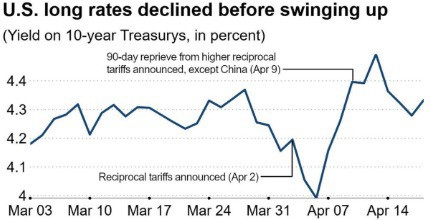
"During times of stress, Treasury yields have actually been rising instead of falling. Why aren't U.S. Treasuries acting like a safe haven anymore?" Piepenburg asks and answers, "The answer lies in debt, which has buried the U.S. economy."
U.S. federal debt is about to exceed $37 trillion, or over $100 trillion if household, corporate, and long-term welfare debts are included. The entire system is teetering under the weight of its own promises.
"When buried under such enormous debt, even Santa Claus can't solve a liquidity crisis," Piepenburg warns. "Without helicopter money, without currency devaluation, there's not enough lubricant to keep these debt wheels turning."
He adds that this is why gold is being quietly re-monetized by global central banks, not as a safe-haven tool, but as a core reserve asset.
"Gold is now a Tier 1 asset. Central banks are net settling in gold. They're moving away from U.S. Treasuries," Piepenburg says. "They're not doing this to get rich. They're doing it to avoid getting poor."
The de-dollarization trend has long been discussed in policy circles, becoming an observable reality after the U.S. sanctioned Russia in 2022. Initially a geopolitical power play, it has now accelerated the adjustment towards multipolar finance.
"Since the dollar's weaponization in 2022, 45 countries have started trading outside the dollar system. 30 countries have repatriated physical gold. This isn't coincidence, it's a reaction," Piepenburg told Deluce.
He points to the key shift when the U.S. froze Russian central bank assets. For many governments, this action shattered the illusion of the dollar as a neutral global reserve. "When you weaponize the world's reserve currency," he says, "you destroy the very trust it relies on."
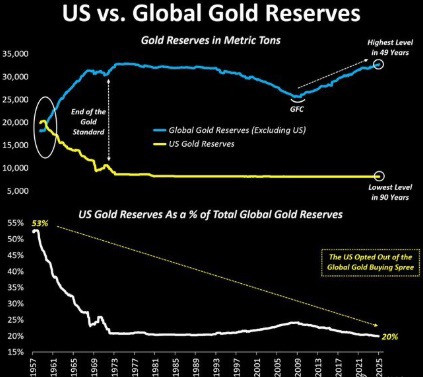
This shift is most evident in BRICS countries (Brazil, Russia, India, China, South Africa). Despite rumors about a BRICS currency, Piepenburg believes they might trust gold more among themselves.
He points out that the BRICS plan is not to replace the dollar overnight, but they are undoubtedly moving away from it.
After their exchange, Deluce and Piepenburg believe, "What we are witnessing now is not the end of the dollar, but the end of its hegemony."
The petrodollar system is breaking down. Gold is quietly being reshaped as a strategic reserve asset. U.S. Treasuries, once the unshakeable cornerstone of global markets, are being reassessed by the institutions that once relied on them. The impact of these changes is far-reaching. Central banks are no longer concealing their actions—they are swiftly and firmly turning to gold.
Finally, the real question is no longer whether gold will continue to rise, but whether the public can understand the deep logic driving this transformation.