
Post-Easter Financial Market Update: Trump's Tariff War, Dollar Weakness, and Cryptocurrency Opportunities

The financial landscape following the Easter holiday remains largely unchanged, with President Trump's tariff war continuing to dominate market discussions. Despite overall weakness in U.S. stocks, a closer examination of the April 21 market performance reveals a nuanced picture. Large-cap stocks, particularly those affected by the tariff war, bore the brunt of selling pressure. In contrast, companies reporting better-than-expected earnings, such as Netflix, managed to buck the downward trend.
Market sentiment has shown signs of improvement since Trump's initial announcement of "reciprocal tariffs" in early April. This shift is primarily attributed to the prevailing belief that these tariffs are negotiation tactics rather than final policy decisions. Investors anticipate significant differences between the announced measures and the eventual implemented plan. Nevertheless, given Trump's characteristically tough stance, the tariff war's influence on market performance is expected to persist throughout the second quarter of 2025.
Against this backdrop, gold prices have consistently reached new historical highs. This surge is not solely due to risk aversion but also reflects the ongoing weakness of the U.S. dollar. Trump's recent threats to Federal Reserve Chairman Powell, aimed at forcing interest rate cuts, have further exacerbated the dollar's vulnerability.
The Dollar Index, having fallen below the critical 100 mark, continues to face selling pressure with no signs of immediate recovery. While short-term technical rebounds are possible, the overall downward trend appears difficult to reverse. Market sentiment remains heavily influenced by developments in Trump's tariff strategy. The President's actions, combined with the risks associated with the tariff war, the U.S. position on the Russia-Ukraine conflict, and comments impacting Federal Reserve decisions, are collectively driving efforts towards "de-dollarization."
The rising popularity of traditional safe-haven assets like gold and the Japanese yen is not solely a result of risk aversion. It also reflects growing market interest in alternatives to dollar-denominated assets. This trend opens up potential opportunities in the cryptocurrency market, particularly if the global economy avoids a significant recession. The parallels between "de-dollarization" and the decentralization ethos of cryptocurrencies are becoming increasingly apparent.
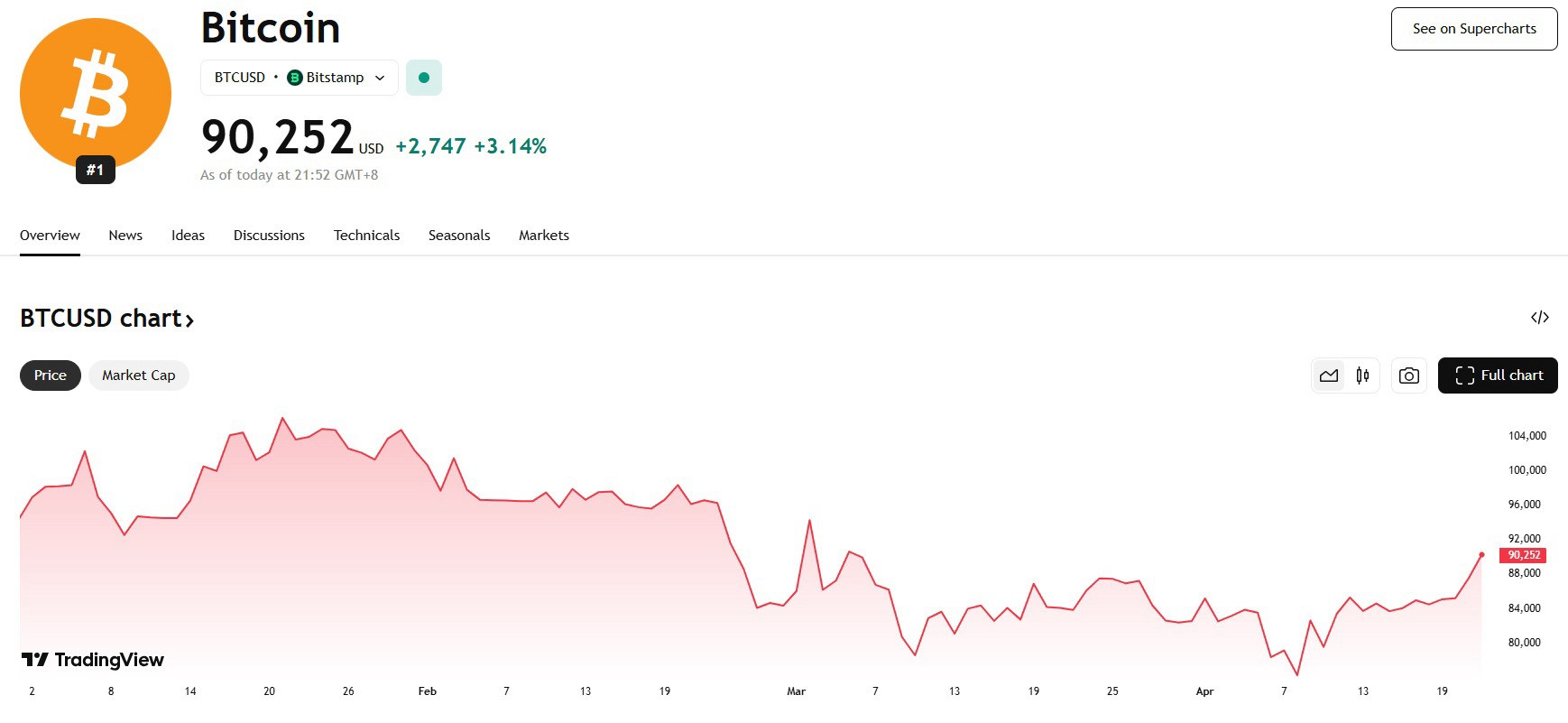
Bitcoin, the leading cryptocurrency, has shown promising technical improvements since April 11. After entering a technical bear market following its all-time high of 109,640 points, Bitcoin has recently regained the $90,000 level. This recovery is significant for the quantitative trading-driven cryptocurrency market.
Ethereum, another major player in the crypto space, has also displayed signs of a technical rebound. However, investors should approach Ethereum with caution due to the current risk-averse market environment and the complex, often conflicting information surrounding this asset.
It's important to note that while cryptocurrencies are benefiting from the de-dollarization trend, the practical applications of many digital assets remain uncertain. Several cryptocurrencies with similar concepts to Bitcoin and Ethereum, such as Solana, Ripple, Chainlink, and Avalanche, continue to underperform, highlighting the high-risk nature of these investments.
The current investment thesis for cryptocurrencies primarily revolves around dollar weakness and, in Bitcoin's case, its scarcity. For those interested in exposure to the crypto market through traditional equities, focusing on companies like Strategy may be advisable. Cryptocurrency exchanges like Coinbase, while integral to the ecosystem, may face challenges in demonstrating long-term value appreciation without a broader cryptocurrency boom.
In conclusion, the weakening dollar creates opportunities across various asset classes. While gold remains a traditional beneficiary of dollar weakness, cryptocurrencies are increasingly positioning themselves as potential alternatives. However, investors should approach the crypto market with caution, recognizing both its potential and its inherent volatility.
As the financial landscape continues to evolve, staying informed about global economic trends, policy decisions, and technological advancements will be crucial for navigating the complex interplay between traditional and emerging asset classes. The ongoing tariff war, shifts in monetary policy, and the growing interest in decentralized financial systems are likely to shape investment strategies in the coming months and years.