
Is This the Moment to Pounce on NVIDIA’s Dip?

$NVDA ’s stock has taken a beating—but is it a buying opportunity? Recent research from Bank of America and Citigroup highlights three looming catalysts that could redefine the semiconductor leader’s trajectory. Despite near-term headwinds, both firms stick with “Buy” ratings, suggesting long-term upside remains compelling.
What’s Driving the Sell-Off?
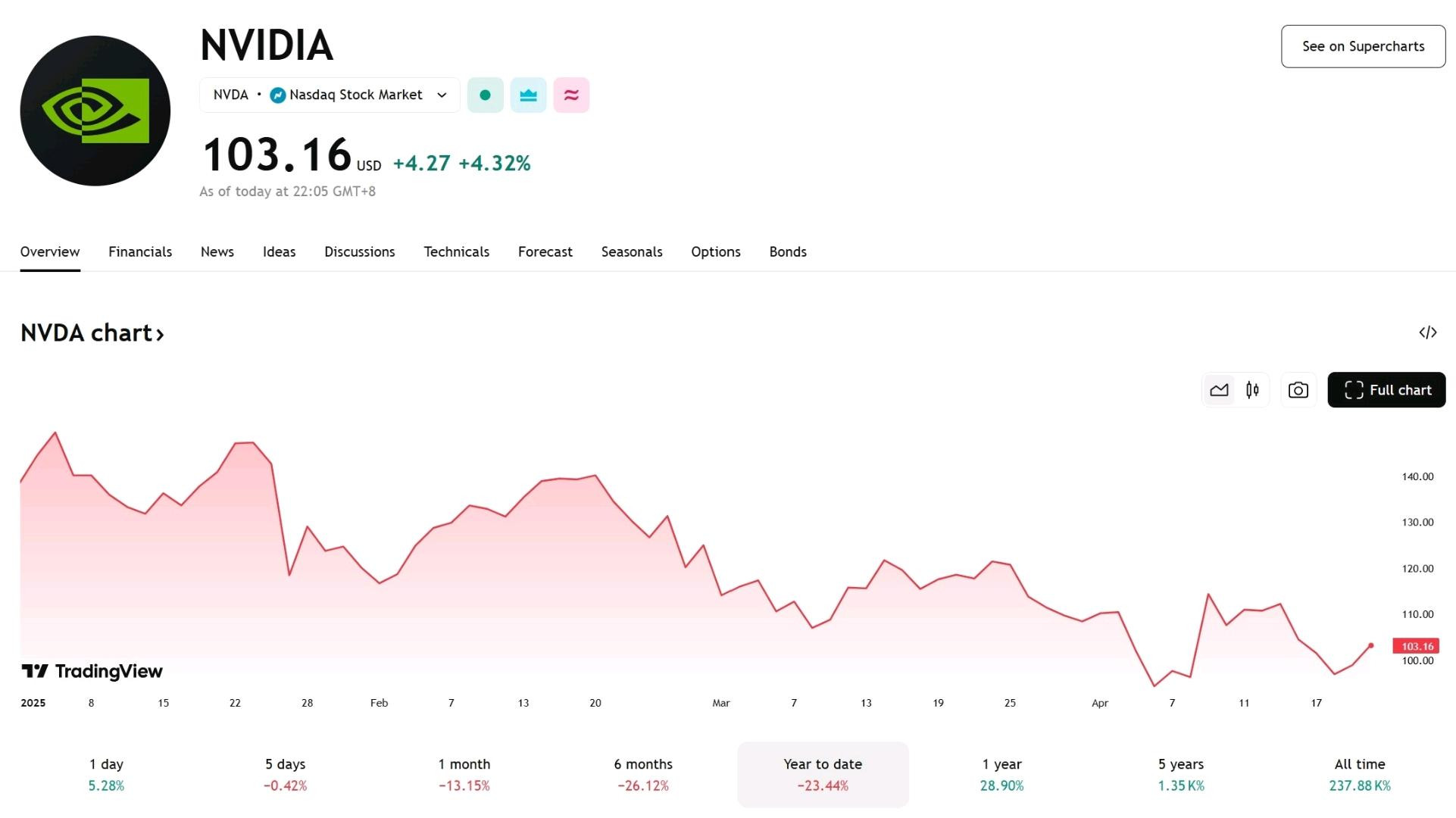
$NVDA plunged 14% after U.S. export curbs on its H20 GPUs took effect on April 15, underperforming the Philadelphia Semiconductor Index’s 8% drop and $SPX ’s 4% slide. Four factors are weighing on valuations: tightened Chinese sales (≈13–14% of total revenue but just 3–6% of data-center sales), new AI export controls set for May 15 that threaten up to 10% of sovereign-nation sales, near-term margin pressure as gross profit dips before rebounding to ~70%, and uncertain cloud capital expenditure outlook for 2026.
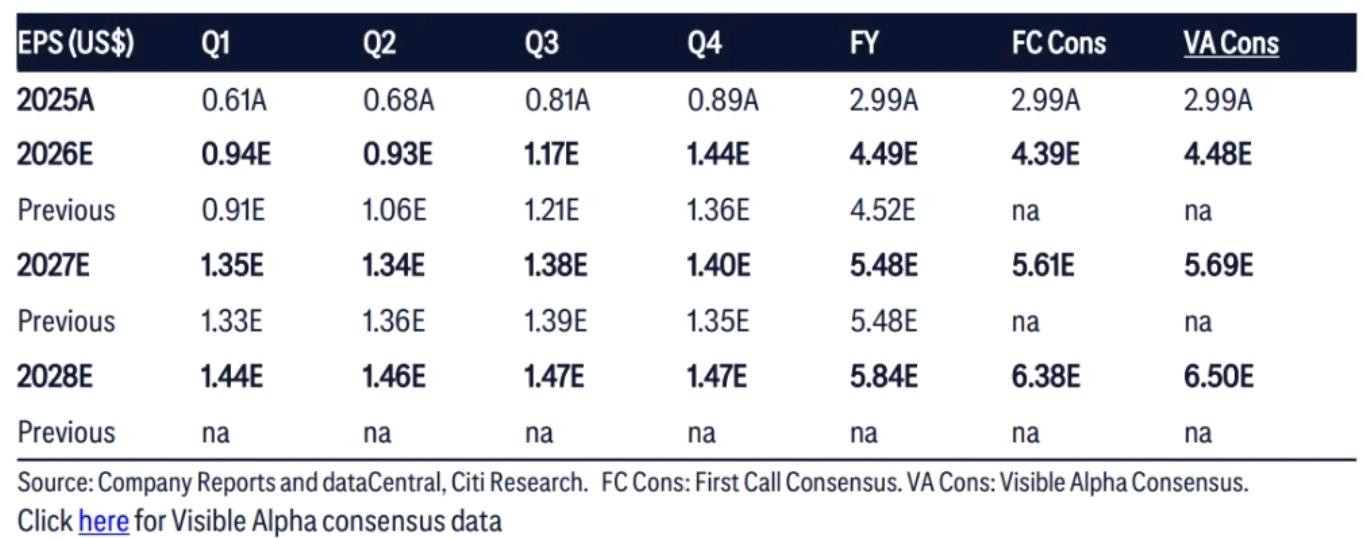
Bank of America still sees the pullback as a buying chance. Their 2026/27 EPS forecasts of $3.97 and $5.74 embed these risks. Yet even in a worst-case scenario—10% export clampdown—the forward P/E remains just 19×, well below its 30× historical median and 23× cycle trough. BofA’s $150 target reflects a 26× multiple on 2026 EPS.
Is Citigroup Seeing the Same Opportunities?
Citigroup analysts Atif Malik and Papa Sylla warn of three “clear-out” events: the May 15 AI rules, big cloud-provider spending, and tariff-driven margin erosion. After provisioning $5.5 billion for export restrictions, Citi pegs Q1 revenue roughly $500 million above consensus but forecasts Q2 flat sequentially at $44 billion—an unusual stall for a firm built on growth momentum.
Even with new GB200 chips out and GB300 on deck for late 2025, weak H20 demand in Asia and broader Hopper series softness could limit upside. Citi nonetheless retains a Buy rating and $150 price target, underpinned by a 30× multiple on 2026 EPS and faith in NVIDIA’s AI dominance.
How Bad Is AMD’s Outlook?
$AMD looks the other way. BofA downgraded its stance to Neutral, cutting the target from $110 to $105. Like $NVDA , $AMD will shoulder China-ban write-offs—about $800 million in Q2 for MI308 inventory reserves. Assuming a 40% gross-margin hit, those MI308 shipments represent 18% of data-center GPU volumes and 4% of total sales this year.
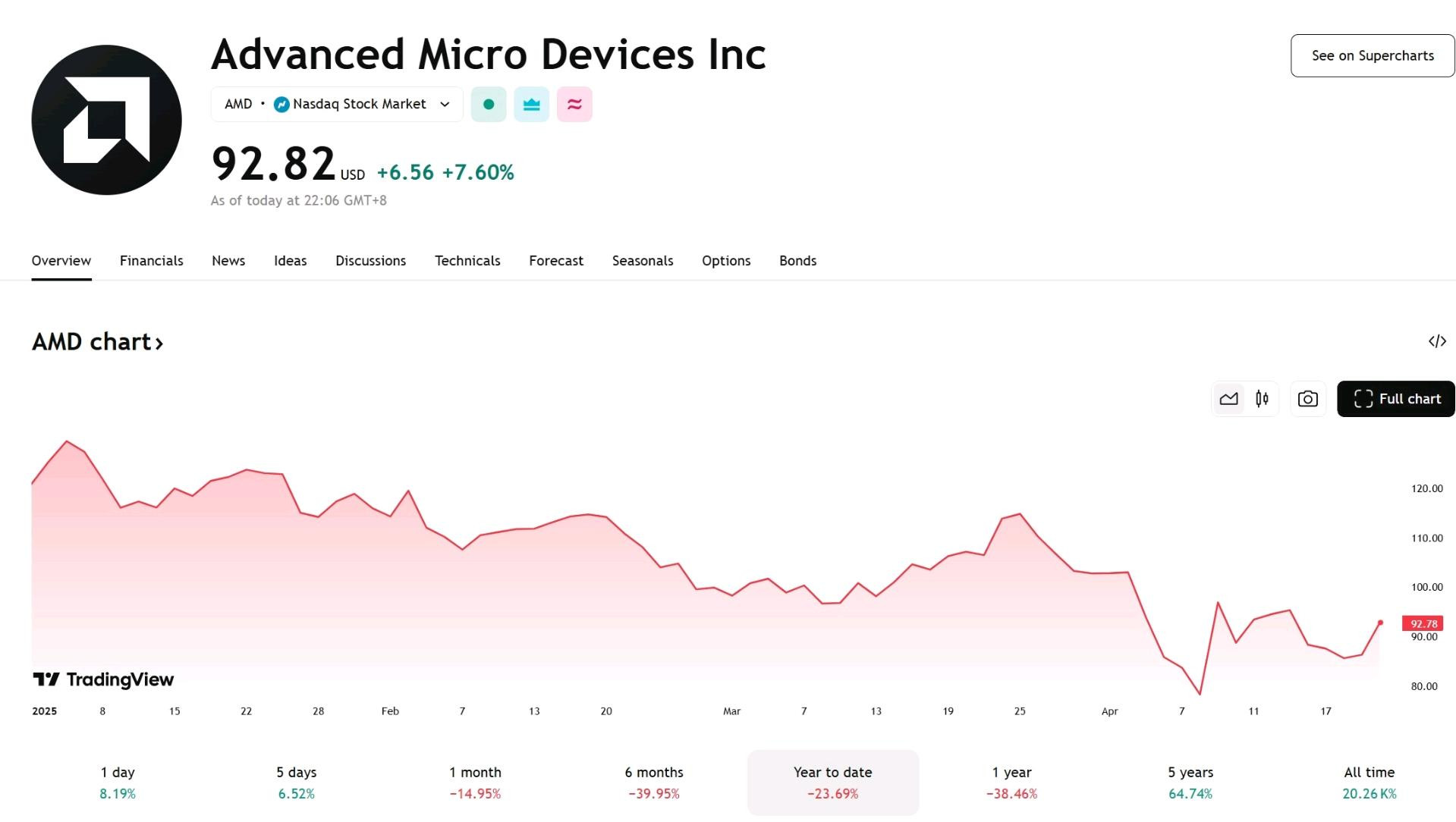
BofA expects resistance to ease in FY26–27 as China-sold MI308s face local rivals. They model a 50 bp gross-margin uptick from Q3 onward as dilution fades and tariffs partly offset cost inflation via supply-chain reshoring. Their $105 target equates to a 20× forward P/E and PEG ≈0.9, in line with high-growth compute peers.
Bernstein, however, strikes a more skeptical tone. Analyst Stacy Rasgon says $AMD ’s AI chips “lack competitiveness,” and the PC business may suffer as clients front-load orders ahead of tariffs. He forecasts Q2 revenue of $6.79 billion—well below FactSet’s $7.25 billion consensus—and full-year 2025 sales of $28.6 billion versus $31 billion prior guidance. Bernstein maintains a Market-Perform rating with a $95 target, arguing Intel’s revived CPU push and $AMD ’s fragile AI roadmap justify caution.
Could Domestic Players Seize the Moment?
China’s tech champions aren’t standing idle. Homegrown GPU and CPU innovators have a shot at filling the void left by U.S. export controls. Breakthroughs in advanced wafer fabrication and AI-optimized architectures could unlock massive share gains and outsized returns in Beijing’s push for semiconductor self-reliance.
What’s the Takeaway for Investors?
The export curbs and new “AI diffusion” rules inject fresh volatility, but market panic may overshoot fundamentals. $NVDA ’s forward P/E near 17.4× sits well below historical norms, implying that episodic policy shocks have been over-discounted. Meanwhile, $AMD ’s Neutral status and mid-teens multiples leave less room for error unless it can prove its AI chops.
True resilience may lie with companies mastering the full chip lifecycle—from design to foundry alliances to software ecosystems. In the meantime, share-price dips present selective entry points. For those wagering on entrenched AI leadership, $NVDA ’s pullback may be too good to ignore. For risk-adjusted exposure, $AMD ’s mid-cycle neutrality warrants close monitoring—especially once its June earnings clarify the fallout from China.
In an industry buffeted by geopolitics, the winners will likely be those that navigate export rules, diversify customer bases, and cement AI moats. Whether you side with $NVDA ’s discounted growth or tread carefully around $AMD ’s hurdles, understanding these “three clearing events” and supply-chain dynamics is critical to threading the needle in semiconductor investing.
This content is provided for informational or educational purposes only and does not constitute investment advice.