
Earnings Preview of US Stocks: The Google Empire Under Siege

The transfer of power in human society always follows a certain pattern: when a force becomes powerful enough to monopolize the rules, it will eventually become its own gravedigger.
Tocqueville already revealed in The Old Regime and the French Revolution that absolute power inevitably gives rise to absolute resistance.
At this moment, Google is right at the eye of this historical cycle.
After the market closes on April 24th, Google will release its first-quarter earnings report for this year.
Recently, Google has not performed well. When other tech giants were rising together in the past, its upward momentum lagged behind, but when they fell, it didn't miss out on any of the decline.
Currently, Google's stock price is around $150. It has dropped by about 22% since the beginning of the year, far lower than its level of $194 at the end of June 2024. It has also underperformed the S&P 500 index, which has fallen by 10% during the same period.
At the same time, the iron fists of global regulatory authorities have come one after another. The U.S. Department of Justice has demanded the divestiture of Google's Chrome browser and its advertising trading platform. The European Union has imposed a cumulative fine of over 8.25 billion euros, and Japan has ordered Google to rectify its pre-installation agreements.
It seems that the Google Empire is on the verge of collapse.
Forecast for This Earnings Report and What We Should Pay Attention To
Currently, Wall Street expects that Alphabet, Google's parent company, will report revenue of $89.2 billion for the first quarter, a year-on-year increase of 11%. The net profit is expected to be $24.71 billion, which is $2.01 per share, higher than the $23.66 billion and $1.89 per share in the same period last year.
Benefiting from its search engine and the continuously growing cloud business, my estimate might be a bit better than Wall Street's. We estimate that Google's revenue for this quarter will be between $91 billion and $92 billion, and the net profit will be between $25 billion and $26.5 billion.
Currently, the market still focuses on the following key points in Google's earnings report and conference call: advertising revenue, search engine market share, AI application and monetization, the growth rate of the intelligent cloud, the digital countermeasures from the European Union and China, as well as the progress of antitrust actions.
The advertising business accounts for 75% to 80% of Google's revenue and is its absolute core business. For Wall Street, the revenue of YouTube is the core of the core.
Analysts expect that the advertising revenue in the first quarter will be between $68 billion and $70 billion, with a year-on-year growth rate slightly higher than 8%, but failing to reach double digits. Among them, the expected core advertising revenue from YouTube is about $8.8 billion to $9 billion, with a growth rate of around 10%, slightly lower than the previous performance.
The number of YouTube users is still increasing. Considering the number of impressions per user and the advertising unit price, its core advertising revenue may be flat or higher than expected. However, since the advertising business is highly cyclical, and the relevant data in the United States in the first quarter was not good, the advertising unit price may face pressure to decline.
In terms of the search engine, according to Citibank, Google still holds about 90% of the search engine market share and nearly two-thirds of the browser market share. Microsoft's Bing still can't compete with Google, and Google's moat remains solid. However, at the hearing on Tuesday, the U.S. Department of Justice's antitrust lawsuit targeted Google, and Chrome may be forcibly divested. We will elaborate on this later.
In the area of cloud computing, it is currently Google's fastest-growing business and is regarded as the next growth point. Although its growth rate in the first quarter has slowed down somewhat, it is still the fastest-growing among the three major cloud service providers. Its market share remained at 12% in the fourth quarter of last year, and its backlog of contracts exceeded $90 billion. It is highly likely to accelerate again in the future.
The Google Empire Is Under Siege Worldwide
In addition to the above, we need to pay attention to how Google's senior management will respond to the global antitrust proceedings against Google.
In April 2025, the U.S. Department of Justice demanded that Google spin off its $31 billion advertising business. The Department of Justice believes that Google has a monopoly position in the search and advertising markets. Through various exclusive agreements, bundled sales, and other means, it has restricted competition and harmed the interests of consumers. The divestiture of the advertising business will help break Google's monopoly and promote fair competition in the market.
In addition to the advertising business, the U.S. Department of Justice also requires Google to divest its Chrome browser business and prohibits Google from paying billions of dollars to device manufacturers like Apple to ensure that its search engine remains the default option. Moreover, it requires Google to license its search data to competitors and disclose information such as its search results and ranking signals to help new entrants overcome the barriers to entry.
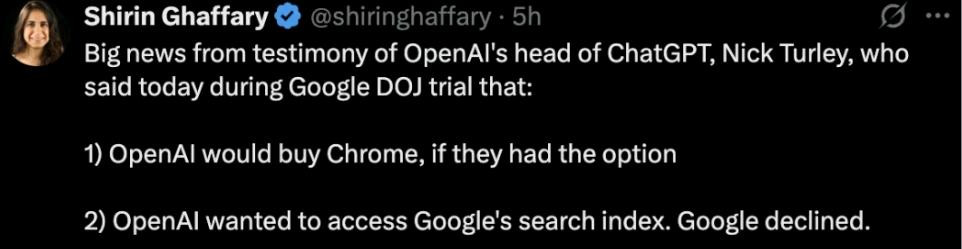
Meanwhile, at the court hearing, Nick Turley, the head of ChatGPT, declared with great determination: If the federal court forces Google to divest Chrome, OpenAI will not hesitate to acquire it.
If Google is forced to sell Chrome, it will be a milestone event in the history of technology. If this ruling comes true, it will be the first "mandatory" divestiture of a tech giant in the United States since the breakup of AT&T in the 1980s.
It will also deal a heavy blow to Google. I can't help but wonder, will Google still be that technological empire without Chrome?
In addition, in 2017, the European Union imposed a fine of 2.42 billion euros on Google because its shopping comparison service abused its dominant position in the search engine market. Google gave priority to its own shopping comparison service (Google Shopping) in the search results and was required to rectify the situation to allow competitors to compete fairly. This case was also the first major antitrust penalty imposed by the European Union on a tech giant.
In 2018, the European Union accused Google of forcing mobile phone manufacturers to pre-install Google Search and the Chrome browser, and through economic incentives, prohibited manufacturers from pre-installing competing applications and prevented them from using non-official Android systems (such as forked versions). The European Union required Google to stop the bundling behavior, allow device manufacturers to choose pre-installed applications independently, and issued the highest antitrust fine in the history of the European Union at that time, which was 4.34 billion euros.
In 2019, the European Union filed an online advertising monopoly case against Google, accusing Google of restricting third-party websites from displaying advertisements of its competitors (such as Microsoft and Yahoo) through AdSense advertising service contracts, hindering market competition. Google was prohibited from setting exclusive clauses in advertising contracts, and was required to open up advertising cooperation channels, and was fined 1.49 billion euros.
The European Union's three lawsuits have cumulatively demanded a fine of 8.25 billion euros from Google. Although Google appealed against the first two cases, on the morning of September 10, 2024, the European Court announced that it would uphold the ruling of the lower court, and Google failed to overturn the EU's decision to fine it 2.4 billion euros for its monopolistic behavior.
What's Next for Google?
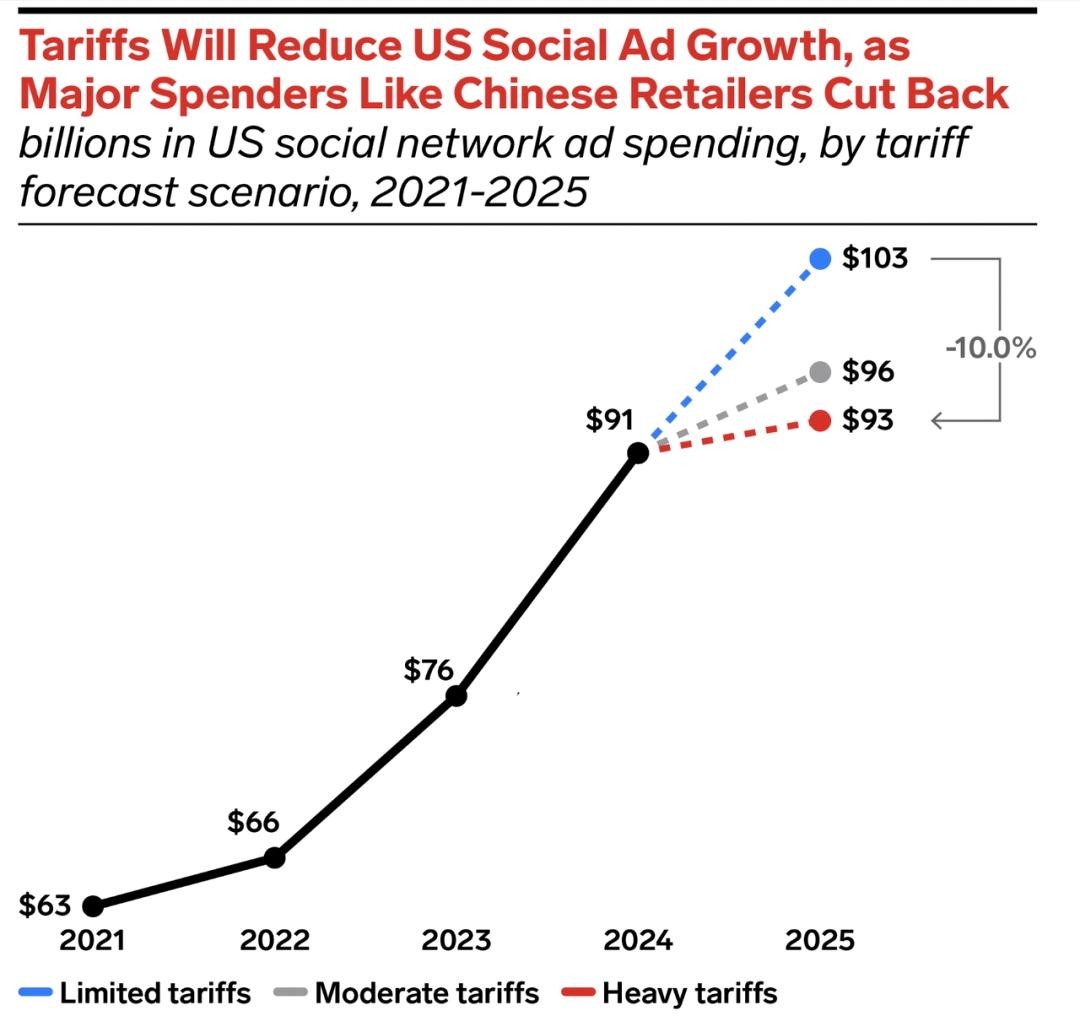
In fact, the recent tariffs have also had a certain impact on Google. Analysts estimate that by 2025, tariffs may reduce U.S. social advertising spending by about $10 billion. If the tariffs are less severe and more targeted, the growth may still be around the initially predicted $103 billion. In the case of mild tariffs, the growth may decline to $96 billion, and under more severe and widespread tariffs, this figure may drop to $93 billion.
This is undoubtedly another negative factor for Google.
From a technical perspective, the stock seems to be trying to climb out of the trough. Currently, the stock price is lower than its EMA21 ($159.2), EMA50 ($167.2), and EMA200 ($171.4) moving averages. Although the stock is attempting to rise towards these EMAs, it has not yet triggered a bullish crossover. Therefore, before the 50-day moving average breaks through the 200-day moving average, there is no strong technical confirmation of a breakout. The RSI indicator has rebounded from the oversold area since early April and is currently around 42, with the momentum increasing.
In fact, based on the above analysis, I am still optimistic about Google's trend. First of all, based on previous examples, I think the probability of it being forced to divest Chrome is extremely low. At the same time, benefiting from the rapid development of AI and its relatively low valuation, it still has investment value.
I believe that Google is such a stock. It is not an easy stock to make money from, but it is a safe haven for stable growth for every long-term investor.