
Gold ETFs Face Massive Outflows: A Sign of Economic Uncertainty or False Dawn?

The world's largest gold ETF, GLD, experienced an outflow of $1.3 billion last Wednesday, marking the third-largest outflow on record. This follows a record daily inflow of approximately $1.9 billion the previous week.
Consequently, according to Goldman Sachs data, GLD was the third most traded ETF on Wednesday.
Additionally, GDX, one of the world's top three gold ETFs, saw a $200 million withdrawal, the largest single-day outflow in the past 12 months.
All this stems from Wednesday's 2.7% drop in gold prices, the second-largest decline this year. After a strong rally, the recent price drop triggered significant profit-taking and repositioning.
Selling gold for liquidity has been and remains inevitable. The U.S. market craves clarity. Once clarity emerges, funds will flow out of gold into other assets.
However, is the U.S. market truly clear now? Often, market sentiment surrounding gold ETFs is just a typical liquidity trap, as retail investors tend to react only to headlines.
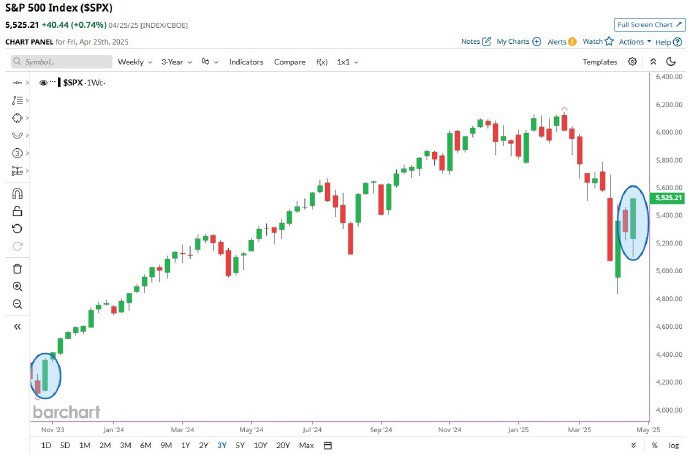
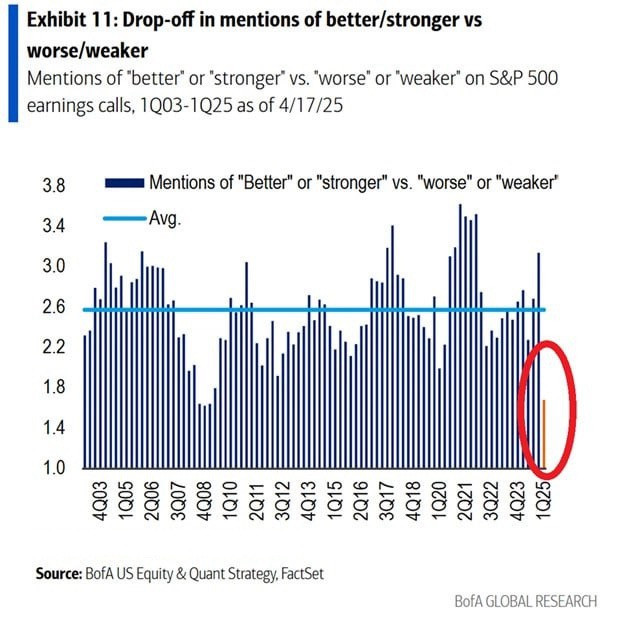
The same applies to the S&P 500. The index rose 4.59% this week, its third-best week since October 2023. Yet, U.S. executives are rarely so pessimistic about the economy: In Q1 2025 earnings calls, the ratio of S&P 500 companies mentioning "better" or "stronger" versus "worse" or "weaker" was 1.7x, the lowest since 2008.
In contrast, the previous quarter's ratio was 3.1x, almost double. Even in 2020, this indicator was as high as 2.0x.
U.S. bear markets often see 10-15% rebounds during downturns, so is the U.S. market correct or incorrect in its valuation of U.S. companies? Are they simply betting on more currency devaluation and using the stock market as a tool to defend against inflation? What will be the outcome? With soaring uncertainty, U.S. companies are also struggling to provide guidance to investors.
As hopes for Fed rate cuts in the near term fade and macroeconomic uncertainty increases, risk aversion is taking hold—large inflows into U.S. Treasuries indicate investors seeking safety.
The Fed has again signaled "higher for longer," causing funds to shift towards U.S. bonds, raising prices and temporarily lowering yields. If this trend concentrates on the front end, it could flatten the curve; if it broadens, it would compress yields across the board.
If these fund flows persist, a stronger narrative of U.S. economic slowdown would permeate broader risk assets—caution signals are flashing everywhere.
This is based on expectations for the U.S. future, as it will impact the U.S. economy in the coming months.
Reduced inventory on shelves, rising prices, business closures, and layoffs. The U.S. market typically experiences counter-trend rallies before deep dives, and markets often overshoot before corrections.
So, as Trump quietly uses the toughest language to say the most cowardly things across various domains, is the current U.S. market experiencing a genuine rebound or a typical bull trap?
You guess?