
When Will the Impact of the Tariff War on U.S. Basic Consumption Become Apparent?

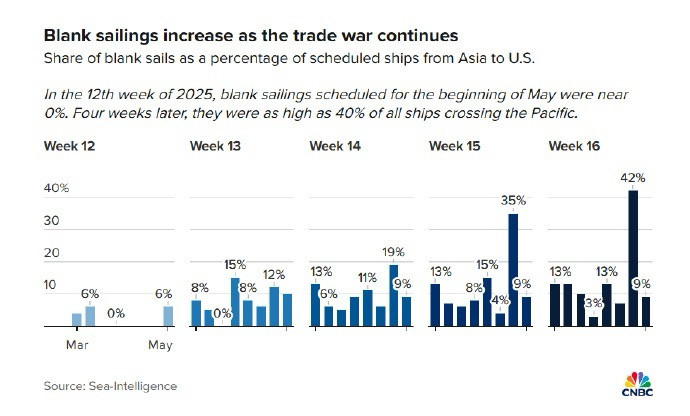
The first chart, from Sea-Intelligence, shows what shipping experts call "blank sailings," or large-scale cancellations on Asia-U.S. routes. Within just four weeks, the cancellation rate skyrocketed from near zero to 42%. This dramatic shift suggests significant changes brewing beneath the surface of the U.S. economy.
Why are U.S. store shelves currently only experiencing price increases rather than widespread shortages?
This involves the physical laws of global trade. For example, the shipping cycle from China's eastern coastal ports to U.S. West Coast city shelves takes 25-45 days—production time alone requires 6 to 12 weeks, depending on the product, sea shipping takes 4 to 6 weeks, and U.S. customs clearance and shipping time is 2 weeks.
The goods Americans are buying now actually started their journey before the new tariffs took effect. This creates a "calm period" at the consumer end—the shopping experience seems normal, but the supply chain's blood vessels are rapidly emptying.
A specific example: When 145% tariffs are added, a product originally costing $100 skyrockets to $245 before accounting for U.S. logistics, warehousing, and retail markups. For U.S. low-end stores and fast-moving consumer goods with already thin profit margins, this arithmetic problem loses its calculable value. U.S. importers are consequently triggering a wave of order cancellations. The U.S. retail system is built on speed and scale; when this engine malfunctions—whether due to tariffs, customs delays, or purchasing restrictions—the products with the lowest profits and fastest turnover will be the first to disappear from the U.S.
Unlike the instant shelf-clearing of the Covid buying panic, this crisis will unfold in slow motion. As U.S. inventories gradually deplete without replenishment, the effects will become apparent in stages over the coming months.
The second chart, from Import Genius and SONAR, presents shipping data from China to retail giants like Amazon, IKEA, and Walmart.
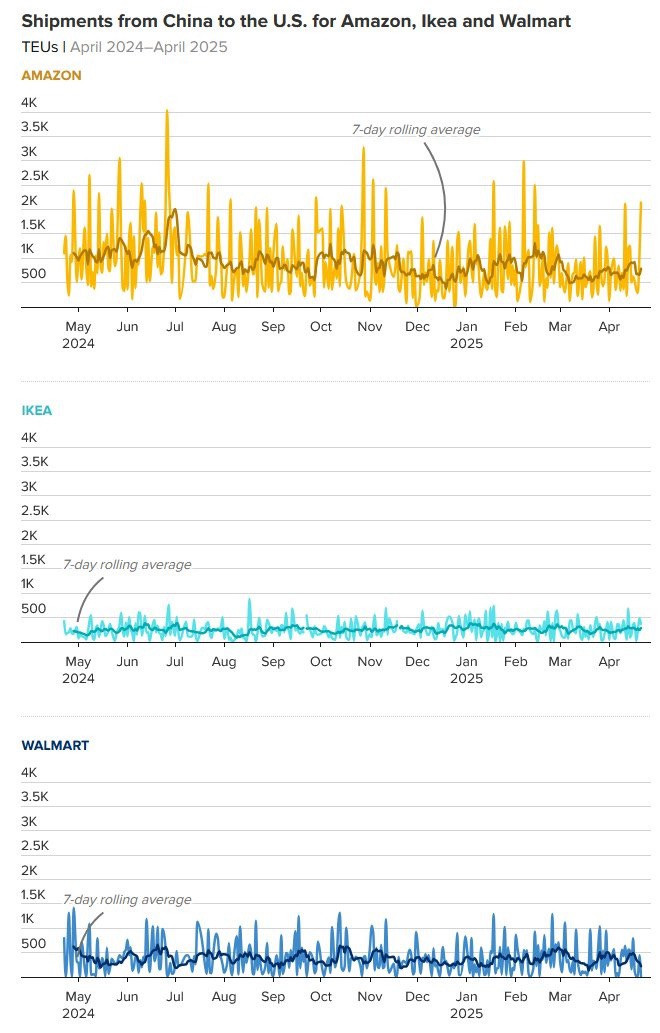
Some may notice that freight volumes haven't yet plummeted, which could create a false sense of security if only focusing on current U.S. store inventories. However, those who understand the workings of U.S. retail supply chains can already foresee the direction of the undercurrent.
Large U.S. retailers typically maintain 60-90 days of inventory for core products. When tariff rumors first arose in the first quarter, many U.S. companies engaged in "rush shipping and stockpiling," which acted as a stimulant for the supply chain. According to Import Genius data, U.S. retail giants like Home Depot have recently increased orders from Chinese suppliers to the U.S. The Lianhe Zaobao reports that tariffs are paid by U.S. companies. While this buffer can delay the visible impact, its protective effect is both time-limited and unevenly distributed across product categories.
The key to predicting the U.S. shortage wave lies in grasping the sequence in which goods will disappear. This follows a logical chain composed of three major factors: paper-thin profit margins, rapid product turnover, and deep dependence on Chinese manufacturing.
It's crucial to look at various U.S. industries' dependence on Chinese manufacturing. Clothing and footwear are at the forefront—about 37% of U.S. clothing and 58% of footwear come from China. When new tariffs are added to existing rates, the total tax rate for most products exceeds 160%. This tax rate is essentially equivalent to an import ban. Basic apparel items like T-shirts, leggings, and socks—which combine rapid turnover with minimal profits—will be the first to disappear from U.S. shelves. Fast-moving consumer goods like clothing typically have quick turnover, and thin profits mean insufficient buffer inventory.
Besides clothing, initial signs of U.S. shelf vacancies will also appear where price-sensitive imported goods dominate—such as toys, games, and affordable household items. These are warning signals of supply chain disruption.
Seasonal goods and toys will be hit first, as they perfectly combine the three risk factors. Currently, it's the purchasing window for U.S. back-to-school items (July-August sales period). This time misalignment will trigger a chain reaction. Due to shortened delivery times and changes in tariff timing, toys and seasonal children's items (including back-to-school supplies) will disappear next.
The supply of low-cost household items and consumer electronics will be restricted because, although many products in these categories are not "finally assembled in China," their components are often assembled there. Moreover, many products (phones, headphones, etc.) update frequently. Some Amazon sellers and large department stores may experience shortages in cheap electronics and accessories.
In the U.S. retail battlefield, giant U.S. companies with multiple moats can still survive: diversified procurement networks outside China + pricing power over consumers + ability to lobby the White House. Membership-based retailers show advantages—their customer base is less price-sensitive, allowing for moderate price increases without losing foot traffic, and they have the strength to get exemptions from Trump.
Discount retailers and U.S. small and medium-sized enterprises, however, face their darkest hour. Their business models are rooted in Chinese manufacturing, fixed pricing strategies leave almost no room for cost transfer, and their customer base is the most price-sensitive group.
Optimism among U.S. small businesses is waning: The NFIB Small Business Optimism Index fell 3.4 points to 97.4, the lowest since last October. This is the third consecutive month of decline. The net percentage of owners expecting improved business conditions decreased by 16 percentage points to 21%, marking the largest single-month drop since December 2020. The proportion of businesses expecting sales growth fell by 11 percentage points to 3%, the lowest since October.
However, since 1995, U.S. small businesses have solved about 62.7% of U.S. employment, with an economic impact of 44%.
This is the fundamental aspect of the U.S. economy.
How to solve these problems? Who can solve these problems?