
Investing Globally: What Is the Outlook for the Stock Markets of the United States and Japan?

Magical Investor
April 28, 2025
GoGPT Summarizes Articles
The US stock market has been weak this year. In particular, there was a significant sell-off when the tariff plan was announced in early April. The market once dropped from a high of around 6,100 points to 4,834 points, with a correction of nearly 20%, and it entered a technical bear market for a while. At the same time, the US Dollar Index also plunged by 10%. The tariffs caused global investors to abandon US dollar assets on a temporary basis.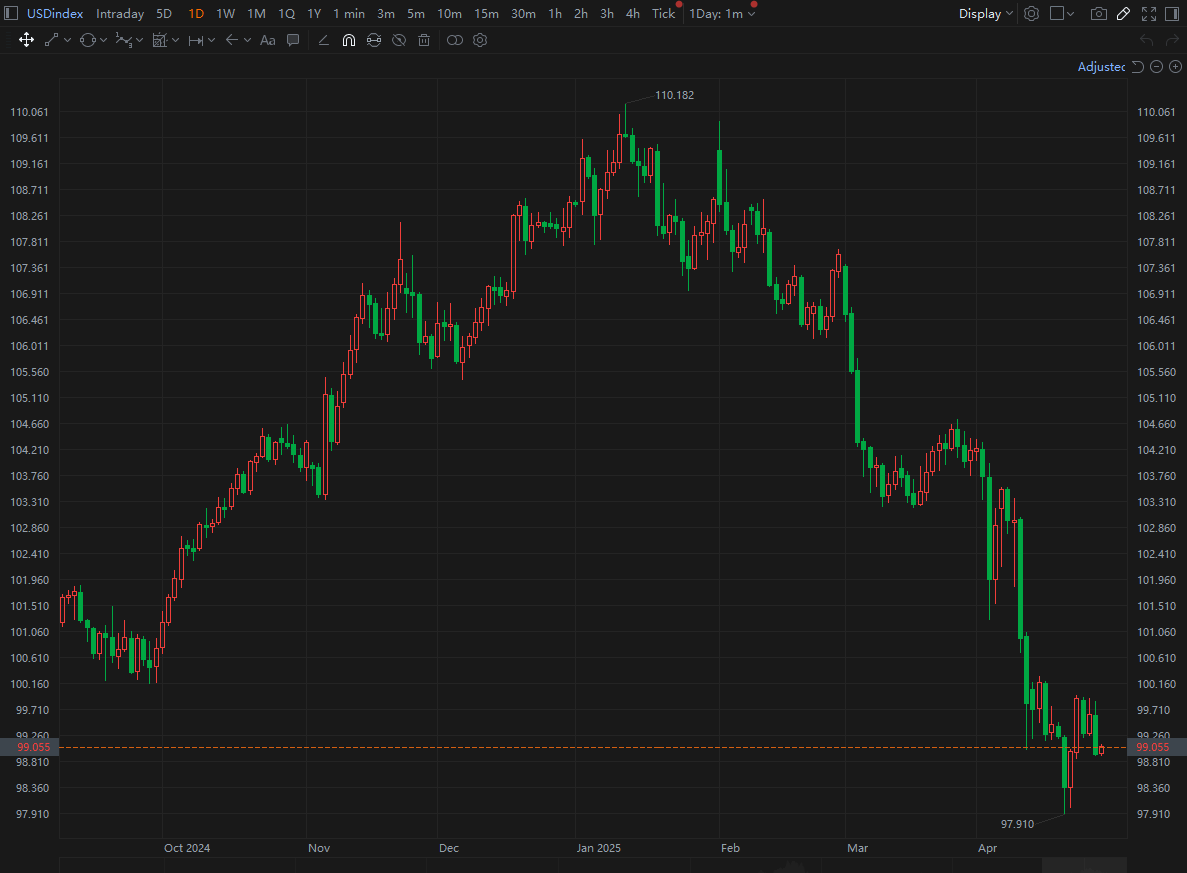
This year, the Japanese stock market has also been quite volatile. On April 7th, due to investors' concerns that the "reciprocal tariffs" imposed by the United States would lead to a global economic recession, the Tokyo stock market in Japan fell across the board on that day. The Nikkei 225 Stock Average closed down 7.83%. However, the market then began to stabilize and rebound. Since the beginning of the year, the Japanese yen has rebounded by about 7% against the US dollar.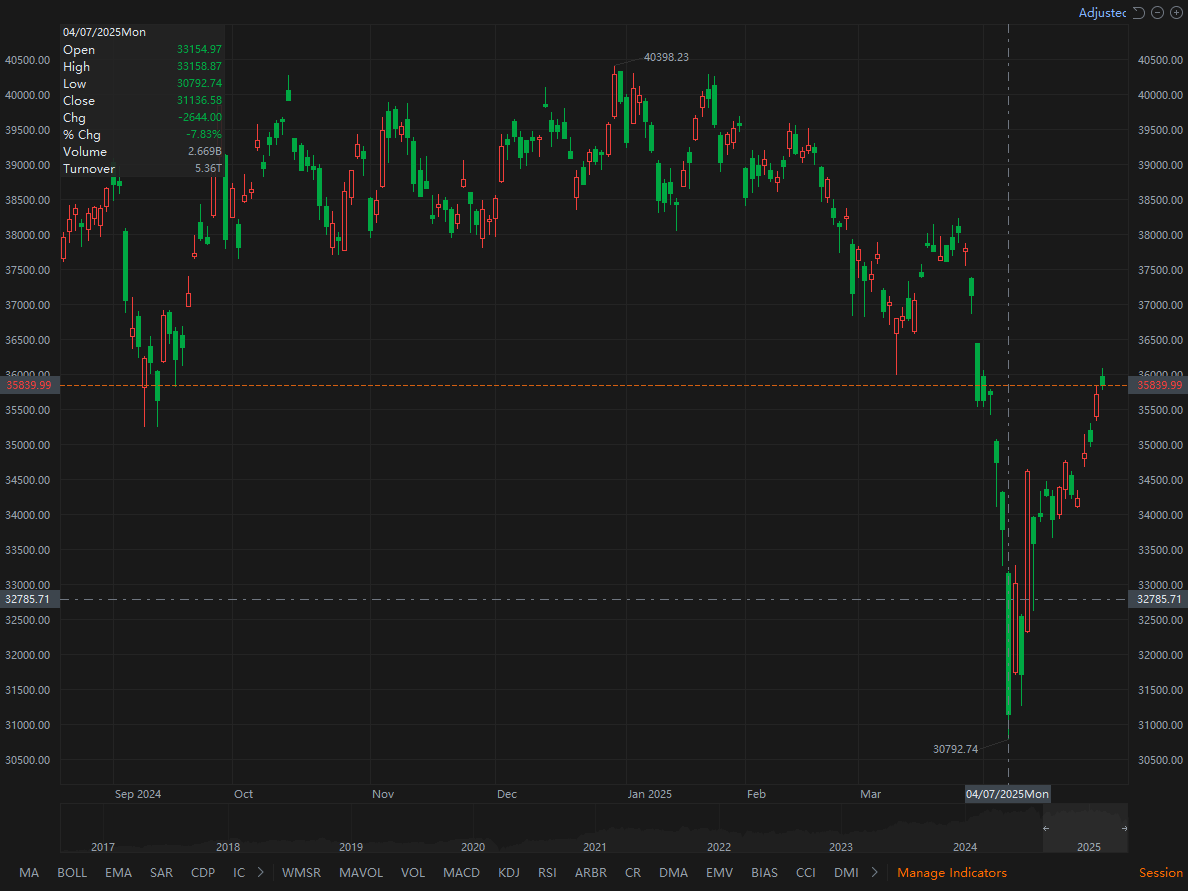
Today, let's discuss these two markets separately.
The US Stock Market Awaits a Breakthrough After Wide Volatility
Now, with the easing of the tariff war, the US stock market has fallen into a wide trading range between 5,000 and 5,600 points (S&P 500 Index).
Michael Wilson, the chief US stock strategist at Morgan Stanley, recently said, "A variety of competing factors are intertwined, keeping the S&P 500 Index still within the short-term trading range of 5,000 to 5,600 points that we set. The recent suspension of reciprocal tariffs and some exemption measures indicate that the government is willing to show a certain degree of flexibility in its tariff policy. This is a positive signal."
However, Morgan Stanley believes that negative factors still exist: the downward revision trend of earnings expectations continues, the Federal Reserve remains on hold, and long-term interest rates are somewhat sticky.
In the future, the upward risks that may push the S&P 500 to break through 5,600 points include: the Federal Reserve turning more dovish, reaching a broader trade agreement with China, long-term interest rates falling below about 4% (without a recession), or an upward inflection point in earnings expectations.
Currently, there is still a high degree of uncertainty in the US stock market. In the view of Goldman Sachs, if the tariff issue cannot be effectively resolved, the selling of international funds may not have ended yet, and it will have a huge impact on the US stock market.
Specifically, the crowded trading of US assets is more serious than most people expected. Foreign investors hold a large amount of US assets (approximately 18% of the entire US stock market and 20% of the US bond market). Goldman Sachs said that it is not common for the US dollar and US Treasuries to fall when US stocks are sold off. It feels as if foreign investors are simultaneously reducing their exposures in US stocks, foreign exchange, and bonds.
According to Goldman Sachs PB's data estimated as of April 25th, foreign investors have sold approximately $60 billion worth of US stocks since March.
But positive signs are also starting to emerge. For example, Google (GOOGL)'s earnings report last week was excellent. As of now, about 30% of the market value of S&P 500 component stocks have released their earnings reports, and another 40% will be announced this week.
Currently, 46% of the companies have exceeded earnings expectations, and only 10% have significantly fallen short of expectations . Despite the difficult overall macro environment, earnings have not been significantly revised downward.
In addition, the corporate share repurchase blackout period has ended. Historically, the share repurchase window from April to May is the third strongest period of the year.
The scale of share repurchases approved so far this year has reached $377.1 billion, and Goldman Sachs expects that the share repurchase authorization for the whole year will reach $1.45 trillion, with the implementation scale expected to reach $1.16 trillion. This will provide substantial support to the market.
At the same time, the portfolio rebalancing of pension funds at the end of the month will also bring about approximately $15 billion in buying orders, and the movement of CTA funds also indicates that the market momentum is upward.
It is worth mentioning that this week the US stock market will enter a crucial window of opportunity that technology giants such as Apple, Meta, and Amazon will release their earnings reports.
I currently believe that "if the S&P 500 can break through upward, then around 5,656 points will become the next important target. if there is a pullback after a rally to confirm the upward movement, the resistance level here will become a new potential support area."
Institutions Still Have a Bullish Outlook on Japanese Stocks and the Japanese Yen
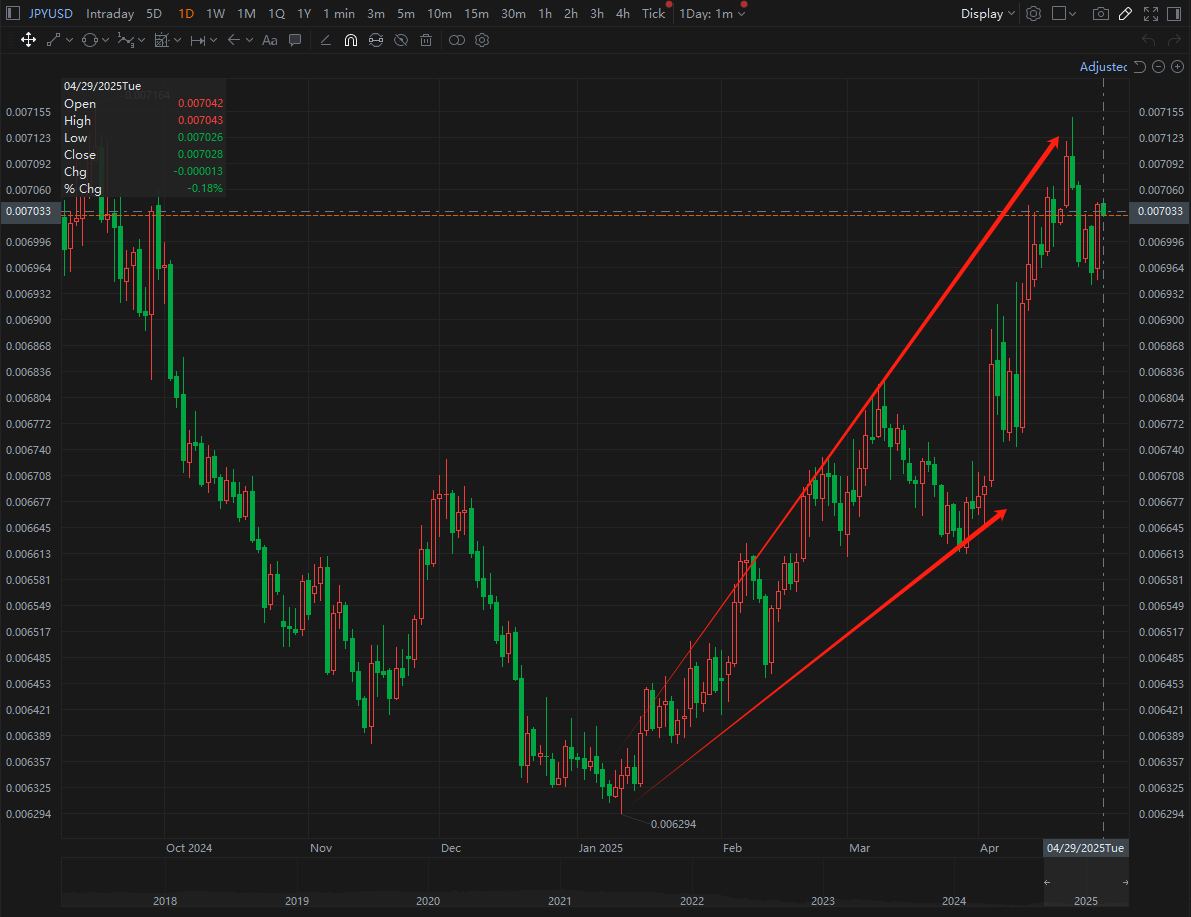
Facing the continuously rising inflation and wages, major institutions are more optimistic about the Japanese stock market, and the Japanese yen is also in an appreciation channel.

However, the investment enthusiasm of domestic investors has significantly cooled down. On April 28th, the premium rate of the Tokyo Stock Price Index ETF (513899) in Japan has fallen into the negative range, reaching -0.33%.
This year, the Japanese stock market has been quite volatile. On April 7th, due to investors' concerns that the "reciprocal tariffs" of the United States would lead to a global economic recession, the Tokyo stock market in Japan fell across the board on that day. The Nikkei 225 Stock Average closed down 7.83%. However, the market then began to stabilize and rebound. Since the beginning of the year, the Japanese yen has rebounded by about 7% against the US dollar.
An Asian economist said that as the Japanese economy enters a new stage of sustained moderate inflation growth and higher nominal growth, the Bank of Japan is on the path of interest rate normalization.
The "Shunto" (spring wage offensive) wage negotiations have also sent positive signals. It is expected that major labor unions will strive for a 5% wage increase again this year, which will also become the benchmark level for overall wage growth. With the continuous increase in wages, the real income of households will increase, and they will be more likely to accept rising prices, thus achieving a higher inflation equilibrium level in the medium term.
She believes that as the uncertainty of global trade rises and more countries start to diversify and restructure their supply chains, Japan may benefit from "friend-shoring." However, considering the uncertainty of US trade policies, the Bank of Japan may remain cautious in raising interest rates and may raise interest rates moderately in the future.
Although the appreciation of the Japanese yen may affect the performance of the Japanese stock market, the consensus is that as long as the Japanese yen does not experience a sharp short-term surge, a gradual appreciation will have a limited impact on the stock market.
In the past two years, the corporate governance reform in Japan has attracted a large amount of international capital to invest in the Japanese stock market. And the positive aspect now is that since Japan reintroduced the NISA (Japanese Individual Savings Account) system for retail investors in January 2024, these tax-free savings funds may accelerate their investment in the Japanese stock market.
All along, local Japanese investors have shown little interest in investing in the Japanese stock market and instead prefer to allocate to US stocks with higher yields. Goldman Sachs said that since the beginning of 2025, the S&P 500 Index and the stocks of the "Magnificent Seven" in the technology sector denominated in Japanese yen have fallen by -19% and -30% respectively.
The reversal of the performance of overseas stock markets (especially in the United States) denominated in Japanese yen may be prompting more NISA funds to flow back to the Japanese domestic market.
Foreign capital has flowed into Japan due to the corporate governance reform of Japanese listed companies. The situation of cross-shareholdings has improved in the past, financial reports are more transparent, and companies have increased share repurchases.
In recent years, the inflow of domestic funds in Japan has increased, and the sources of funds are more balanced. At the same time, the yen carry trade has reversed, reducing the volatility impact on the stock market. Coupled with international funds diversifying from US dollar assets, the Japanese stock market has received more attention due to its relatively low valuation.
#Follow the Money: Where Are the Market Giants Investing