
Is It Time to Buy Bitcoin Before It Hits $100K?

$BTC is back in the spotlight. After a rocky start to the year, it’s now climbing steadily toward $95,000, and investors are asking a familiar question: Is now the right time to get in?
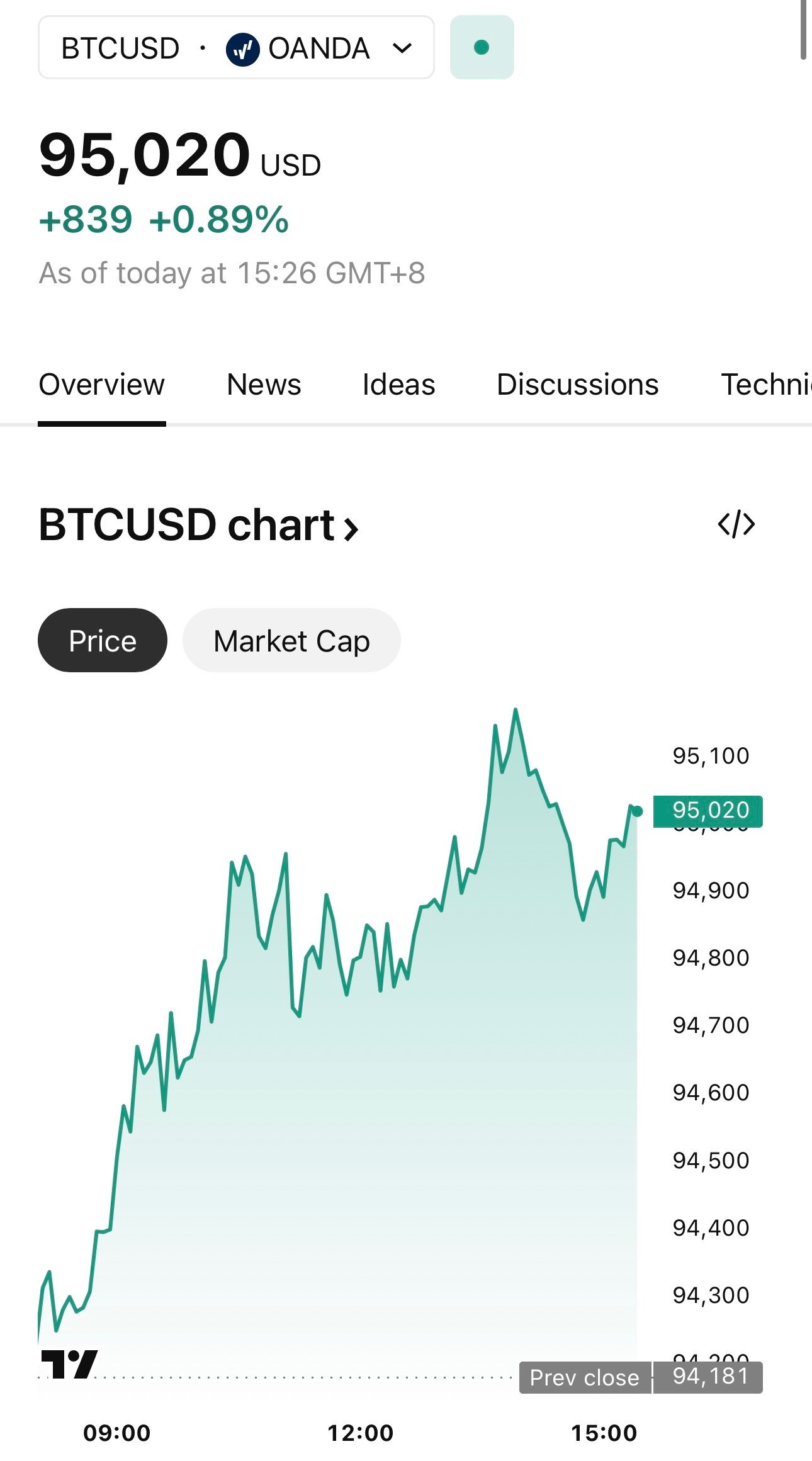
At a time when gold has already jumped 30% this year, Bitcoin’s rebound is reminding many why it’s still worth a spot in your portfolio—especially in a world full of economic uncertainty, rising inflation, and growing interest in alternative assets.
Why Bitcoin Still Matters
Bitcoin’s strength right now comes from two sides: everyday investors and big institutions.
Last week alone, Bitcoin jumped 11%. Binance data showed retail traders bought over 15,000 BTC between April 19–23, worth roughly $1.4 billion. At the same time, U.S. spot Bitcoin ETFs saw their biggest inflows since late 2024—over $3 billion—led by BlackRock and Fidelity. This is clear evidence: both small and large players are buying in.
BlackRock’s Jay Jacobs put it simply: “In a world of geopolitical fractures and monetary experimentation, assets like Bitcoin and gold are becoming anchors.”
Bitcoin vs. Gold: The Next Generation Store of Value
Gold is still seen as a safe haven—but Bitcoin is catching up fast, thanks to its built-in scarcity and tech advantages. Since launching in January 2024, BlackRock’s iShares Bitcoin Trust (IBIT) has returned 116%, while its gold counterpart (IAU) is up 68%.
Bitcoin’s historical performance also speaks volumes: a 21% annualized return since 2020, compared to gold’s 6%. That gap keeps widening as institutional support grows and volatility starts to smooth out.
BlackRock even found that in five out of six major global crises since 2020—including COVID and the war in Ukraine—Bitcoin outperformed gold within 60 days. It’s proving to be a resilient hedge in uncertain times.
What gives Bitcoin the edge? Its fixed supply: only 21 million coins, hardcoded and unchangeable. Unlike gold, which can be mined more each year, Bitcoin’s scarcity is predictable and absolute. Add in its global accessibility, ease of transfer, and growing institutional trust, and it’s easy to see why many call it “gold 2.0.”
Three Reasons the Bull Case Is Still Strong
1. Digital Scarcity and Inflation Hedge
Central banks are printing more money to deal with debt and slowing growth. Bitcoin’s limited supply offers a hedge, just like gold—but with better portability and transparency.
2. Institutional Support Is Growing
More than 10% of Bitcoin’s supply is now held by corporations, governments, or ETFs. MicroStrategy leads the pack with over 538,000 BTC, but newer players like Twenty One (backed by Tether and SoftBank) are jumping in with massive holdings too. Regulatory reforms, like the FASB’s fair-value accounting rule, have also made it easier for companies to hold Bitcoin on their balance sheets.
3. Portfolio Diversification
Bitcoin doesn’t move in lockstep with stocks or bonds. Its 90-day correlation with the S&P 500 is just 0.18, compared to 0.78 for tech stocks. Since 2020, Bitcoin’s 57% annualized return crushes gold (14%) and the S&P 500 (17%).
ARK Invest sees potential for Bitcoin to hit $2.4 million by 2030 if it captures even 5% of the $21 trillion global asset market. Whether or not that happens, the upside is clearly big—and uncorrelated returns make it a useful portfolio diversifier.
So, Why Now?
ETF Flows and Global Access
Since U.S. regulators approved spot Bitcoin ETFs in early 2024, demand has surged. These ETFs now hold $110 billion in assets. BlackRock’s IBIT alone controls nearly 3% of Bitcoin’s entire supply. South Korea has also seen record retail trading activity this year.
Macro Uncertainty Is Back
From trade tensions to currency devaluation, global risks are making people look for hedges. Bitcoin’s market cap is still just $1.9 trillion—less than a tenth of gold’s $21 trillion—so there’s still room to grow.
Corporate Adoption Is Heating Up
Companies like Twenty One Holdings are entering the space aggressively. With 42,000 BTC and no long-term debt, it’s already the third-largest corporate Bitcoin holder behind MicroStrategy and Marathon Digital. Their strategy? Be capital-efficient and avoid the high leverage of earlier players.
Risks to Watch
Of course, Bitcoin still faces hurdles. After a 40% dip in Q1 2025, some long-term holders are taking profits. The Adjusted Spent Output Profit Ratio (aSOPR) recently rose above 1.0, which often signals that coins are being sold for gains. April saw over $1.4 billion worth of BTC moved to exchanges—potentially setting the stage for more short-term selling.
But the good news? Retail buyers seem to be soaking up the supply. Binance data shows strong demand, and ETF inflows continue. If Bitcoin can break past the $95K–$96K resistance zone, it could trigger a final push toward the $100,000 mark.
Final Thoughts
Bitcoin isn’t just for speculators anymore—it’s becoming a strategic asset. At $94,000, it offers a combination of scarcity, growing adoption, and portfolio diversification that’s hard to ignore.
Beyond buying BTC directly, investors can look at related stocks like MicroStrategy (MSTR), Coinbase (COIN), Marathon Digital (MARA), or ETFs like IBIT and BITB.
Of course, risks like regulatory pressure and liquidity crunches remain. But in today’s world, where inflation, debt, and global instability are becoming the norm, Bitcoin is less about “if” and more about “how much.”