
Trump 2.0’s First Report Card: Negative GDP Growth, No Escaping the Blame

The U.S. economy handed in a report card for Q1 2025 that’s hard to swallow: the annualized GDP growth rate fell to -0.3%, marking the first negative growth since 2022. What once was a political label—“Trump 2.0”—now has real numbers behind it.
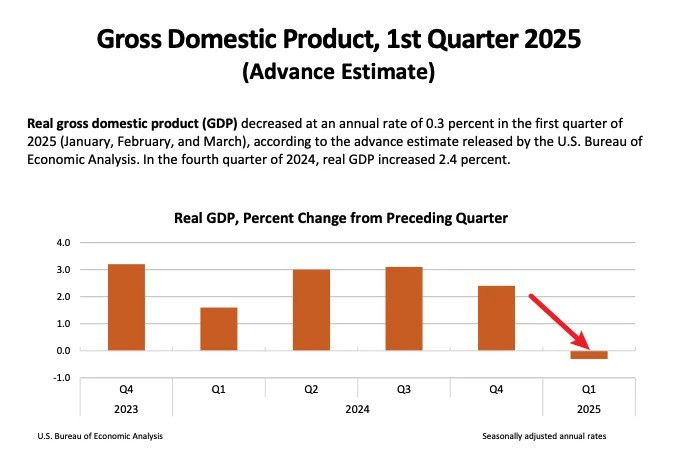
This isn’t just about a slowdown in economic growth; it’s a collision of multiple factors, with the most significant being an explosion in the trade deficit, a weakening consumer sector, and shrinking government spending. But the key factor driving all this is Trump’s new round of tariffs, which directly slashed nearly 5 percentage points off GDP.
Trade Deficit Explodes, Companies Hurt by Their Own Actions
One of the most eye-catching elements of the GDP report was the 41% surge in imports. This sharp, unusual increase in imports wasn’t driven by domestic demand—it was the result of U.S. companies rushing to import goods ahead of the looming tariffs.
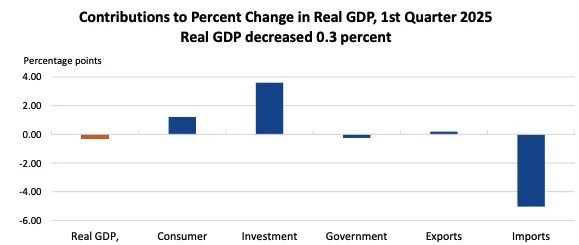
The problem is that these imports don’t contribute to actual U.S. output and instead subtract from GDP. As a result, the trade deficit reached a historic high, pulling GDP down significantly for the quarter.
The U.S. Bureau of Economic Analysis pointed out that net exports were a drag of 4.9 percentage points on GDP. This scale of negative contribution hasn’t been seen since the 2020 pandemic collapse.
Consumers Can’t Hold Up, Domestic Demand Weakens
Even more concerning is the slowdown in consumer spending, which accounts for two-thirds of GDP. The annual growth rate dropped to just 1.8%, marking the lowest level in nearly a year.
This isn’t just about a high base effect; it’s a real decline in consumer spending power. It could be due to inflationary pressures or greater uncertainty about future income, leading to a rise in savings. Either way, this downturn is not driven by weak consumption but rather a more fundamental shift toward recession.
Government Spending Shrinks, Fed in a Tight Spot
Government spending also dropped, particularly in defense. This is directly linked to Trump’s decision to halt aid to Ukraine, signaling that his fiscal policies are tightening. This is somewhat surprising—on one hand, he’s ramping up tariffs to increase inflation, while on the other, he’s reducing government spending, further weakening domestic demand. It’s essentially a downhill spiral.
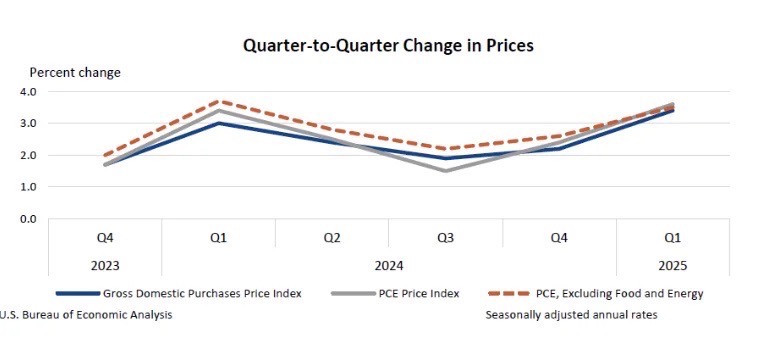
The bigger problem is that the Federal Reserve finds itself in a tough position. While negative GDP growth could justify rate cuts, core PCE inflation has risen from 2.4% to 3.5%, meaning inflation is actually picking up. If this “stagflation” warning holds true, the Fed could be stuck between a rock and a hard place.
Trump Wants to Pass the Blame, But the Market Isn’t Buying It
In response to these numbers, Trump’s usual tactic is in full swing—shift the blame and change the narrative. He claims that the GDP decline is the result of Biden’s mess, that tariffs have nothing to do with the data, and that stock market drops can’t be blamed on him…
The issue is that the market isn’t buying it. The S&P 500 and NASDAQ dropped nearly 2%, copper futures plummeted over 6%, and gold surged by $40. These market movements clearly indicate that investors have already priced in the “Trump tariff economy.”
My Take: The Tariffs Aren’t Over, and the Risks Are Just Beginning
Compared to Trump’s first term, this time he’s moving faster and more aggressively. These tariffs aren’t symbolic gestures—they’re real, with a clear direction and significant impact. The fact that companies are rushing to import goods shows just how seriously the market is taking these tariffs.
This also means that the first quarter might not be the worst of it. In the coming months, once the rush to import goods subsides, inventory piles up, and costs rise, we may see more feedback in the form of stagflation. If job data continues to worsen, the U.S. could go from “technical contraction” to actual recession.
Conclusion
Trump’s economic policies have never been moderate. From day one, he wielded a big stick, trying to bring manufacturing back to the U.S. through tariffs. But the reality is that the more aggressive he gets, the more he risks stepping on his own toes.
This GDP report is Trump 2.0’s first real test, and it shows the market that the old “tariff-manufacturing-middle-class revival” script is entering a new uncertain phase. The next few months will determine whether this script turns into a full-blown economic drama.