
US Stocks: Rebound or Reversal? A Deep Dive into the Market’s Future

This time, the US stock market is likely experiencing a rebound rather than a reversal.
It's been quite a while since I last had a chat with all of you.
Today, I happen to have some free time, so I'd like to share with you my thoughts on the current state of the US stock market.
My stance is crystal clear. In the short run, due to the precipitous drop in US stocks, there has emerged a trading-based rebound opportunity. From a trading perspective, there's currently a trading window that might last for one or two weeks, or even longer. But make no mistake, this probably isn't the start of a reversal in the market trend.
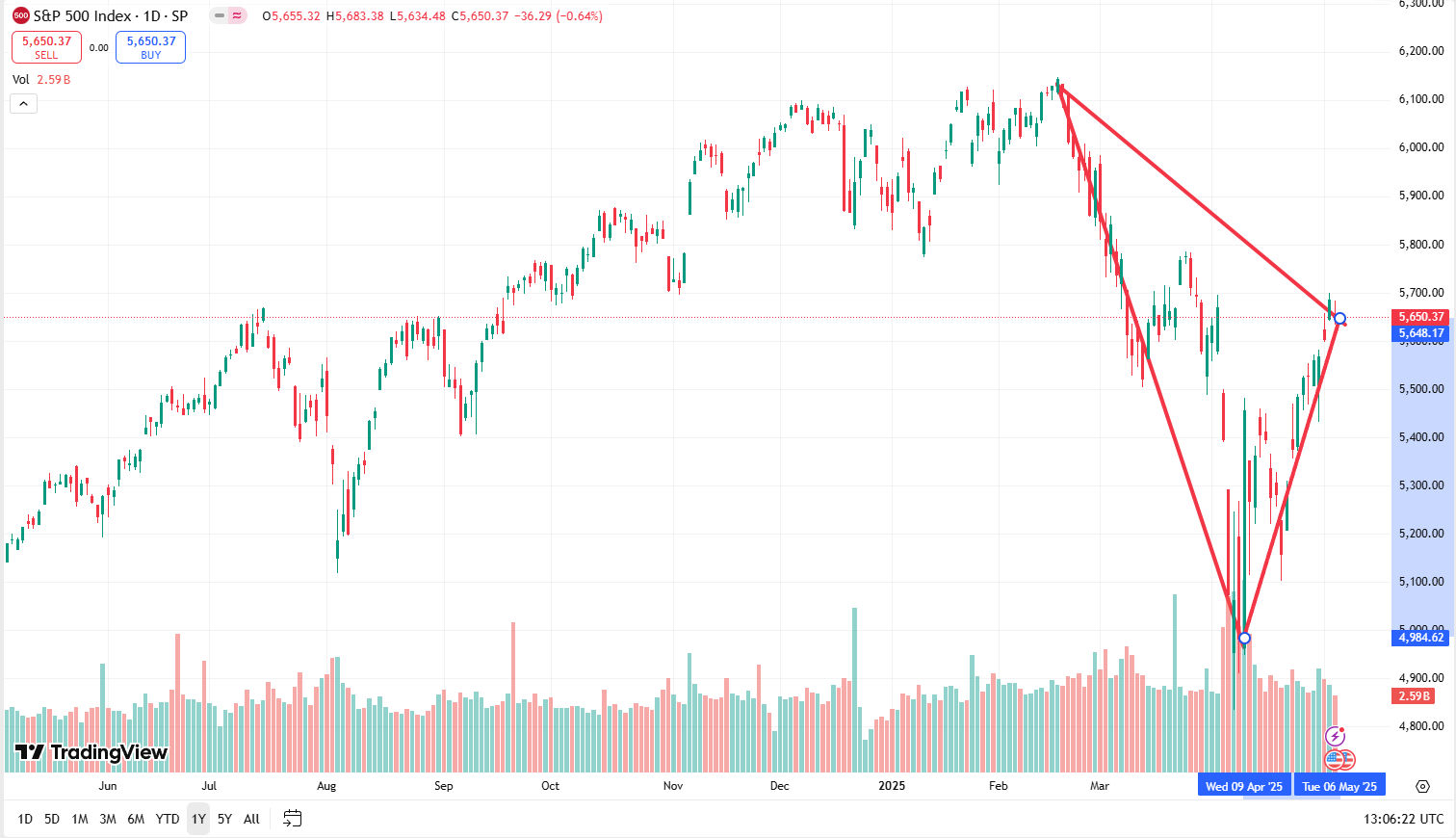
From a technical chart perspective, I think that the US stock market is likely to test the vicinity of 4,900 points again in one to two weeks.
I'm well aware that history has shown that being bearish on the US stock market has often been a foolish move. However, I firmly believe that there are just too many variables on the horizon. The US stock market might not be able to sustain its long-term bull run and could even continue to correct downward.
Profitable Tech Stocks, Yet Still in Peril
FFor now, corporate earnings have stabilized, serving as one of the core pillars supporting the current rally. Against the backdrop of the unpredictable trade policies under the Trump era, although the earnings expectations for many sectors within the S&P 500 index have declined during this earnings season, the big US tech giants have delivered surprisingly robust earnings reports.
Among the Mag 7 companies that have already released their earnings reports, four of them have provided revenue forecasts that are either roughly in line with Wall Street expectations or exceed them.
Due to the strong performance of its Azure cloud computing business, Microsoft's revenue forecast for the current quarter exceeded expectations. The demand for this business continues to outstrip the capacity of its data centers.
Although Amazon's outlook for operating profit is weaker than expected, CEO Andy Jassy said that the company "hasn't seen any signs of weakening demand." Meta, on the other hand, has instilled confidence in the prospects of digital advertising spending with a forecast that is roughly in line with analysts' expectations.
Despite Apple's disappointing performance, on the whole, these earnings reports have provided a solid boost to the stock market rebound.

Yet, not all the news is rosy. Tesla has abandoned its previous forecast of a return to revenue growth in 2025, and Apple has stated that it anticipates tariffs will add $900 million in costs to the current quarter. Apple has been downgraded by at least two Wall Street institutions, with analysts citing tariff headwinds and growth concerns as the reasons.
When we take a closer look at the US stock market now, even though the overall market has gone up, there are underlying concerns. Most of the gains are being driven by just a handful of giant tech stocks.On the other hand, defensive stocks, which are typically seen as safe havens during economic downturns—such as consumer staples and utility sectors—have actually performed quite well. In contrast, the energy and consumer discretionary sectors, which are more sensitive to economic conditions, have lagged behind.
The pressure from tariffs and the external environment could potentially shatter the revenue myth of these tech giants.Without their support, have you ever stopped to think about what the US stock market would look like?
Stocks and Bonds in a Double Bind: Will US Stocks Correct by One-Third?
Regarding the outlook for the US economy, most of the recently released data points to a deteriorating economic situation.
The GDP in the first quarter posted negative growth. This was due to the impact of inventory, which led to a surge in imports, dragging down the GDP. It was what you might call a technical negative growth.
I'm of the opinion that a similar situation will play out in the second quarter. With the 90-day tariff negotiations in the second quarter still fraught with uncertainty, some key economic indicators for the second quarter, such as employment figures, the labor market situation, wage growth, retail sales growth, and the Purchasing Managers' Index (PMI), will show clear signs of deterioration.
So, it's entirely possible that the first and second quarters will see negative growth, much like in 2022. Technically speaking, that would mean an economic recession, and there's a high likelihood of this happening this year.
And tariffs are likely to drive up inflation in the US. In fact, we've already witnessed tariffs pushing up inflation expectations in the US. It's now around 7%, the highest inflation expectation in over 40 years, and it's rising rapidly.
If tariffs cause inflation to spike, then the Federal Reserve won't be able to cut interest rates. Even if they were tempted to do so temporarily, they couldn't because inflation would be too high. Plus, the Federal Reserve's balance sheet is shrinking. It's already reached over $6 trillion.
Moreover, if the US fiscal policy this year is contractionary rather than expansionary, and both fiscal and monetary policies are tightened simultaneously, we could see a repeat of the market situation in 2022. This is what's known as the "double whammy" for stocks and bonds.
With inflation running high, interest rates will need to stay elevated, which means bonds will underperform. As for stocks, with both monetary and fiscal policies tightening, the stock market will also suffer. In 2022, US tech stocks plunged nearly 40% in the early part of the year.
If the US stock market is set to correct this time around, I think it will likely correct by at least one-third, bringing the price-to-earnings ratio down to around 15 times, which would be more in line with the market's fundamentals.
Institutions' Outlook: The Market Will Hit 6,000 Points and Then Tumble into a Bear Market
JPMorgan Chase's view aligns quite closely with mine.
Their take is that the US stock market will have a brief rally and then correct again. JPMorgan Chase traders have issued a warning that the market will reach 6,000 points, which could very well represent the recent peak, after which they're bearish on the medium-term outlook.
The traders said they do concur with the prevailing view of an impending economic recession and expect to see a significant decline in hard data like non-farm payrolls and retail sales over the next one to two months.
Once the economic deterioration becomes evident, the narrative will take center stage. The two most probable scenarios are:
- Tariffs remain high, and trade agreements are still being negotiated;
- Multiple agreements have been signed, and the economic soft landing can be seen as a temporary phenomenon.
They believe the first scenario is the most likely to unfold, meaning that even though there are signals of good progress in the tariff negotiations, the chances of signing an agreement before the 90-day tariff suspension period expires are slim. This could serve as a major roadblock for the US stock market.
All things considered, JPMorgan Chase believes the market might retest its lows. As the market slides, the earnings-per-share expectations for the S&P 500 index are likely to be revised downward.
However, if the large-cap tech stocks manage to perform strongly, the S&P 500 index might stay above the 5,000-5,150 range. Tom DeMark, a seasoned technical analyst who accurately predicted the market peak in February and the trough in April this year, has sounded the alarm that the US stock market will drop again. The S&P 500 index could dip below the intraday low of 4,835 in April, correcting 20% from the February high and thus entering bear market territory.
DeMark said, "Historically, the market rarely bottoms out on good news, just like the positive developments in trade last month. Stocks usually hit rock bottom when everything seems bleak and everyone is forced to throw in the towel—but that hasn't happened yet. Stocks are just severely oversold, and it was only natural for them to bounce back. Since then, stocks have continued to struggle technically, and beneath the surface, the market is at risk of a substantial decline."