
Reflections on Recent Asian Market Exchange Rate Fluctuations

A notable development in the market these days is the appreciation of Asian currencies, with the New Taiwan Dollar leading the pack.
Public opinion suggests that the first to "kneel" has appeared, which is both right and wrong. It's incorrect because the New Taiwan Dollar and other Asian currencies are all appreciating, seemingly due to investors, especially insurance funds that buy government bonds, fleeing from U.S. dollar assets.
The main information from last weekend can be summarized in two points. First, Warren Buffett, who recently announced his retirement, criticized Trump's tariff war and indicated he would hold more non-U.S. dollar currencies (likely primarily Japanese Yen). Second, the second round of U.S.-Japan negotiations broke down, with the Japanese Finance Minister threatening to use Japan's $1.2 trillion in U.S. Treasury holdings as a bargaining chip and calling on China to join.
Although he later retracted this statement twice, the strategic deterrence has clearly been achieved. Considering Japan's influence in Taiwan, the aforementioned investments, and even some speculative yen-based arbitrage trades, are likely to flee rapidly. This part cannot be considered a "kneeling" action. However, the central bank of Taiwan's lack of intervention in such a significant depreciation clearly indicates the government's acquiescence.
In fact, even under U.S. pressure, if you choose to compromise, you can still intervene by saying, "Yes, we will appreciate our currency as per U.S. demands, but we prefer a gradual, step-by-step approach, and temporary intervention is necessary for overly large fluctuations." So, complete non-intervention might be a way to demonstrate the determination and extent of "kneeling," hoping Trump will seize this opportunity to promote his political achievements.
However, the thought processes of some in the financial world sometimes surprise me. There are significant disparities in exchange rate perceptions. Some ask if the RMB will depreciate to 8 against the dollar, while China's current concern is actually whether the RMB will break through 7, understand?
As we see in the chart, when the RMB appreciated and broke through 7.2, it was pushed back slightly by central bank intervention. According to the logic of trade wars, if you impose a 10% tariff, some depreciation might be possible, but if it becomes a trade embargo, would depreciation even be useful?
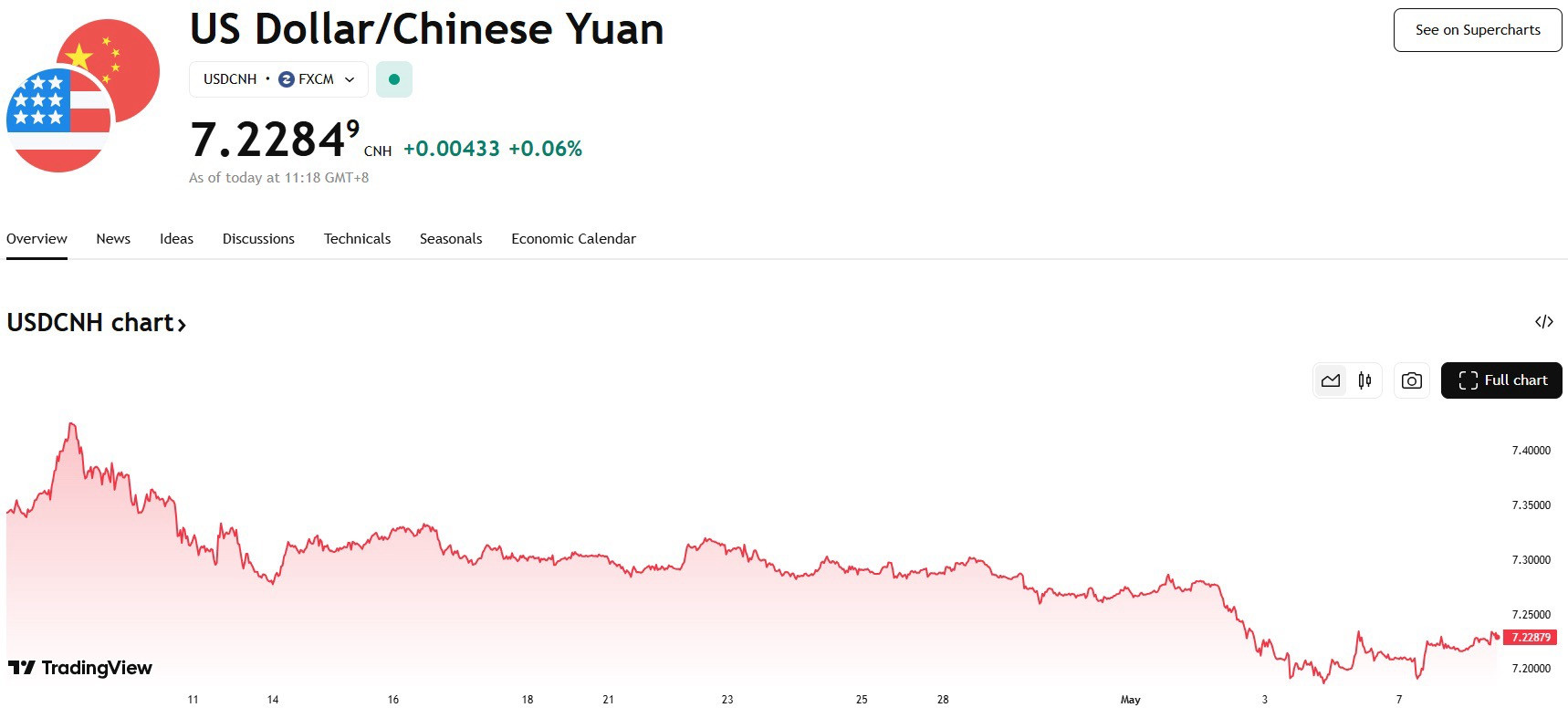
From China's perspective, RMB appreciation aids internationalization. Therefore, the balanced result might be maintaining stability within a certain range as the best choice. The recent appreciation pressure is likely a catch-up to the significant appreciation of European currencies like the Euro, Pound, Swiss Franc, and Japanese Yen against the dollar.
It might also reflect that, apart from China, the possibility of the U.S. quickly securing a substantial gain from its other East Asian trading partners (excluding Taiwan) is relatively low.