
Nvidia Tweaks H20 Chip for China After US Export Rules Tighten

Nvidia is reportedly redesigning its H20 AI chip to comply with tightened US export controls, aiming to deliver a downgraded version to the Chinese market as early as July.
This is not just another product iteration—it reflects how global tech firms are navigating geopolitical headwinds while trying to hold onto key markets. The changes to H20 reveal a deeper shift in the balance between technology, policy, and business strategy in the AI race between the US and China.
Why Was the H20 Chip Blocked?
The US government has been tightening restrictions on advanced chip exports to China in order to limit the country’s access to high-performance AI computing. These rules mainly target chips that could be used to train large AI models.
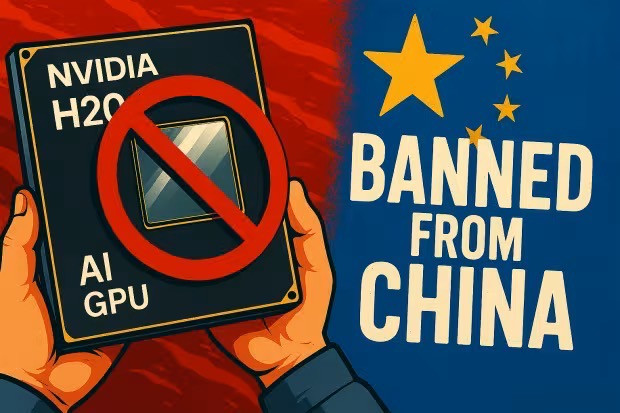
The H20 was Nvidia’s answer to an earlier round of restrictions. It was designed as a China-friendly alternative to its flagship chips like the A100 and H100, which had already been blacklisted. But in March, the US Department of Commerce told Nvidia that the H20 also exceeded performance thresholds and would now require a special export license—effectively blocking its sale in China.
These performance thresholds cover factors like total processing power and memory bandwidth. If a chip crosses the line, it’s banned.
Why Is Nvidia Downgrading It?
According to reports, Nvidia is planning to reduce some of the H20’s key specs, such as memory size, possibly cutting it from 96GB to 48GB or less. The goal is to stay under the regulatory radar and avoid triggering the export ban.
This strategy allows Nvidia to keep selling in China, but at a cost—reduced chip performance. That raises questions about how much value remains in the product and whether Chinese companies will still find it worth buying.
Why Do Chinese Companies Want the H20?
China has a strong demand for AI chips, not only from tech giants like ByteDance and Alibaba but also from a growing wave of AI startups. Compared to top-tier chips like the H100, the H20 was seen as a more affordable option for running inference tasks or training mid-sized models.
Reuters reported that Nvidia had racked up $18 billion worth of H20 orders from China this year. Clearly, even with restrictions, the demand for accessible computing power remains high.
What About Local Alternatives Like Huawei?
At the same time, Chinese firms like Huawei are pushing hard to develop their own AI chips, such as the Ascend series. These chips are starting to perform well in certain use cases, especially for inference, but they still lag in areas like ecosystem support and compatibility with mainstream AI development tools.
That’s why Nvidia’s chips, even with downgraded specs, still hold significant appeal in China.
This Is More Than a One-Time Workaround
Nvidia’s redesign of the H20 is not an isolated case. It reflects a broader trend of companies adapting to an increasingly fragmented tech landscape. US export rules keep evolving, and tech firms must constantly adjust to avoid getting locked out of crucial markets.
Looking ahead, this trend may lead to three possible shifts:
1. The stricter the controls, the stronger China’s push for homegrown chip development
2. Companies like Nvidia will find it harder to balance between compliance and market retention
3. The AI hardware race will move beyond specs and into supply chains, ecosystems, and policy
My Take
From an industry and investment standpoint, the H20 story is more of a transition than an endpoint.
For China, a downgraded H20 may ease short-term pressure on computing capacity, but it doesn’t solve the underlying dependence on foreign hardware. For Nvidia, making strategic compromises to keep selling in China may work for now, but it raises questions about long-term sustainability.
Whether similar workarounds will still be possible in the future depends on how US policy evolves, how fast China builds up its domestic alternatives, and how global AI workloads continue to grow and shift.